
SURFACE TREATMENT

Aluminum Chemical Conversion Coating: Type I, Type II, Class 1A and Class 3

How to specify MIL-DTL-5541 without confusing chemistry type with performance class, including electrical contact, painting, masking and records.

01

What the coating does

A chemical conversion coating is formed by reaction with an aluminum surface. It is commonly used for corrosion protection, paint adhesion or controlled electrical-contact areas. It is not the same process as anodizing, and a trade name such as Alodine does not define the full requirement. A usable RFQ should identify the governing specification, Type, Class, treated area, masking, final dimensional state and required records.
02

Type and Class answer different questions

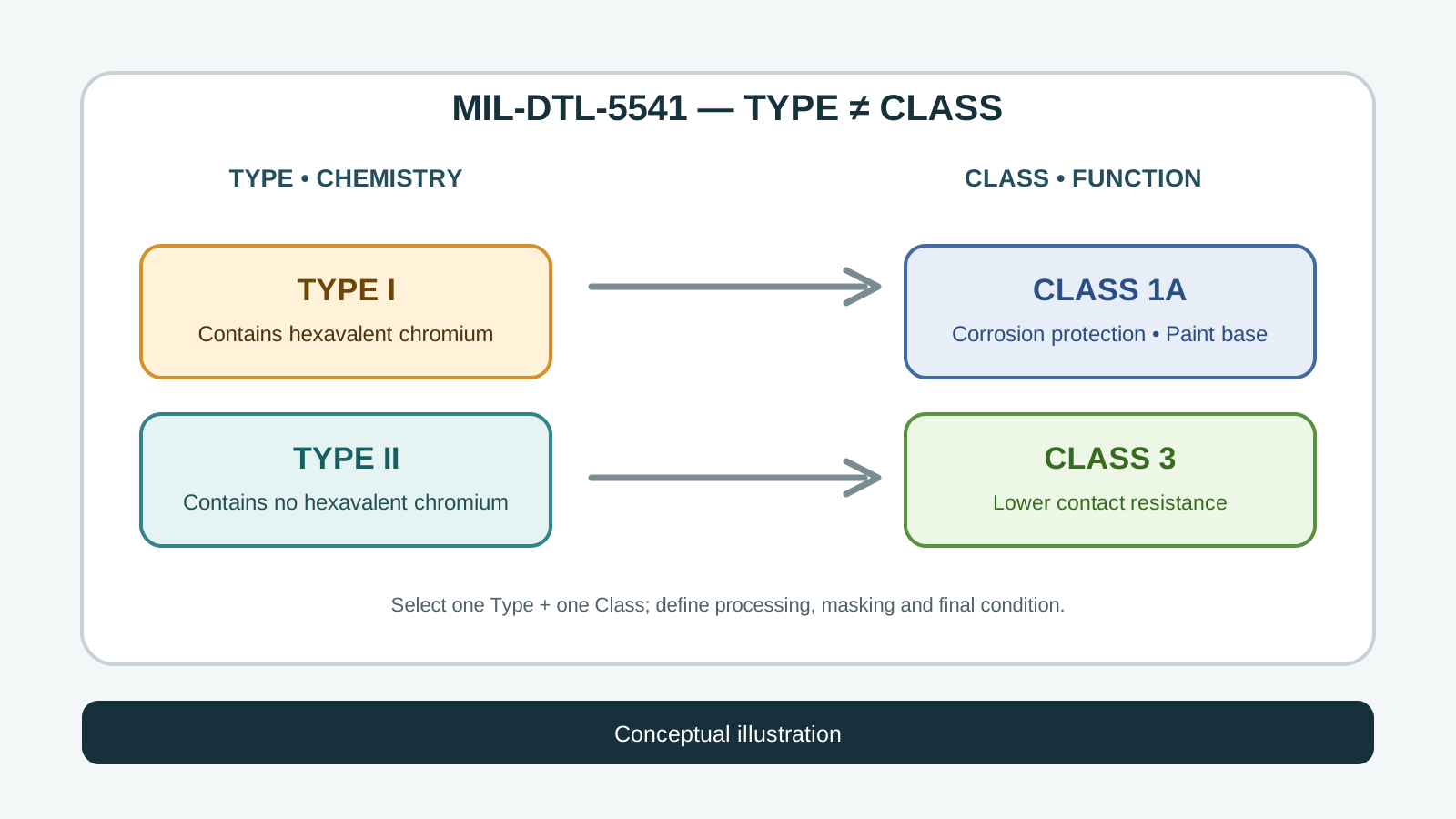
Under MIL-DTL-5541, Type I identifies compositions containing hexavalent chromium, while Type II identifies compositions containing no hexavalent chromium. Class 1A is intended for maximum corrosion protection, painted or unpainted. Class 3 addresses electrical and electronic applications requiring lower contact resistance than Class 1A and anodic coatings. Type II does not automatically mean Class 3; both fields must be stated.

Technical diagram distinguishing MIL-DTL-5541 Type I, Type II, Class 1A and Class 3
Conceptual illustration: Type defines chemistry and Class defines function. This is not a photograph of VietTech production.
DesignationPrimary meaningSpecify with
Type IContains hexavalent chromiumClass, area and records
Type IIContains no hexavalent chromiumClass and qualified material requirements
Class 1AMaximum corrosion protection; painted or unpaintedPaint system and masking
Class 3Corrosion protection with lower contact resistanceElectrical-contact zones and test needs
03

Functional zones and appearance

Class 1A is not simply a color choice, and Class 3 does not by itself define the resistance of a completed assembly. Color varies with chemistry, alloy and preparation. Drawings should identify electrical-contact pads, paint-free areas, bonded surfaces, fits and cosmetic zones. If appearance matters, define an approved sample or acceptance criteria rather than relying on a website photograph.

04

Dimensions, threads and masking

The film is thin compared with many plated or anodic coatings, but preparation, etching and subsequent paint still matter. Drawings should state whether threads, fits, sealing faces and adhesive-bond areas are treated or masked, and whether dimensions apply before or after the complete finish stack. VietTech plans machining and inspection around the required final state; specialized chemical processing is coordinated with a suitable partner.

05

Supplier control and documentation

MIL-DTL-5541 is used with qualified conversion materials governed by MIL-DTL-81706. The RFQ should state whether qualified-product evidence, lot records or specific corrosion, paint-adhesion or contact-resistance tests are required. DLA QuickSearch listed MIL-DTL-5541F with Validation Notice 2 dated 7 February 2024 when this article was prepared; the contract revision must still be confirmed.

06

RFQ checklist

Send matching 2D and STEP revisions, aluminum grade and temper, Type and Class, processing and masking zones, paint and electrical-contact requirements, inspection state, documentation, quantity and packaging. Identify inserts, mixed materials, welding or prior anodizing because they can change the process sequence.

  • Specification, revision policy, Type and Class
  • Alloy/temper and matching 2D/3D revision
  • Processing, masking, paint and contact zones
  • Final dimensional state and inspection
  • Certificates, lot records, quantity and packaging
07

Sources and limits

This article uses the DLA ASSIST QuickSearch record for MIL-DTL-5541 and its relationship with MIL-DTL-81706. It does not prescribe a universal color, thickness or resistance value. The full contract specification, drawing, qualified-material listing and processor procedure govern acceptance.

RELATED PAGES

Type II vs. Type III Anodizing: Which Finish for a Machined Aluminum Part? ↗How to Specify Materials and Surface Finishes in an RFQ ↗How to Request a Quote ↗

FAQ

Frequently asked questions

Does Type II always mean Class 3?

No. Type identifies chemistry; Class identifies function. Type II may be paired with Class 1A or Class 3.

How do Class 1A and Class 3 differ?

Class 1A prioritizes corrosion protection and paint base; Class 3 serves applications needing lower contact resistance.

Can Class be verified by color?

Not reliably. Color varies; the specification, certificate and required tests are the basis.

Should threads be masked?

It depends on function and final dimensional state. The drawing must define treated and masked areas.

Does VietTech process MIL-DTL-5541 in-house?

VietTech performs CNC machining and inspection within confirmed capability; specialized conversion coating is coordinated with a suitable partner.

SURFACE TREATMENT

Need a quote for an aluminum chem-film part?

Send the drawing, alloy, Type/Class, masking, final dimensions, documentation and quantity for machining, inspection and partner-process review.REQUEST A QUOTE ↗