
MATERIALS

C1100 Copper vs. C3604 Brass: Which Material for a CNC-Machined Part?

Compare C1100 and C3604 by electrical conductivity, machinability, strength, application, inspection, and RFQ requirements.

MATERIALSTECHNICAL CONCEPT IMAGE
01

C1100 and C3604 are not interchangeable

C1100 is a JIS electrolytic tough-pitch copper grade selected when electrical conductivity, thermal conductivity, and formability are primary. C3604 is a free-cutting brass used for turned parts, fittings, bushings, screws, and components requiring productive machining. They differ in composition, strength, density, color, corrosion behavior, and environmental compliance. UNS C11000 and C36000 are closely named international grades, but they should not be treated as automatically identical to JIS C1100 or C3604 without reviewing the applicable specification and material certificate.

  • Pure copper — Đồng tinh khiết — 純銅
  • Free-cutting brass — Đồng thau dễ cắt — 快削黄銅
  • Electrical conductivity — Độ dẫn điện — 導電率
  • Machinability — Khả năng gia công — 被削性
02

Key performance differences

C1100 provides high electrical and thermal conductivity for busbars, electrodes, heat-transfer parts, and electrical components. Its relatively soft, ductile behavior makes it sensitive to workholding pressure. C3604 offers higher machining productivity for many small mechanical components but lower conductivity than pure copper. Lead in many free-cutting brass grades improves chip formation and may be restricted by RoHS, drinking-water, environmental, or sector-specific requirements. The current material standard and compliance limits must be verified.

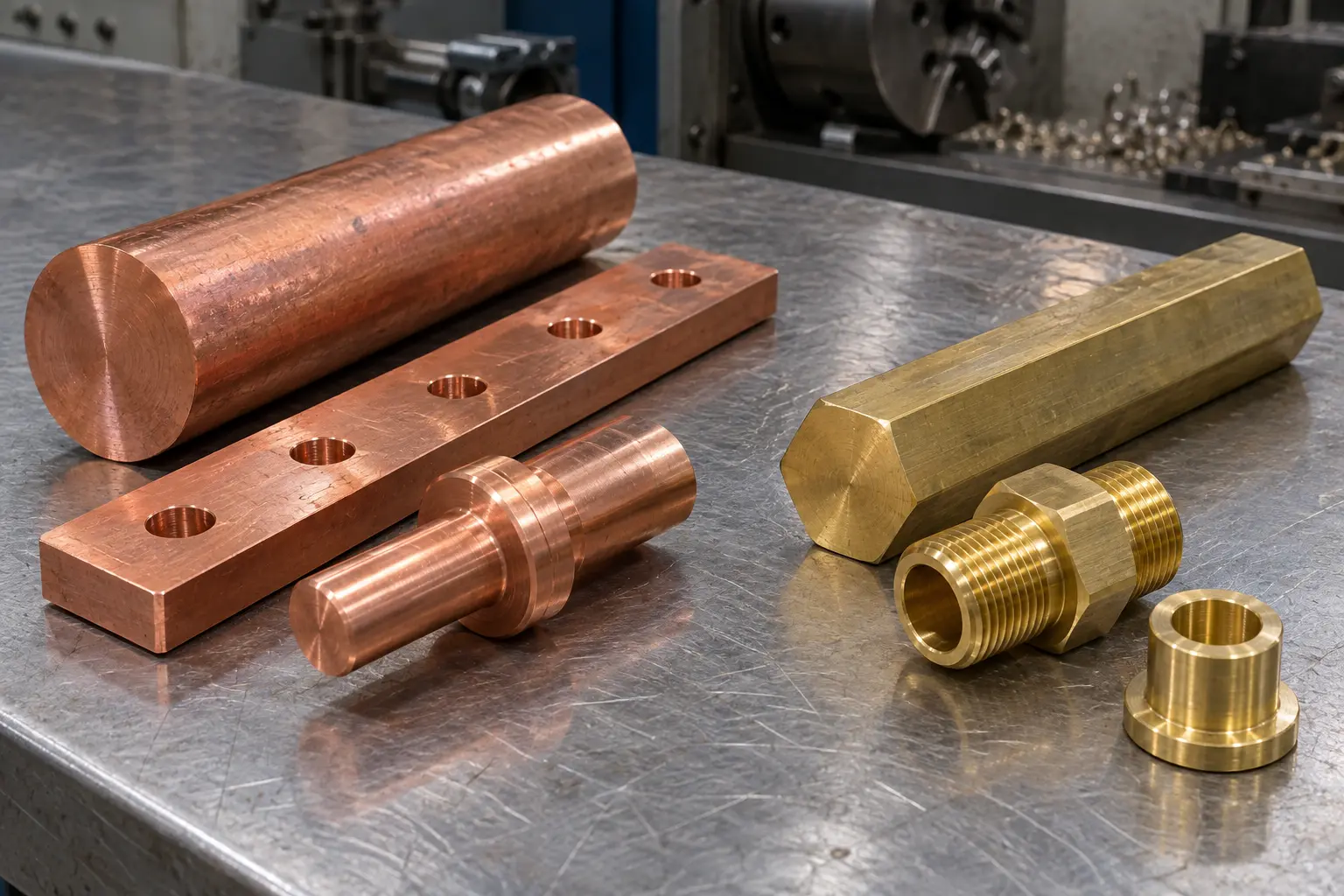
Realistic technical concept image for C1100 Copper vs. C3604 Brass: Which Material for a CNC-Machined Part?
Conceptual image created to illustrate the article's technical setup; not an actual VietTech production photograph. Specifications and acceptance follow the drawing/RFQ.
  • C1100: conductivity, thermal transfer, and copper purity
  • C3604: chip control and high-productivity turning
  • Do not select by color or commercial name alone
  • Confirm lead restrictions and compliance documentation
03

Machining behavior of C1100

Pure copper combines ductility with high thermal conductivity. A dull edge or poor chip evacuation can promote built-up edge, burrs, and surface dragging. Excessive clamping may dent a thin component, while insufficient clamping reduces stability. Sharp tooling, suitable rake geometry, controlled tool engagement, and reliable chip evacuation improve consistency. For electrodes or contact faces, scratches, flatness, contamination, and cleaning must be controlled because a visually bright surface does not by itself guarantee low contact resistance.

Thin components

Use soft jaws, collets, or distributed-support fixtures. Balance stock removal and inspect after unclamping to detect elastic recovery.

Burr control

Burrs at holes and slots can affect assembly and safety. Define edge-break requirements, no-scratch zones, and cleaning.

04

Machining behavior of C3604

C3604 generally forms short chips and is well suited to turning, drilling, tapping, and repeat production. Good machinability does not eliminate process risk: worn tools, runout, chatter, and poor centering can still affect thread quality, roundness, and finish. Thin walls, deep grooves, and multiple reversals require a controlled datum and setup plan. Brass surfaces may tarnish from oil, fingerprints, or storage conditions, so cleaning and packaging requirements should be separated from dimensional acceptance.

  • Suitable for threaded, grooved, and stepped turned parts
  • Control chips in deep bores and internal threads
  • Avoid excessive polishing that rounds edges or changes size
  • Verify material by certificate rather than visual color
05

Tolerance, inspection, and temperature

Copper and brass expand with temperature; machining heat and handling can affect close measurements. C1100 is softer and more sensitive to measuring force and clamping. Small diameters and thicknesses require appropriate measuring force and stable temperature. Thin-plate flatness must be evaluated in an agreed free or supported condition. For an electrical contact, the drawing should separately control geometry, roughness, coating, cleanliness, and any electrical performance requirement.

Measurement equipment

Micrometers, gages, height instruments, and CMMs are selected according to geometry and tolerance. Measuring force must not deform a soft part.

Surface condition

Oxide, protective oil, or plating can affect contact and size. State whether acceptance is before or after treatment.

06

Material condition, finishing, and certification

C1100 is supplied in different tempers, while C3604 also varies by product form and condition. Calling out only copper or brass is insufficient. Nickel plating, tin plating, anti-tarnish treatment, or exposed conductive areas require defined coverage, thickness, and masking. Material certification, RoHS/REACH declarations, or composition limits should be requested before stock procurement. Equivalent material should be used only after customer or design approval.

  • Grade and standard: JIS, UNS, EN, or customer specification
  • Temper and stock form
  • Composition or environmental-compliance limits
  • Plating thickness and no-plate zones
07

Information to include in an RFQ

Complete input allows VietTech to review material sourcing, workholding, tooling, inspection, cleaning, and packaging. Machining feasibility is confirmed against the drawing rather than grade name alone.

  • Exact C1100, C3604, or alternative grade and standard
  • Temper and certification requirements
  • Revision-controlled 2D drawing and 3D model
  • Tolerances, roughness, and conductivity or thermal requirements
  • Plating, masking, cleanliness, and cosmetic requirements
  • Quantity, repeat demand, packaging, and delivery date

RELATED PAGES

S45C vs. SCM440 ↗POM vs. cast nylon ↗Materials and treatments ↗

FAQ

Frequently asked questions

Is C1100 easier to machine than C3604?

No. C1100 is soft and ductile and may form burrs or built-up edge; C3604 is engineered for better cutting behavior.

Can C3604 replace C1100 when dimensions are identical?

Not without engineering approval. Conductivity, composition, strength, and compliance requirements differ.

Does C3604 meet every low-lead requirement?

No assumption is safe. Verify the specified standard, certificate, and product-specific limit.

Does copper require temperature control during inspection?

Yes for close tolerances. Let the part stabilize and use suitable measuring force.

Does VietTech machine C1100 and C3604?

VietTech evaluates stock form, dimensions, tolerance, quantity, finish, and material availability for each drawing.

MATERIALS

Need to select copper or brass for a machined part?

Send the drawing, material standard, stock condition, quantity, tolerances, conductivity needs, and finishing requirements for review before quotation.REQUEST A QUOTE ↗