
MATERIALS

POM vs. Cast Nylon: Which Engineering Plastic for CNC-Machined Parts?

Compare POM and cast nylon for dimensional stability, moisture absorption, friction, wear, and CNC machinability to select the right plastic.

MATERIALSTECHNICAL CONCEPT IMAGE
01

Overview

POM and cast nylon are widely used for bushings, rollers, gears, guide plates, insulating blocks, fixtures, and components that replace metal. Both are lightweight, machinable, and suitable for some low-lubrication applications. Their behavior differs substantially, however, particularly in moisture absorption, dimensional stability, toughness, and wear performance. POM is commonly selected when dimension retention, stiffness, and lower moisture sensitivity are important. Cast nylon is often attractive for large parts requiring impact resistance, damping, sliding, or wear performance, but its moisture-related dimensional change must be included in design. Material should not be selected by color or trade name alone.

02

What are POM and cast nylon?

POM—also called acetal or polyacetal—is a semi-crystalline thermoplastic with relatively high stiffness, low friction, and better dimensional stability than many common nylons. Homopolymer and copolymer types are available, and properties such as chemical resistance and service limits vary by grade. Cast nylon, often called MC Nylon in Asian industry, is generally based on cast PA6. The casting process enables large plate, rod, and tube sizes. The material offers toughness, damping, and wear resistance. Oil-filled, solid-lubricant, and other modified grades can improve sliding behavior. This table is directional. Actual properties depend on grade, producer, color, additives, temperature, and service conditions.

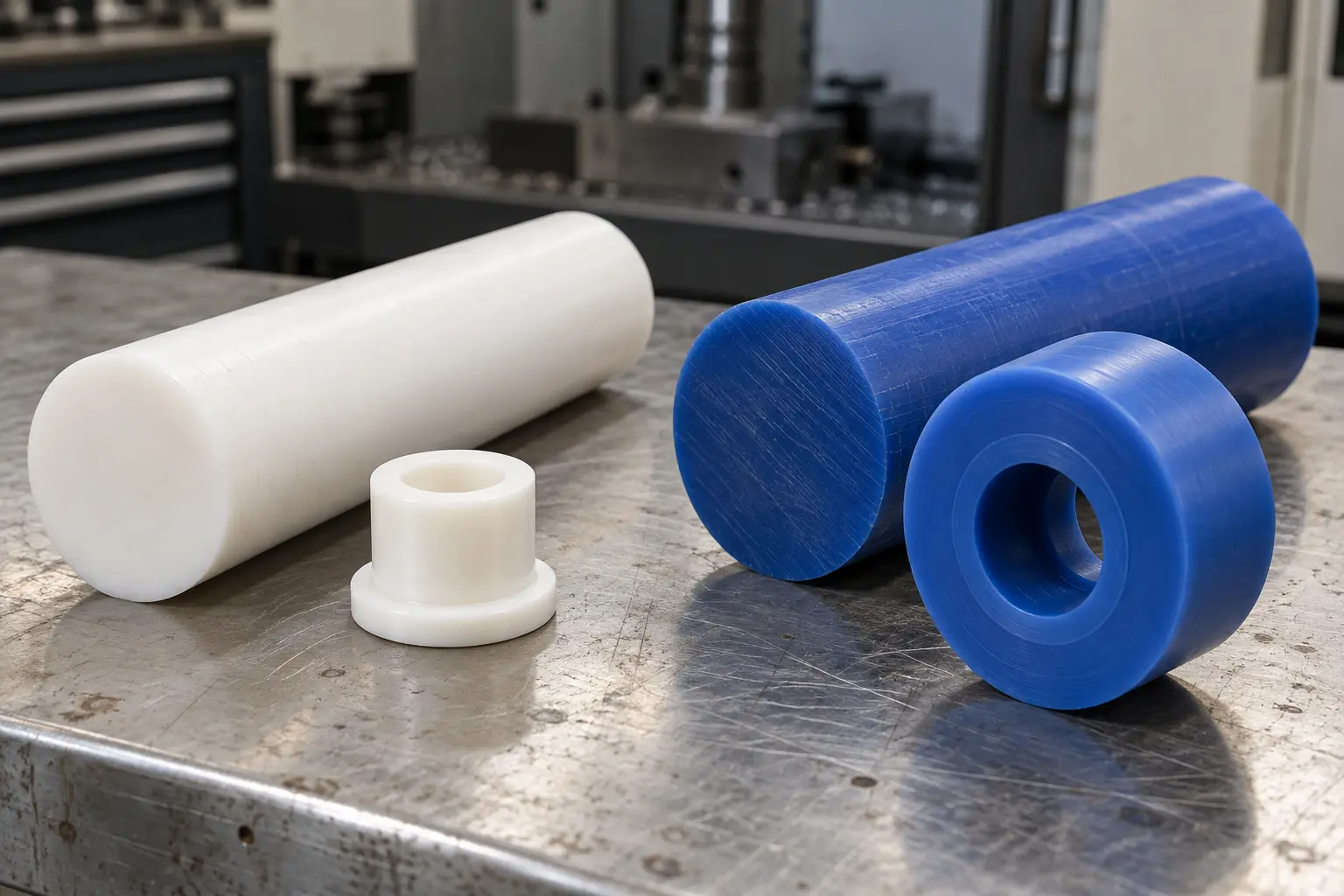
Realistic technical concept image for POM vs. Cast Nylon: Which Engineering Plastic for CNC-Machined Parts?
Conceptual image created to illustrate the article's technical setup; not an actual VietTech production photograph. Specifications and acceptance follow the drawing/RFQ.
CriterionPOMCast nylon / MC Nylon
Dimensional stabilityGenerally better in humid conditionsSignificantly affected by moisture absorption
Moisture absorptionLowHigher than POM
RigidityRelatively high and stableGood but changes with moisture
Wear resistanceGoodVery good in many sliding applications
Damping and impact toughnessModerate to goodGenerally stronger advantage
Large stock shapesDepends on supplier rangeCast process supports larger shapes
Typical partsPrecision parts, small gears, blocksRollers, guides, bushings, large gears
03

Moisture absorption and dimensional stability

The most important difference is that cast nylon absorbs moisture from the environment. Water entering the polymer can change dimensions, stiffness, and mechanical behavior. A part machined in a dry condition may increase in size after exposure to humid air or water. POM absorbs less moisture and generally maintains dimensions more consistently. It is therefore often preferred for small-clearance mechanisms, controlled relative positions, or changing humidity. POM still expands substantially more than metal with temperature, so machining and inspection temperatures must be considered. For cast nylon, the drawing should define material condition and acceptance environment. Tolerance cannot be evaluated separately from moisture condition. Bushings and rollers require clearance for both thermal expansion and moisture-related growth.

04

Friction, wear, and load

Both materials provide relatively low friction and are used in sliding components. POM offers a hard, consistent sliding surface and low stick-slip behavior, making it useful for precision mechanisms, small gears, and repetitive motion. Cast nylon provides strong wear resistance, toughness, and vibration damping. It is commonly used for rollers, guide rails, bushings, and large gears. Oil-filled grades may lower friction and support operation with limited external lubrication. Allowable load depends on surface pressure, sliding speed, temperature, counterface material, roughness, lubrication, and heat removal. A published material load value should not be applied directly to every component. PV conditions, duty cycle, lubrication, temperature, and long-term deformation require engineering review.

05

CNC machining behavior

POM usually forms manageable chips and can produce a clean surface with sharp tools. Its rigidity supports small features, holes, slots, and precise profiles. Heat accumulation can still cause expansion, tool buildup, or distortion, requiring sharp edges, effective chip evacuation, and appropriate cutting data. Cast nylon is tougher and may generate long, stringy chips. Dull tools and excessive heat can pull the surface, create fuzz, or leave burrs. Thick cast stock may contain residual stress or nonuniform material behavior; heavy one-sided stock removal can bend the part. Balanced machining, separate roughing and finishing, and stabilization time may be required. Drilling requires heat control, chip evacuation, and sharp geometry. Deep holes may change size after cooling. Excessive chuck or vise force can elastically distort the part and produce size error after unclamping.

06

Tolerancing plastic components

Metal-part tolerances should not be copied automatically to POM or nylon. Plastics have lower elastic modulus, greater thermal expansion, and higher sensitivity to measurement force. Cast nylon also changes with humidity. The drawing should address conditioning temperature, material moisture state, necessary functional tolerance, assembly clearance at operating conditions, measurement force, support method, stabilization time, permitted fixture marks, and corner radii. Long dimensions and thin plates may change flatness in a free state. If acceptance depends on flatness, the drawing should define support and measurement condition.

07

When to select POM

POM is commonly considered when the part requires relatively stable dimensions in humidity, small or medium precision geometry, low friction, repeatable motion, a clean machined surface, or lower moisture absorption than nylon. Typical parts include small gears, cams, guide blocks, insulating components, and fixtures. Chemical, temperature, food-contact, or regulatory capability must be confirmed for the exact grade. It should not be inferred from the generic term POM.

08

When to select cast nylon

Cast nylon is commonly considered for large stock shapes, wear resistance, toughness, damping, rollers, bushings, large gears, wear pads, or guide rails. Oil-filled and modified grades may provide suitable sliding behavior for particular applications. In water or high humidity, moisture-related growth must be included. Cast nylon should not replace POM in a close fit without recalculating clearance.

09

Color, appearance, and certification

White, black, blue, or another color does not uniquely identify the polymer grade. Producers use different color and additive systems. The RFQ should state polymer type, grade, required manufacturer or standard, color, food-contact requirement, static-control requirement, and certification. Equivalent material should only be used with approval. For critical applications, certification must be agreed before stock procurement.

010

RFQ information

  • POM homopolymer/copolymer or exact cast-nylon grade.
  • Color, additives, food-contact, or static-control requirement.
  • Operating temperature, humidity, water, oil, and chemical exposure.
  • Load, sliding speed, and counterface material for bearings or rollers.
  • 2D drawing, 3D model, tolerances, and inspection condition.
  • Quantity, stock size, appearance, and certificate requirements.

RELATED PAGES

CNC machining thin-wall parts ↗Flatness vs. parallelism ↗Materials and processing ↗

FAQ

Frequently asked questions

Is POM always more accurate than cast nylon?

POM is generally more dimensionally stable in humidity, but final accuracy also depends on geometry, temperature, stress, workholding, and inspection.

Can cast nylon operate in water?

It can in some applications, but water absorption and the resulting changes in size, stiffness, and clearance must be considered.

Can cast nylon directly replace POM?

Not without review. Tolerance, humidity, friction, load, temperature, and stock size must be reassessed.

Do engineering plastics require cooling during machining?

Heat and chip evacuation must be controlled. Cooling strategy depends on material, cleanliness requirement, and machine; no single method fits every plastic.

Does VietTech machine POM and cast nylon?

VietTech can evaluate engineering-plastic machining according to the drawing, part size, grade, tolerance, and inspection requirement.

MATERIALS

Have an engineering-plastic part to review?

Send the 2D drawing, 3D model, POM or cast-nylon grade, quantity, operating conditions, and tolerances for a machining and inspection review.REQUEST A QUOTE ↗