
HEAT TREATMENT

Nitriding vs Carburizing: Which Process Fits Your Machined Part?

Nitriding and carburizing are thermochemical treatments used to produce a wear-resistant surface while retaining suitable core properties. They are often s

HEAT TREATMENTVIETTECH · TECHNICAL RESOURCES
01

Overview

Nitriding and carburizing are thermochemical treatments used to produce a wear-resistant surface while retaining suitable core properties. They are often specified for shafts, pins, gears, bushes, sliding parts and repeatedly loaded machine components. They should not be treated as interchangeable based on surface hardness alone. The selection must consider steel grade, contact load, required case depth, process temperature, distortion risk, core condition and the surfaces that require precision finishing after treatment.

02

Practical comparison

This comparison is an initial guide. Actual hardness and case depth depend on grade, size, incoming condition, equipment and the heat-treatment cycle.

Nitriding vs Carburizing: Which Process Fits Your Machined Part?
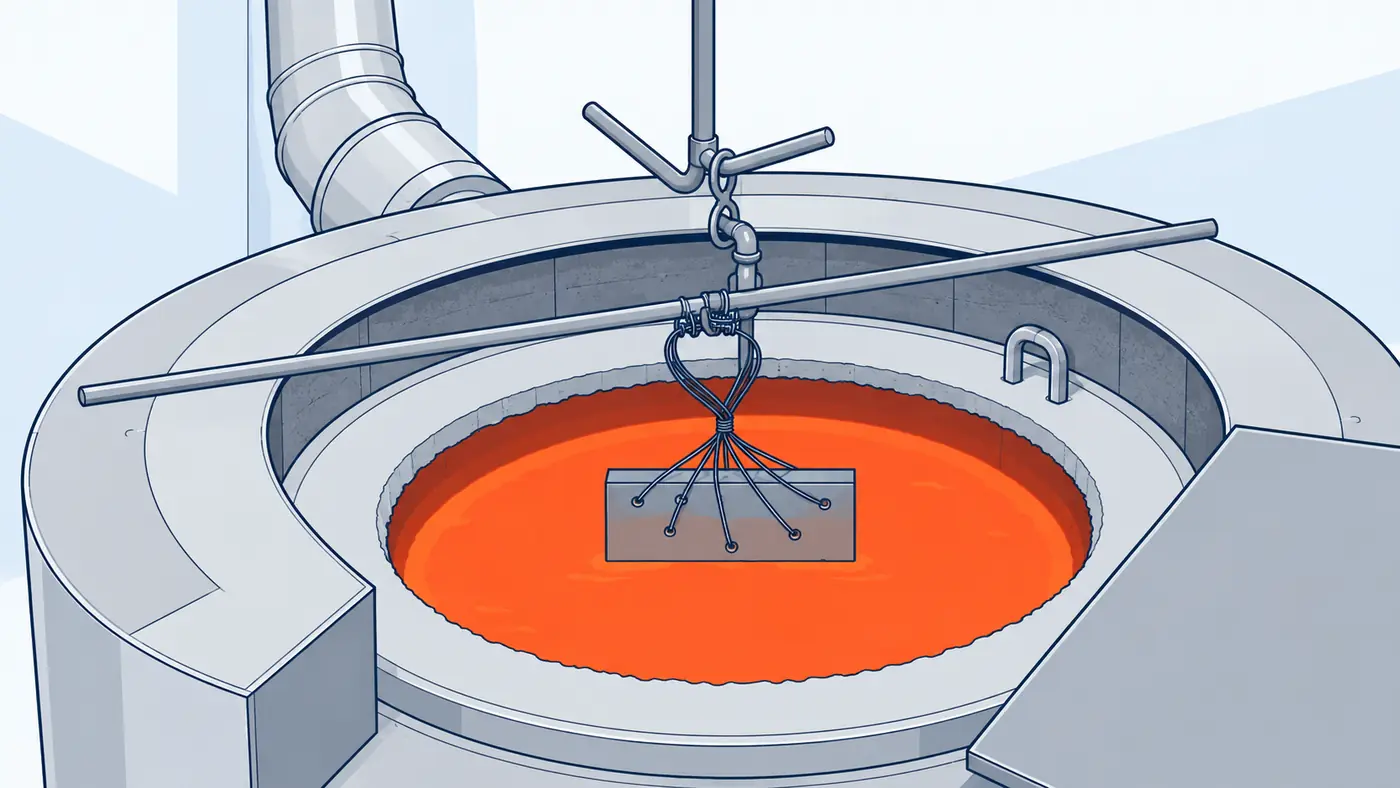
Technical diagram: Nitriding vs Carburizing: Which Process Fits Your Machined Part?. This is not a production photograph; specifications and acceptance follow the drawing.
PointNitridingCarburizing
Main diffusing elementNitrogenCarbon
Relative process temperatureGenerally lowerGenerally higher and commonly followed by quenching and tempering
Case characteristicHard wear-resistant surface; case depth is often more limitedA deeper case may be developed depending on grade and cycle
Distortion riskOften lower because of the lower temperatureRequires close control because of high temperature and quenching
Material selectionAlloy composition and nitride-forming response must be checkedCommonly uses steels selected for a suitable core carbon level
Post-treatment finishingRemoval of the treated layer may need to be limitedGrinding allowance may be planned for critical surfaces
03

When nitriding may be appropriate

Nitriding is often considered when wear resistance and relatively low distortion are important, or when the component is close to its finished dimensions before treatment. The steel grade must contain an alloy system suitable for developing the required nitrided case. Possible applications include shafts, sliding rods, pins, bushes, tooling components and friction surfaces. The drawing should not state only “nitriding”; it should define the material, required hardness and case-depth requirement. For close-tolerance or low-roughness faces, state whether polishing or light finishing after treatment is permitted.

04

When carburizing may be appropriate

Carburizing is commonly selected when a hard surface must work with a tough core, particularly under contact load and impact. Gears, shafts, cams, pins and transmission components are typical candidates. Because the cycle generally includes high temperature and quenching, bending, ovality and dimensional movement must be considered in process planning. Precision surfaces may require grinding allowance. Datum strategy, section shape and abrupt thickness changes also influence distortion.

05

Case depth needs a defined criterion

A drawing should state how case depth is defined and the hardness threshold used for evaluation. A numerical depth without a criterion may be interpreted differently by the machining supplier and heat-treatment provider. A deeper case normally requires more process time, so it should not be specified beyond the functional need. Identify the loaded area, expected material removal after treatment and whether destructive sample verification is required.

06

Higher hardness is not automatically better

Surface hardness is only one requirement. A component may still fail if the core is unsuitable, the case is brittle, the compound layer is uncontrolled or distortion exceeds tolerance. For fitted features, review final size, roundness, coaxiality, flatness, roughness and remaining case depth together. Long shafts and thin sections require early distortion assessment.

07

Planning the operation sequence

A possible route includes stock preparation, rough machining, stress relief where appropriate, semi-finishing, heat treatment, and grinding or finishing of functional surfaces. The actual route depends on material, geometry and drawing requirements. Grinding allowance should not be copied as one fixed value. Too little may not clean up distortion; too much may remove useful case depth, increase grinding time or reduce the remaining hardened layer.

08

Inspection after treatment

Required records may include surface hardness, core hardness, case depth, final dimensions and geometric tolerances. Confirm hardness-test locations, sample quantity, case-depth method and whether test impressions are permitted on the production part. VietTech provides CNC milling, CNC turning, surface grinding, cylindrical grinding, wire EDM and dimensional inspection. Heat treatment is coordinated with suitable partners; the standard, treatment scope and documentation are confirmed for each order.

09

RFQ checklist

  • Material grade and standard.
  • Incoming material condition.
  • Nitriding or carburizing process.
  • Surface and core hardness when required.
  • Case depth and evaluation method.
  • Treated, masked or untreated surfaces.
  • Dimensions and tolerances applicable after heat treatment.
  • Surfaces requiring grinding allowance.
  • Quantity, certificates and inspection requirements.
010

Conclusion

Nitriding is often suitable when wear resistance, relatively low distortion and a compatible alloy steel are required. Carburizing is suitable when a deeper hard case must work with a load-bearing core, but it requires more careful distortion and finish-machining control. The final decision must follow function, material, case depth and post-treatment tolerances.

011

日本語

メインキーワード: 窒化 浸炭 違い

RELATED PAGES

Precision grinding after heat treatment ↗S45C vs SCM440 ↗Surface roughness Ra ↗

FAQ

Frequently asked questions

Does nitriding cause less distortion than carburizing?

The risk is generally lower because of the lower process temperature, but nitriding is not distortion-free. Geometry, residual stress and incoming condition still matter.

Can a nitrided surface be ground?

It may be possible, but material removal must be controlled so the required hardened case is retained.

Can every steel be carburized?

No. The material should be selected for the required surface and core properties.

Is a hardness value alone sufficient on the drawing?

No. Define the treatment method, case depth, treated area and final inspection condition.

Does VietTech perform heat treatment in-house?

No. VietTech coordinates heat treatment with suitable partners and manages the requirements for each drawing and order. Suggested internal links: - Precision grinding after heat treatment: /en/precision-grinding-after-heat-treatment - S45C vs SCM440: /en/s45c-vs-scm440-cnc-machining - Surface roughness Ra: /en/surface-roughness-ra-3-2-ra-1-6-ra-0-8 - RFQ guide: /en/rfq-guide CTA: Send the drawing, material, quantity, hardness and case-depth requirements for VietTech to review machining, heat treatment, grinding and inspection before quotation. ---

HEAT TREATMENT

Have a heat-treated part to review?

Send the drawing, material, quantity, hardness and case-depth requirements for VietTech to review machining, heat treatment, grinding and inspection.REQUEST A QUOTE ↗