
MACHINING

CNC Machining Thin-Wall Parts: Reducing Vibration and Distortion

Practical considerations for milling thin-wall housings and plates: stock, sequence, workholding, tooling and inspection after unclamping.

MACHININGVIETTECH · TECHNICAL RESOURCES
01

Why thin-wall parts are difficult

As wall thickness decreases, stiffness drops rapidly. Cutting force, clamping and heat can deflect the wall during machining, while residual stress may redistribute after release. Typical results include chatter, inconsistent tool marks, taper, flatness error and shifted features. Planning must consider starting stock, removed volume and machining sequence rather than only finished dimensions.
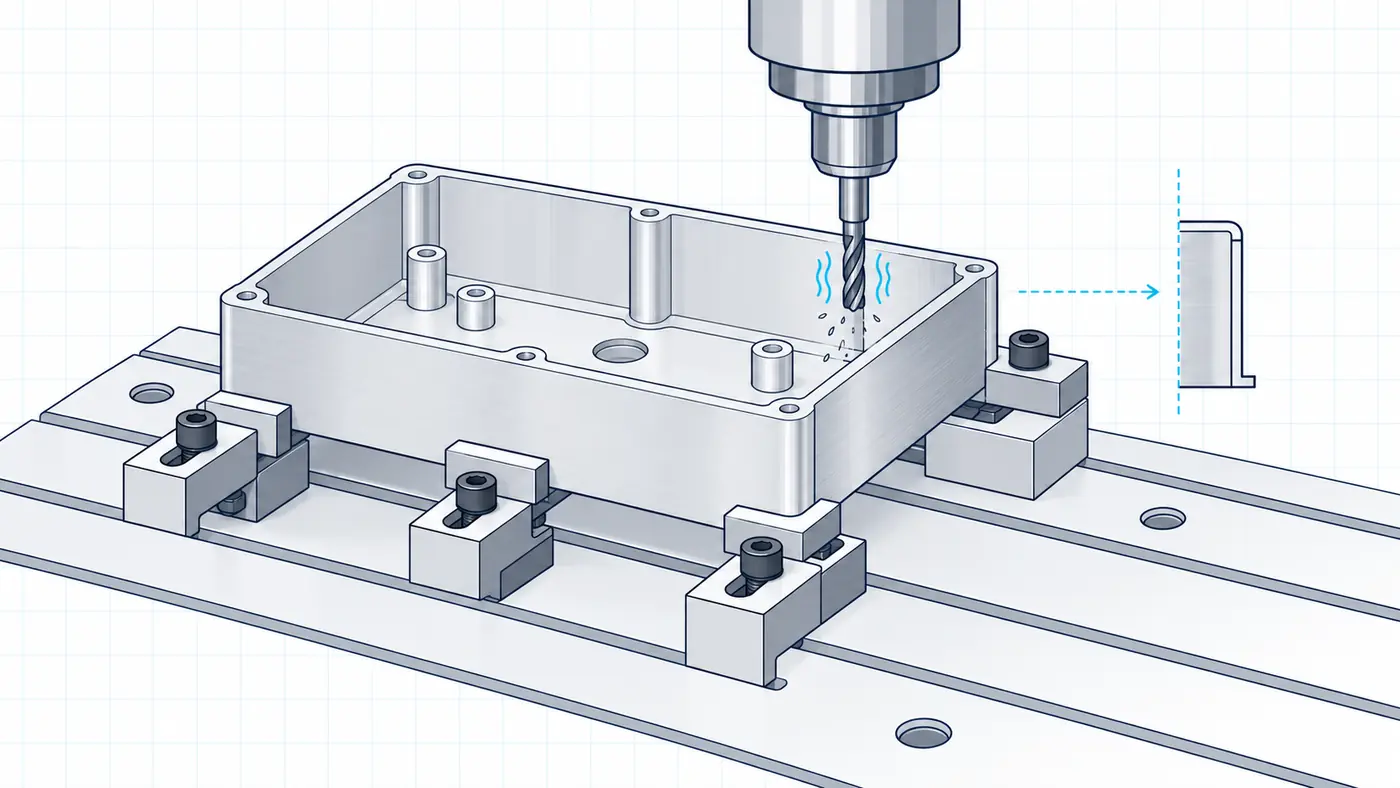
2D sketch of CNC milling a thin-wall housing
Conceptual support close to the cutting zone; actual workholding is designed for each part.
02

Stock and material-removal sequence

Stock that is already too thin may lack roughing stiffness, while excessive stock increases removal and heat. Review material condition, rolling direction and residual-stress risk. Establish stable datums, rough with allowance, allow stabilization, semi-finish and then complete functional walls. Avoid finishing one fragile wall while large volumes remain elsewhere; opposing walls may be cut alternately to balance forces.

03

Support the cut without clamping distortion

Excessive force can make a part measure correctly while clamped and fail after release; insufficient force permits chatter or movement. Apply load through stiff regions, increase contact area and support near the cutting zone without blocking the toolpath. Contoured supports, soft packing or internal support may be appropriate. Tightening order and seating conditions should remain repeatable.

04

Tooling, toolpath and cutting data

Sharp, light-cutting geometry and short overhang help reduce force. Cutter diameter, flute count, engagement and feed must also permit chip evacuation. Layered passes, adjusted toolpath direction and reduced engagement may help weak walls. Simply reducing every parameter can cause rubbing, heat and poor finish when chip thickness becomes unsuitable.

05

Inspect after release and stabilization

Wall size, flatness and feature position may change after unclamping or thermal stabilization. Define free-state or restrained measurement, support points, temperature and timing. Large surfaces require an agreed point pattern and evaluation method. A warm component should stabilize before final acceptance.

06

RFQ checklist

Complete input supports early evaluation of distortion and fixture cost.

  • Controlled 2D drawing and 3D model
  • Material and stock condition
  • Nominal thickness and critical thin-wall regions
  • Tolerances after unclamping
  • Datums, measurement state and report requirements
  • Prototype and batch quantity
  • Finishing after machining
07

VietTech review scope

VietTech reviews CNC milling, workholding, process sequence and inspection drawing by drawing. Capability depends on material, overall size, wall height-to-thickness ratio, removal volume, datums, tolerances and post-process condition. No universal minimum wall thickness applies to every component.

RELATED PAGES

Flatness vs parallelism ↗Surface roughness Ra ↗Equipment and capabilities ↗

FAQ

Frequently asked questions

Should cutting speed simply be reduced?

No. Cutting forces, feed, engagement, tooling, toolpath, workholding and chip evacuation must be considered together.

Can the part be inspected while clamped?

That supports process control, but final requirements may need confirmation after release.

Does stronger clamping always reduce chatter?

No. Excessive clamping can distort the part.

Should one side be completed first?

It depends on geometry; balanced removal and alternating passes are often considered.

Does VietTech specify one minimum wall thickness?

No universal value is used. Feasibility is reviewed drawing by drawing.

MACHINING

Have a thin-wall part to review?

Send the drawing, model, material, quantity and free-state tolerances for VietTech to review the process, fixture and inspection method.REQUEST A QUOTE ↗