
HEAT TREATMENT

Vacuum vs Induction Hardening: Which Process Fits a Machined Part?

Compare vacuum and induction hardening by hardened zone, core properties, distortion, surface condition and finish-machining requirements.

HEAT TREATMENTVIETTECH · TECHNICAL RESOURCES
01

Two processes for different functions

Both processes can raise hardness and wear resistance, but they do not affect the same volume. Vacuum hardening generally heats the complete component in a controlled low-pressure chamber before quenching. Induction hardening rapidly heats a selected surface zone with an electromagnetic field, producing a hardened case while retaining a relatively tough core.
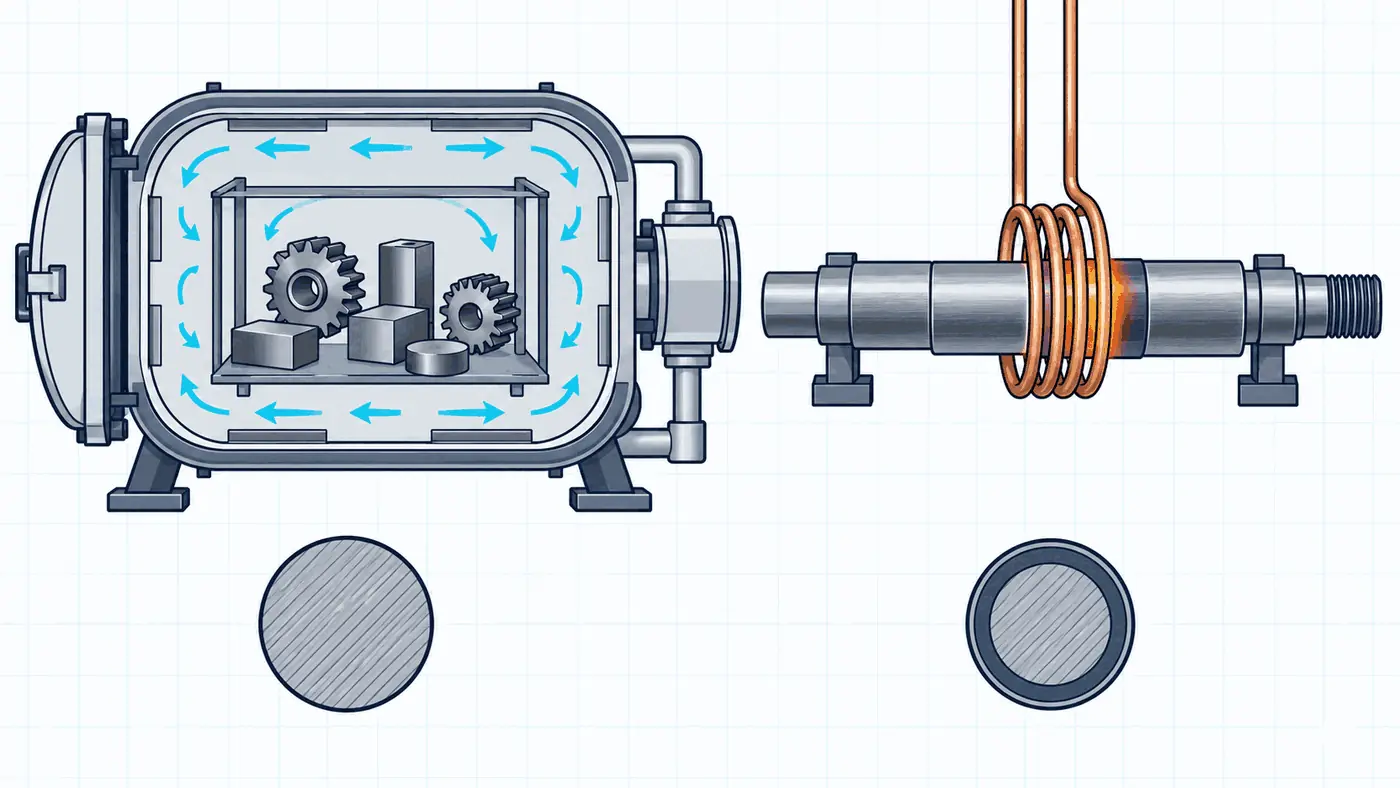
2D comparison of vacuum furnace and induction coil hardening
Vacuum treatment acts on the complete part; induction concentrates heat at a selected surface zone.
  • Vacuum: complete-part or complete-load treatment
  • Induction: selective treatment of journals, tracks, teeth or working zones
  • Material, target hardness and tempering condition must be defined
  • A process name alone is not a complete specification
02

How vacuum hardening works

Parts are heated under vacuum or protective gas and quenched by gas or another suitable medium. The controlled environment can limit oxidation and decarburization compared with heating in air, making it useful for tool steels, dies and precision parts requiring a clean surface. Distortion is not eliminated: section changes, loading, support, temperature and cooling rate still influence the result.

03

How induction hardening works

Alternating current in a coil creates an electromagnetic field that rapidly heats the steel surface. Quenching transforms the austenitized layer while the core is affected less. Shafts, pins, gears and running surfaces can gain wear and contact-fatigue resistance while retaining core toughness. Coil geometry, gap, frequency, power, heating time and quench method control case depth and uniformity.

04

Selection guide

Begin with the function of the working zone, not only the final HRC value.

  • Relatively uniform hardness through the section: consider vacuum hardening
  • Only a working surface needs hardness: consider induction hardening
  • Clean surface and limited oxidation are priorities: vacuum often offers an advantage
  • A defined journal, shoulder or tooth profile needs a case: induction enables selective treatment
  • Thin, asymmetric or rapidly changing sections require a specific distortion review
05

Hardness alone is not sufficient

Two parts with the same surface HRC may differ in case depth, core hardness, transition zone, microstructure and residual stress. Drawings should identify measurement position, scale, point count and effective case depth where surface performance depends on it. Through-hardening requirements should state hardness after tempering and the agreed inspection location.

06

Distortion and machining allowance

Microstructural and volume changes can cause bending, ovality, flatness error or feature shift. Before treatment, agree which surfaces retain finish allowance, which datums will be used afterward and whether grinding or wire EDM completes critical features. No single allowance suits every part; size, grade, geometry, final hardness and expected movement all matter.

07

Typical process sequence

A route may include rough machining, stress relief where needed, semi-finishing, hardening, tempering, then grinding or finish machining of functional surfaces. For induction treatment, mark the hardened and unaffected zones clearly. For vacuum treatment, loading orientation and support should be reviewed with the heat-treatment specialist.

08

RFQ checklist

Clear input supports process, distortion and inspection review.

  • Material grade, standard and stock condition
  • Controlled 2D drawing and 3D model if available
  • Specified process or functional objective
  • Target hardness, measurement position and scale
  • Required case depth and induction-hardened zone
  • Grinding allowance, final tolerances and roughness
  • Certificate, microstructure or hardness-report requirements
  • Quantity and requested delivery
09

VietTech coordination scope

VietTech performs CNC machining, grinding, wire EDM and inspection to drawing. Vacuum and induction hardening are coordinated through suitable specialist partners. VietTech reviews the pre- and post-heat-treatment sequence, finish allowance and inspection plan before confirming feasibility.

RELATED PAGES

Nitriding vs carburizing ↗Grinding after heat treatment ↗S45C vs SCM440 ↗

FAQ

Frequently asked questions

Does vacuum hardening eliminate distortion?

No. Surface condition is well controlled, but material, geometry, residual stress, loading and cooling still affect movement.

Does induction hardening harden the complete core?

Usually the objective is a hard surface case with a relatively tough core; the result depends on material and settings.

Is an HRC value alone enough?

Not always. Surface hardening may also require a defined zone, test location and effective case depth.

Is grinding required afterward?

It may be needed where dimensional, roundness, flatness or roughness tolerances are tight.

Does VietTech heat-treat in-house?

No. VietTech coordinates specialist partners and controls the surrounding machining and inspection plan.

HEAT TREATMENT

Need a heat-treatment route reviewed?

Send the drawing, material, quantity, hardened zone, target hardness and final tolerances for VietTech to review machining and heat-treatment coordination.REQUEST A QUOTE ↗