
MATERIALS

6061 vs. 7075 Aluminum: Which Alloy for CNC-Machined Parts?

6061 and 7075 are widely used for CNC-machined components, but they are not interchangeable based on appearance or weight alone. 6061 is commonly selected

MATERIALSVIETTECH · TECHNICAL RESOURCES
01

Overview

6061 and 7075 are widely used for CNC-machined components, but they are not interchangeable based on appearance or weight alone. 6061 is commonly selected for its balanced performance, corrosion resistance, weldability, availability, and cost. 7075 provides substantially higher strength and is suited to demanding load-bearing components, but it requires closer attention to temper, corrosion exposure, joining methods, and surface protection. Material selection should begin with part function, service load, operating environment, tolerance requirements, stock form, and post-machining processes. The alloy designation alone is incomplete. Full specifications such as 6061-T6, 6061-T651, or 7075-T651 allow the manufacturer to evaluate the application more accurately.

02

What Is the Main Difference Between 6061 and 7075?

6061 is a heat-treatable 6xxx-series aluminum alloy whose principal alloying elements are magnesium and silicon. It offers a practical balance of strength, machinability, weldability, corrosion resistance, and finishing performance. Typical CNC-machined applications include plates, brackets, housings, manifolds, fixtures, and general industrial components. 7075 is a 7xxx-series alloy in which zinc is the principal alloying element, with magnesium and copper also contributing to its properties. It is generally selected when a high strength-to-weight ratio is a functional requirement. Typical applications include highly loaded brackets, structural links, rigid fixtures, moving components, and parts that must reduce weight without sacrificing strength. 7075 is not automatically the better material. When a component does not require its higher strength, specifying 7075 may increase material cost and process controls without adding functional value.

6061 vs. 7075 Aluminum: Which Alloy for CNC-Machined Parts?
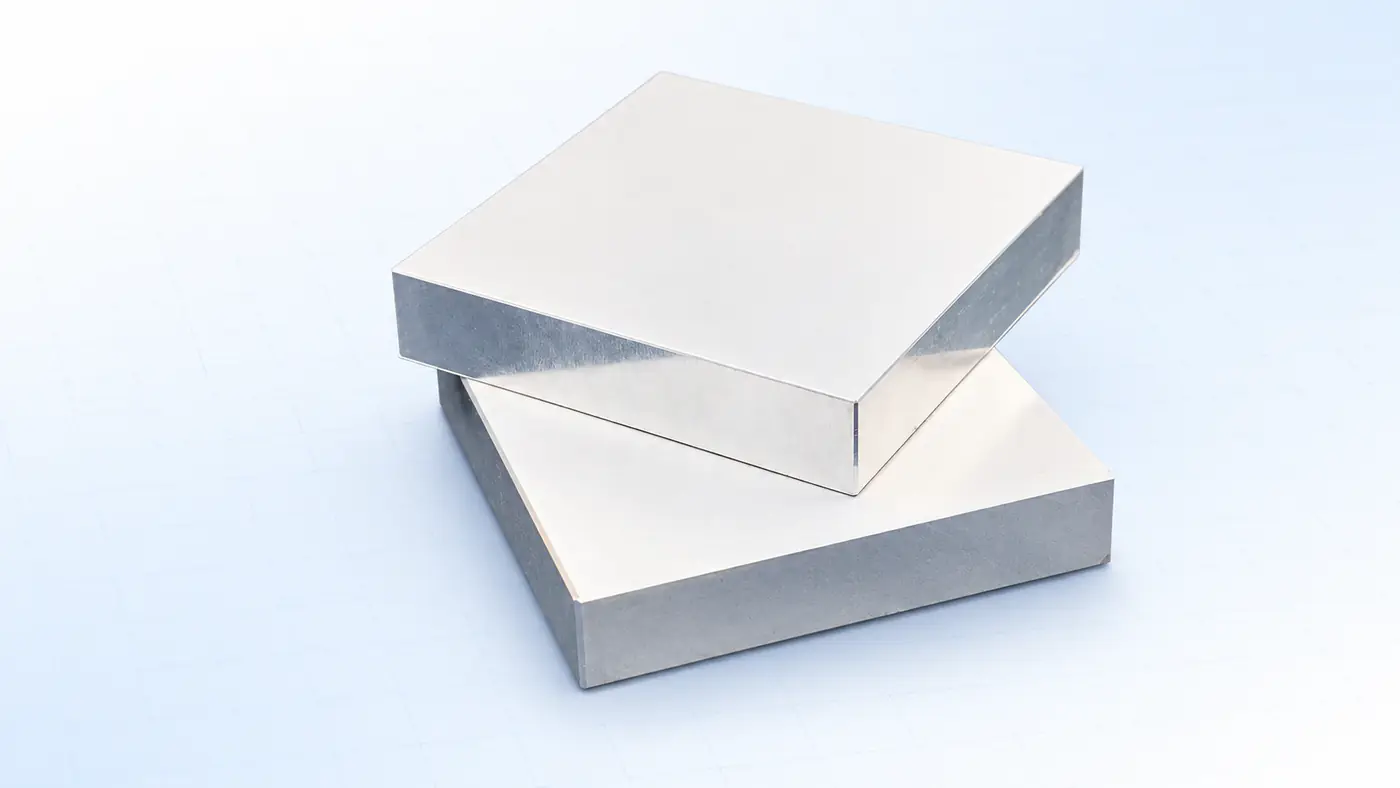
Technical diagram: 6061 vs. 7075 Aluminum: Which Alloy for CNC-Machined Parts?. This is not a production photograph; specifications and acceptance follow the drawing.
03

Practical Comparison

The following values are general references for common T6/T651 tempers. Actual properties vary with product form, thickness, processing direction, applicable specification, and supplier certification.

Criterion6061-T6/T6517075-T6/T651
Alloy familyAl-Mg-Si, 6xxx seriesAl-Zn-Mg-Cu, 7xxx series
Approximate density2.70 g/cm³2.81 g/cm³
Typical yield strengthApproximately 240–276 MPaApproximately 430–503 MPa
Typical tensile strengthApproximately 290–310 MPaApproximately 510–572 MPa
MachinabilityGood for a broad range of general componentsGood; higher hardness can support controlled chip formation under suitable cutting conditions
Corrosion resistanceGenerally better in common service environmentsLower than 6061; surface protection and exposure require review
WeldabilityGenerally good, although the heat-affected zone may lose strengthFusion welding is generally not preferred for load-bearing structures
Anodizing responseResponds well to decorative and hard anodizing when processed correctlyCan be anodized, but color and appearance may differ from 6061
Cost and availabilityUsually more economical and widely availableUsually more expensive and may have fewer stock options
Typical directionHousings, brackets, fixtures, manifolds, and platesHigh-load, lightweight components and rigid tooling
04

CNC Machinability

6061 for versatile production

6061 performs well in CNC milling, turning, drilling, tapping, and reaming. It is a practical choice for housings, plates, and manifolds containing multiple holes, pockets, and threads. Although it cuts readily, aluminum can form built-up edge when tooling, chip evacuation, or coolant delivery is inadequate. Sharp cutting edges, aluminum-specific tool geometry, and controlled chip evacuation help reduce burrs, surface scratches, and dimensional error near thin edges. For deep pockets, thin walls, or high material-removal ratios, machining sequence and workholding have a direct effect on distortion.

7075 offers high strength without being inherently difficult to cut

7075-T6/T651 is harder and stronger than 6061. With appropriate tooling and cutting parameters, it can produce controlled chips and a high-quality machined finish. However, cutting loads, tool demand, and workholding requirements may be greater. Small radii, thin walls, and loaded transitions should be finished carefully to avoid tool marks and stress concentration. Machinability should not be judged by alloy designation alone. Stock form, temper, thickness, material quality, and actual hardness all influence process performance.

05

Dimensional Stability and the T651 Temper

When a plate or block undergoes substantial, asymmetric material removal, residual stress can be released and cause bowing or twisting after unclamping. This can occur in both 6061 and 7075. The T651 designation indicates that the material has been solution heat-treated, stress-relieved by stretching, and artificially aged. This temper is often preferred for precision-machined plate, but it does not guarantee zero distortion. Dimensional stability also depends on stock source, rolling direction, material-removal ratio, geometric symmetry, and machining sequence. For thin-wall parts or plates with large pockets, a process plan may include:

  • Verifying stock flatness before machining.
  • Balancing stock allowance between opposing faces.
  • Roughing symmetrically and allowing stabilization before finishing.
  • Maintaining appropriate datums while avoiding excessive clamping force.
  • Inspecting the released part rather than only measuring it under restraint.
06

Anodizing and Cosmetic Requirements

6061 generally responds well to anodizing and is widely used when corrosion resistance, wear resistance, or color is required. 7075 can also be anodized, but its higher copper and zinc content may produce color, shade, or uniformity differences compared with 6061. An engineering drawing should state more than “anodize.” The RFQ should define: Anodizing changes the surface dimension. Hole, shaft, thread, and slot tolerances must therefore be evaluated in either the pre-treatment or post-treatment condition.

  • Anodizing type or applicable specification.
  • Color and limit sample when appearance is critical.
  • Required coating thickness.
  • Masked areas and permissible electrical contact locations.
  • Threads, fits, or dimensions controlled after treatment.
  • Acceptance criteria for rack marks, color variation, and surface scratches.
07

When Should You Select 6061?

6061 is often appropriate when:

  • The component is subject to moderate service loads.
  • Strength, cost, and machinability must be balanced.
  • Welding or integration into a welded structure is required.
  • The service environment benefits from relatively good corrosion resistance.
  • Anodized appearance must be more predictable.
  • Stock availability and lead time are major considerations.
08

When Should You Select 7075?

7075 should be considered when: Changing from 7075 to 6061, or vice versa, is an engineering material change. A machining supplier should not make this substitution without written customer or design-authority approval.

  • Required load capacity or stiffness cannot be met efficiently with 6061.
  • Weight must be reduced while maintaining high strength.
  • The component does not depend on a structural weld.
  • Stress concentration, cyclic loading, and the service environment have been evaluated.
  • An appropriate surface-protection and corrosion-control plan is available.
  • The higher material cost is justified by a functional requirement.
09

Information to Include in an RFQ

For accurate manufacturability review and pricing, provide:

  • Complete alloy and temper, such as 6061-T651 or 7075-T651.
  • Material specification and certification requirements.
  • Stock form: plate, bar, extrusion, or customer-supplied material.
  • Current 2D drawing revision and 3D model.
  • Dimensional tolerances, geometric tolerances, datums, and surface roughness.
  • Anodizing requirements, masked areas, color, and coating thickness.
  • Whether dimensions apply before or after surface treatment.
  • Quantity, repeat demand, and requested delivery date.
010

How VietTech Reviews Aluminum Parts

VietTech performs CNC milling, CNC turning, grinding, wire EDM, and dimensional inspection to customer drawings. For aluminum components, the process plan is reviewed against stock form, temper, material-removal ratio, thin-wall geometry, tolerance, and surface requirements. Anodizing is coordinated through qualified external processing partners, with the specification and final inspection condition confirmed for each order.

011

Conclusion

6061 is suitable for a broad range of industrial components because it balances strength, machinability, corrosion resistance, weldability, and cost. 7075 provides substantially higher strength and is appropriate when a high strength-to-weight ratio is essential. The correct choice is not simply the stronger alloy; it is the alloy whose properties match the functional requirements of the component.

RELATED PAGES

S45C vs. SCM440 ↗CNC machining thin-wall parts ↗Material and finish RFQ guide ↗

FAQ

Frequently asked questions

Is 7075 always better than 6061?

No. 7075 has higher strength, while 6061 often provides better corrosion resistance, weldability, availability, and cost efficiency. Selection must be based on the actual application.

Can 6061 replace 7075 during quotation?

Not without approval. If the drawing specifies 7075, any substitution should receive written authorization from the customer or design authority.

Are T6 and T651 the same?

Both are solution heat-treated and artificially aged. T651 includes additional stress relief by stretching. It is often considered for precision-machined plate, but distortion control is still required.

Can 7075 be anodized?

Yes. However, its color and cosmetic response may differ from 6061. When appearance is important, define the specification, reference sample, and acceptance criteria before production.

Does VietTech perform anodizing in-house?

No. VietTech performs machining and inspection and coordinates anodizing with an appropriate external processing partner for each drawing.

MATERIALS

Need a manufacturability review for a 6061 or 7075 part?

Send the 2D drawing, 3D model, material temper, quantity, tolerances and anodizing requirements. VietTech will review the machining approach before quotation.REQUEST A QUOTE ↗