
TECHNICAL GUIDE

5052 vs. 6061 Aluminum: Which Alloy Is Better for CNC-Machined Parts?

Compare 5052 and 6061 aluminum for strength, forming, welding, CNC machining, dimensional stability, and anodizing before selecting a part material.

TECHNICAL GUIDETECHNICAL CONCEPT IMAGE
01

Overview

5052 and 6061 are widely used wrought aluminum alloys for industrial equipment, fixtures, housings, and lightweight mechanical assemblies. They are not direct substitutes. 5052 is a non-heat-treatable aluminum-magnesium alloy, while 6061 is an aluminum-magnesium-silicon alloy that can be precipitation hardened. This distinction affects strength, forming, welding, machinability, and dimensional behavior during manufacturing. The designations A5052 and A6061 are common in JIS-based drawings and Asian supply chains. In U.S. specifications, the alloys are generally written as 5052 and 6061. A purchase specification should also state the governing standard, product form, temper, and certification requirement. For example, 5052-O behaves differently from 5052-H32, and 6061-T6/T651 must not be evaluated as if it were 6061-O.

02

Alloy systems and strengthening mechanisms

5052: strain-hardened aluminum-magnesium alloy

5052 belongs to the non-heat-treatable 5xxx series. Its strength is primarily controlled through cold work and subsequent stabilization. Common tempers include O, H32, and H34. The alloy offers strong corrosion resistance, weldability, and formability, making it a practical choice for sheet-metal covers, trays, brackets, enclosures, and welded structures. The O temper is softer and more formable. H32 and H34 provide higher strength with a corresponding reduction in formability. A drawing that specifies only “5052” therefore leaves a critical manufacturing variable undefined.

6061: precipitation-hardenable aluminum-magnesium-silicon alloy

6061 belongs to the heat-treatable 6xxx series. T6 and T651 are common tempers for machined components. T6 indicates solution heat treatment followed by artificial aging. T651 includes stress relief by stretching as defined by the temper designation. 6061-T6/T651 is frequently selected for components that require greater strength, rigidity, and machining performance than softer sheet alloys. T651 does not guarantee a distortion-free part. Residual stress is also influenced by stock thickness, production route, material removal, geometry, and machining sequence. Thin walls and heavily pocketed components still require balanced stock removal and controlled fixturing.

03

Directional comparison

This table is a screening tool, not a design property table. Exact mechanical requirements must be taken from the specified standard for the applicable temper, product form, and thickness.

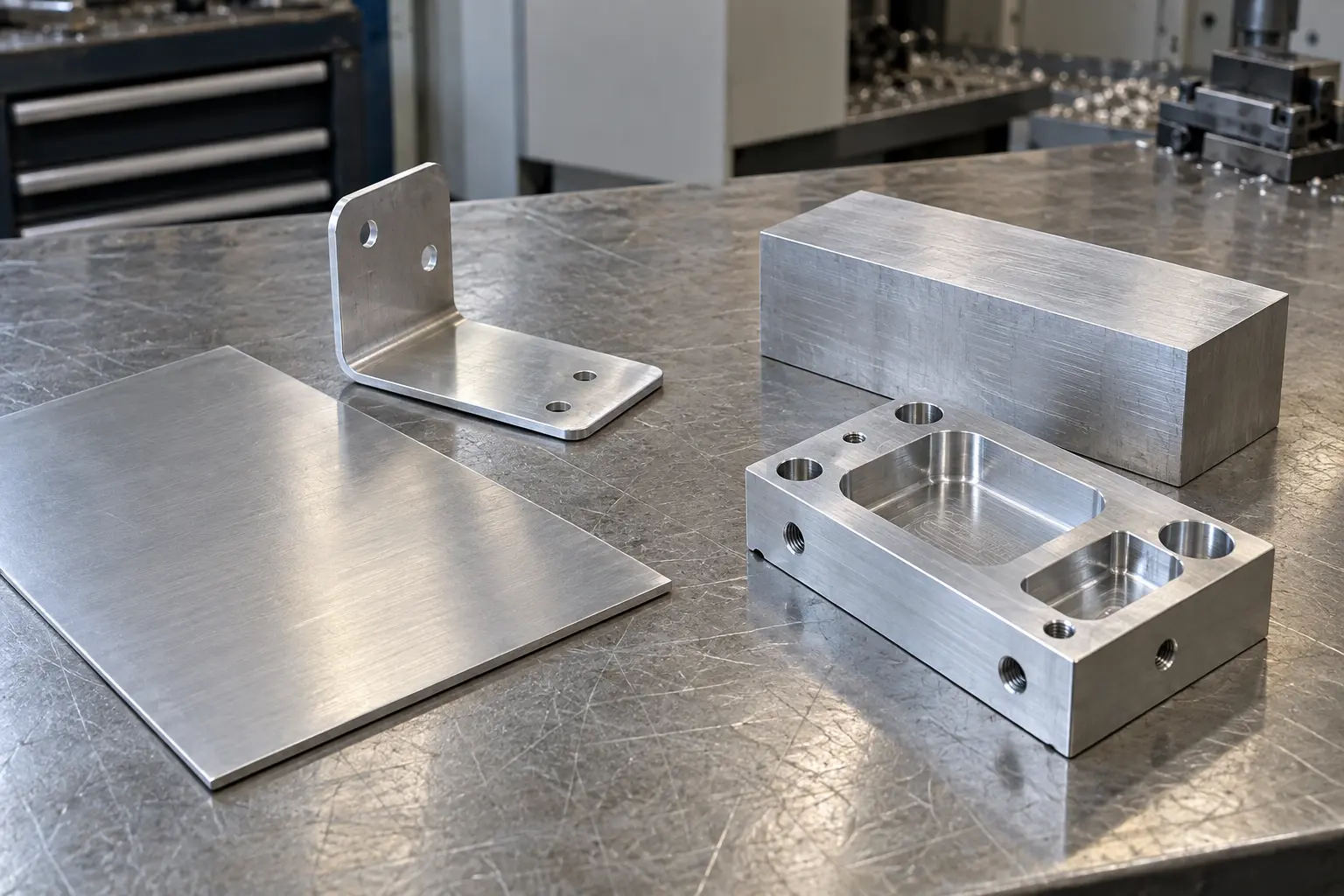
Realistic technical concept image for 5052 vs. 6061 Aluminum: Which Alloy Is Better for CNC-Machined Parts?
Conceptual image created to illustrate the article's technical setup; not an actual VietTech production photograph. Specifications and acceptance follow the drawing/RFQ.
Selection factor50526061
Alloy familyAl-Mg; non-heat-treatableAl-Mg-Si; precipitation-hardenable
Common tempersO, H32, H34O, T4, T6, T651
Relative strengthTemper-dependent; typically below 6061-T6T6/T651 generally stronger than 5052-H32
FormabilityStrong, particularly in softer tempersTemper-dependent; T6 is not suitable for every tight-bend operation
WeldabilityStrongWeldable, but strength reduction in the heat-affected zone requires review
CNC machinabilityMachinable; chip adhesion, burrs, and finish require controlT6/T651 is often more favorable for milled and turned functional features
Corrosion resistanceStrong in many service environmentsSuitable for many environments; actual exposure must be evaluated
AnodizingApplicable; color and appearance depend on lot and processCommonly anodized for mechanical parts and equipment housings
Typical fitFormed or welded sheet componentsFixtures, blocks, housings, brackets, and higher-strength machined parts
04

CNC machining behavior

Machining 5052

5052 is relatively ductile, particularly in soft tempers. During milling or drilling, it may produce long chips, built-up edge, or burrs when cutter geometry, lubrication, and chip evacuation are inadequate. Sharp aluminum-specific cutting edges, low runout, and an open chip path help maintain surface quality. Thin sheet components are also sensitive to clamping force. A part may meet size while constrained but spring into a different shape after release. Stable datum support, distributed clamping, balanced machining where practical, and free-state inspection should be considered when required by the drawing.

Machining 6061

6061-T6/T651 generally provides more favorable chip control and surface generation in precision milling, turning, and drilling. It is a common choice for blocks, housings, fixtures, and parts with bores, pockets, steps, and mounting faces. Aluminum can still adhere to the cutting edge if heat and chip evacuation are not controlled. Heavy one-sided stock removal can distort a 6061 component. The process should balance material removal, maintain uniform finish allowance, and use semi-finishing or stabilization steps when warranted. Tight tolerances must be reviewed together with part size, wall thickness, and inspection conditions.

05

Forming and welding requirements

When a component is formed from sheet, welded, and locally machined, 5052 is often an effective candidate because of its formability and weldability. The minimum bend radius still depends on temper, thickness, rolling direction, tooling, and process. One bend rule should not be applied to every 5052 blank. 6061 can be welded, but welding changes the strengthened condition around the joint. The heat-affected zone may have lower mechanical properties than the T6 base material. Load-bearing or distortion-sensitive assemblies require engineering review of joint design, welding procedure, and postweld condition. A manufacturer should not substitute 6061 for 5052 solely because 6061 has a higher nominal strength.

06

Anodizing and cosmetic requirements

Both alloys can be anodized. Final color, gloss, and uniformity depend on more than the alloy designation. Temper, chemistry within specification limits, machined finish, surface preparation, anodic film thickness, dye, and sealing all contribute to appearance. An RFQ for cosmetic parts should identify the approved color standard or sample, visible surfaces, acceptable variation, electrical contact locations, and masking requirements. Parts visible in the same assembly may also require controlled stock source and lot. Identical anodizing parameters do not guarantee an identical appearance on 5052 and 6061. VietTech performs machining and inspection to drawing requirements. Anodizing is coordinated with specialized processing partners under the agreed technical specification.

07

Tolerance and dimensional stability

Material grade alone does not determine tolerance capability. Initial flatness, stock route, residual stress, material removal, fixture rigidity, process temperature, and inspection method all affect the result. For 5052 sheet, flatness, rolling direction, and clamping distortion deserve particular attention. For 6061 plate or block, the RFQ should identify whether the stock is sheet, plate, bar, or extrusion because product forms follow different requirements and may behave differently. Thin walls, deep pockets, and tight flatness requirements should be reviewed before the process is released. When dimensions apply after anodizing, the drawing should define coated surfaces, masked regions, and how coating thickness is accounted for. This is particularly important for bores, threads, slots, and mating surfaces.

08

Practical selection guidelines

Consider 5052 when the component: Consider 6061 when the component: The final decision must reflect load, environment, joint design, production method, and the material specification. Do not change the alloy or temper without design approval.

  • Is primarily produced from sheet with multiple forming operations.
  • Requires strong weldability and corrosion resistance.
  • Does not require the strength level associated with 6061-T6.
  • Uses enclosure, tray, cover, or formed-bracket geometry.
  • Is milled or turned from plate, block, bar, or extrusion.
  • Contains precision bores, pockets, mounting faces, or multiple functional features.
  • Requires higher strength or rigidity than commonly specified 5052 tempers.
  • Needs a balanced combination of mechanical properties, machining performance, and anodizing.
09

RFQ information checklist

Include the following information in an RFQ: VietTech reviews the material, geometry, stock removal, fixturing, and inspection requirements before proposing a machining approach and quotation. Surface-treatment requirements are translated into clear acceptance criteria for coordination with a qualified partner.

  • Matching 2D drawing and 3D model revisions.
  • Alloy, governing standard, temper, and stock form.
  • Material certificate and lot-traceability requirements.
  • Dimensional tolerances, GD&T, surface roughness, and inspection datums.
  • Anodized surfaces, color, thickness, sealing, masking, and cosmetic criteria.
  • Forming, welding, or assembly requirements after machining.
  • Quantity, first-article plan, and inspection-report requirements.

RELATED PAGES

6061 vs. 7075 Aluminum: Which Alloy for CNC-Machined Parts? ↗Type II vs. Type III Anodizing: Which Finish for a Machined Aluminum Part? ↗

FAQ

Frequently asked questions

Is 6061 always better than 5052?

No. 6061-T6/T651 generally offers higher strength and more favorable cutting behavior, while 5052 is often better for formed and welded sheet components. The functional requirement should drive the choice.

Can 5052-H32 be replaced with 6061-T6 without revising the drawing?

It should not be changed without approval. The alloys have different strengthening mechanisms, properties, forming behavior, welding response, and supply conditions.

Can 5052 be CNC machined?

Yes. Successful machining requires appropriate sharp tooling, chip evacuation, lubrication, burr control, and clamping, especially for soft tempers and thin sheet.

Why must the RFQ identify temper?

Temper materially affects strength, hardness, ductility, bending, and machining behavior. An alloy designation alone does not define the required condition.

Will 5052 and 6061 produce the same anodized color?

Not necessarily. Alloy, temper, initial finish, pretreatment, film thickness, dye, sealing, and lot variation can all affect appearance.

TECHNICAL GUIDE

Request a VietTech review

Send VietTech your 2D drawing, 3D model, material standard, temper, quantity, and surface-treatment requirements. Our engineering team will review machining access, distortion risk, datums, tolerances, and inspection requirements before providing a quotation. ---REQUEST A QUOTE ↗