
RFQ GUIDANCE

CNC First Article Inspection: What to Agree Before Ordering Samples

Define the FAI package in a CNC RFQ: representative samples, ballooned drawings, measurement results, certificates, review responsibilities and release conditions.

01

Start the FAI package with the purchase requirements

First article inspection, or FAI, links design requirements with evidence from a product made using an identified manufacturing process. A common purchasing problem is that both parties agree to sample inspection but mean different things by quantity, finishing condition and required documentation. One expects a dimensional report; the other also expects material evidence, treatment records, photographs and approval before further production. Define that scope in the RFQ. This article focuses on the documentation package and approval hold points, rather than measurement-system qualification or statistical process-capability studies.
02

A first-off check is not automatically a formal FAI

Checking the first part after setup is an operational control for the machine, tools and program before machining continues. A formal FAI typically covers a broader set of requirements, including product configuration, applicable verification evidence and links to the manufacturing process. AS9102 was developed for aviation, space and defence; it does not automatically apply to every machining order. If a customer specifies AS9102C or a particular form, identify it contractually and review the ability to meet it. The term FAI does not establish that VietTech holds aerospace certification, and an ordinary dimensional sheet should not be presented as full compliance with that standard.

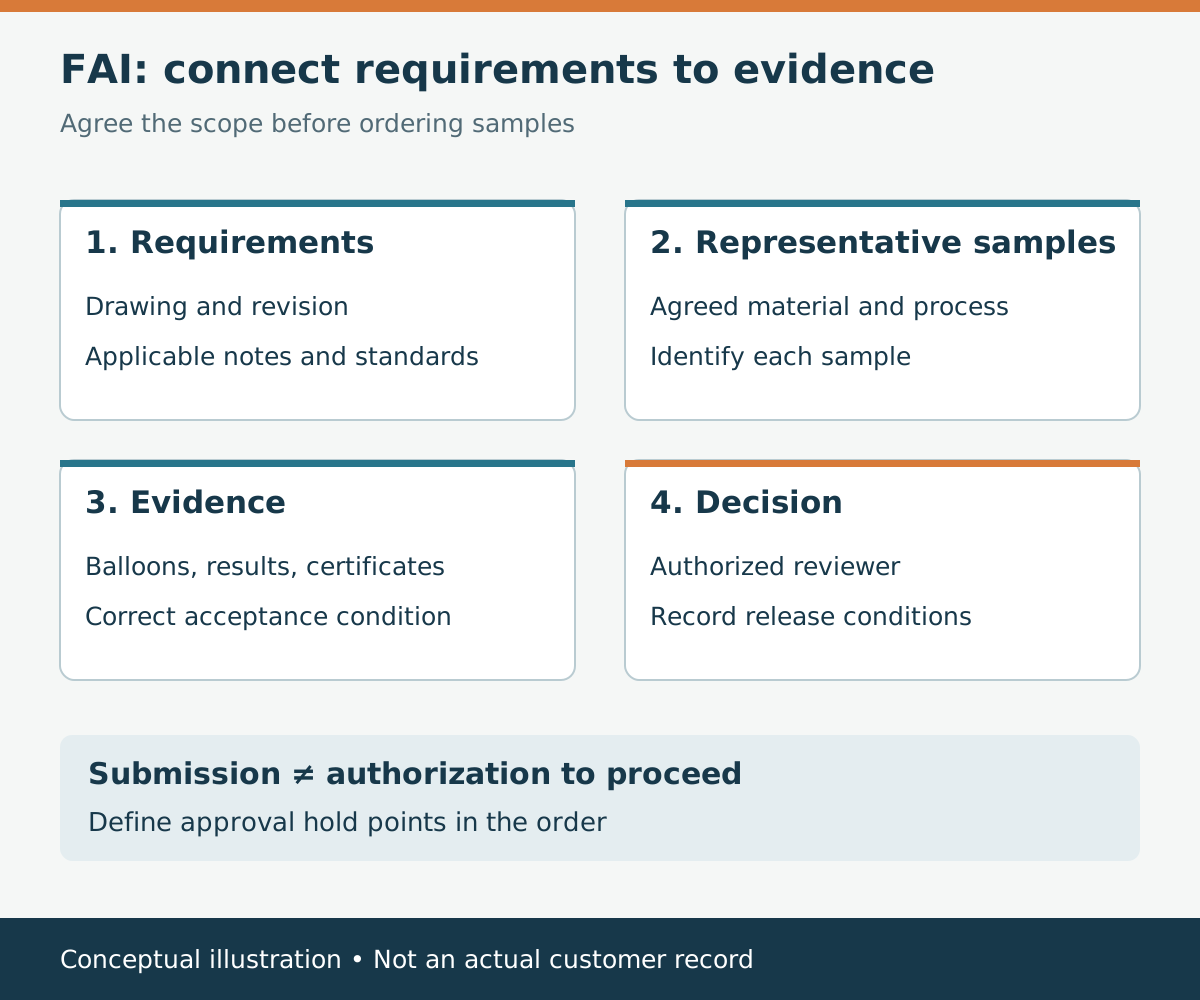
English diagram linking drawing requirements, representative samples, inspection evidence and FAI review decisions
Conceptual illustration: connect requirements, samples and evidence before recording a review decision. This is not a certificate or an actual customer inspection record.
ElementAgree in advanceAvoid
Design requirementsRevision, notes, standards and authoritative dataInspecting to an obsolete drawing
SamplesQuantity, identification, process and final conditionReporting final acceptance before finishing
EvidenceBalloon references, results, certificates and testsFiles that cannot be traced to a requirement
DecisionReviewer, hold points and release conditionsTreating submission as authorization to proceed
03

Choose samples that represent the intended process

Where the purpose is to validate the production route, samples should represent the agreed material, manufacturing methods and finishing operations. A part made by a special one-off method solely to achieve dimensions may not represent the repeat process. Define sample quantity, individual identification, material lot and condition after heat treatment, plating or anodizing. Characteristics that become inaccessible after assembly or processing need verification at the appropriate stage. Destructive testing requires additional quantity and time planning. Do not automatically derive the FAI quantity from a routine lot-sampling table: the two activities serve different purposes.

04

Connect the ballooned drawing, report and evidence

A reviewable package shows where each characteristic is verified, which method is used and which record contains the result. Balloon identifiers should trace applicable requirements, including notes, rather than only the most visible dimensions. Reports for repeated holes or multiple samples must distinguish both feature location and individual product. Use the correct units, processing condition and evaluation quantity. Hole-centre coordinates, for example, do not by themselves replace a positional-tolerance result relative to the specified datums. Do not invent plus/minus limits for boxed basic dimensions. Resolve missing acceptance criteria before issuing a conclusion.

Measurement data

Record actual results as required. Never substitute nominal values for measurements, or product photographs for dimensional evidence.

Supporting documents

Match material, condition, lot and treatment scope to the actual sample. A correctly named file is insufficient if its coverage does not match.

05

Define hold points and nonconformance handling

If sample approval is required before series production or shipment, identify the authorized reviewer, response channel and operation that must wait. Emailing or uploading a package, or receiving confirmation of receipt, is not automatically technical approval. For a deviation, record the characteristic, actual result, affected scope and proposed disposition. Do not alter the design requirement to make a failing result appear acceptable. Any approved concession needs a defined scope, such as a sample, lot or validity period, and must not silently carry over to later orders. Document responsibility for evaluating conformity and authorizing the next step.

06

Assess what needs revalidation after a change

A revision change, different material, a new treatment source or a process change can affect existing evidence. Before reusing an earlier package, compare the new requirements with the configuration and route previously evaluated. Whether full or partial reinspection is needed depends on the contractual standard, customer requirements and change impact. Not every tool change demands a complete new FAI, but retaining the part name does not justify ignoring a significant process change. A follow-up package should identify the earlier baseline, what changed and what additional evidence is provided so the reviewer can understand which previous results remain applicable.

07

RFQ checklist for cost and delivery planning

Provide controlled design data, the FAI requirement and standard edition where applicable, customer forms, sample quantity, documentation language and required review date. List certificates, outside tests, signature requirements and submission channels. Agree whether the sample price includes inspection programming, note review, destructive testing and document revision work. The delivery plan should account for specialist processing and customer review time. VietTech reviews machining and inspection against the drawing; specialized heat treatment and surface finishing are coordinated with partners. Any requirement beyond the confirmed scope must be resolved before a commitment is made.

08

References and application limits

Sources checked on 17 October 2026: IAQG describes the purpose of standardized FAI within the 9102 series; SAE lists AS9102C, revised in June 2023. This article offers practical RFQ planning guidance. It does not reproduce the standard's forms or declare conformity for an unevaluated order. The proposed activities become delivery obligations when incorporated into the applicable requirements. FAI provides evidence for a defined time and scope; it does not guarantee every future part or replace in-process and final inspection.

RELATED PAGES

2D Drawing and 3D Model in a CNC RFQ: Which File Governs When They Differ? ↗Material Certificates in a CNC RFQ: MTC, CoC and Lot Traceability ↗Cp, Cpk, Pp and Ppk in CNC Machining: How to Read Them Correctly ↗How to Request a Quote ↗IAQG — scope of the 9102 standard ↗SAE — AS9102C, revised June 2023 ↗

FAQ

Frequently asked questions

Is AS9102 mandatory for every CNC order?

No. It applies when required by the contract or another applicable specification. Confirm the edition and scope.

Does an acceptable FAI sample prove Cpk capability?

No. FAI and statistical capability studies have different objectives, data structures and acceptance criteria.

Can inspection take place before surface treatment?

Relevant characteristics can be recorded at the appropriate stage, but the final acceptance package must cover the agreed finished condition and requirements.

Can production continue once the report is submitted?

Where an approval hold point exists, obtain the agreed authorization. Receipt confirmation is not approval.

Can an old report be reused after a revision change?

Assess the impact. Unaffected evidence may be referenced when permitted, while changed requirements need suitable verification.

RFQ GUIDANCE

Include first article requirements in your RFQ

Send the drawing, sample quantity, inspection requirements, forms, certificates and approval hold points so VietTech can confirm scope, cost and documentation lead time.REQUEST A QUOTE ↗