
ENGINEERING MATERIALS

NAK55 vs NAK80: Selecting Prehardened Mold Steel for Precision Machining

A practical comparison of NAK55 and NAK80 for machining, mirror polishing, EDM finish, toughness and RFQ preparation without treating the grades as automatic substitutes.

01

What are NAK55 and NAK80?

NAK55 and NAK80 are Daido Steel prehardened mold-steel grades supplied after solution treatment and age hardening. Daido lists a typical supply-hardness range of 37–43 HRC, so the stock can normally proceed to mold machining without an assumed full through-hardening cycle. Both are Ni–Al–Cu precipitation-hardening steels with relatively uniform hardness from surface to core. This common condition can remove one source of distortion compared with machining soft stock followed by hardening, but it does not guarantee zero movement. Unbalanced stock removal, thin sections, welding, EDM and surface processing still require engineering review. The specified grade, producer, supply condition and material certificate should agree across the drawing and purchase documents.
02

The main choice: machining efficiency or critical finish

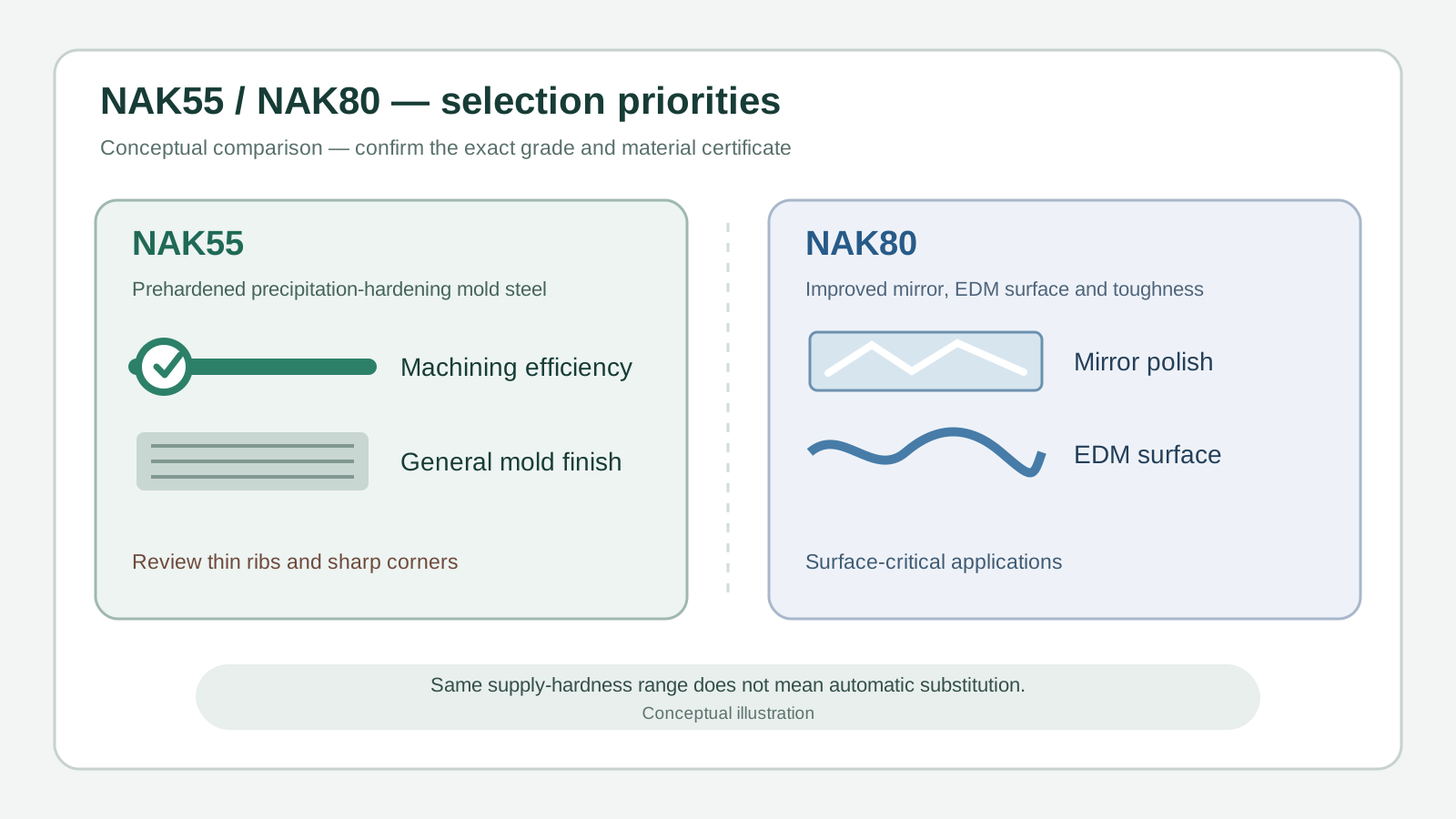
Daido presents NAK80 as an improvement over NAK55 in mirror polishability, EDM surface and toughness. Its published test data also says NAK80 machinability is slightly below NAK55. NAK55 is therefore a logical starting point for general mold components and industrial parts where efficient material removal is more important than an optical-grade surface. NAK80 deserves consideration when transparent molded products, high mirror finish, consistent texturing or an exposed EDM finish drive the design. This is selection guidance, not a substitution rule. Mold life, resin, impact loading, geometry, polishing route and acceptance method can change the decision.

Technical selection diagram comparing NAK55 and NAK80 by machining and surface priorities
Conceptual illustration: NAK55 commonly favors machining efficiency, while NAK80 is considered when mirror polish and EDM surface are critical. This is not an actual VietTech material or production photograph; confirm against the drawing and certificate.
CriterionNAK55NAK80
Supply conditionAge-hardened, typically 37–43 HRCAge-hardened, typically 37–43 HRC
MachinabilityRelative advantage in supplier testsMachinable, but slightly below NAK55
Mirror finishSuitable for many standard mold surfacesImproved for demanding mirror work
EDM surfaceStriping may occur in some conditionsImproved EDM appearance
ToughnessUse care at thin ribs and sharp cornersImproved over NAK55
03

The same hardness does not make the grades identical

Two steels near 40 HRC can still differ in composition, microstructure, toughness, polishing response and EDM behavior. A hardness check alone does not identify the grade. Do not replace NAK80 with NAK55 merely because both are prehardened and have similar HRC values. A substitution requires functional review and controlled approval from the design authority. Incoming material should be checked against the lot certificate, stock size, supply condition and identification. Brochure values are representative rather than guaranteed for every section and source.

04

Planning CNC machining around 40 HRC

Prehardened steel needs a rigid tool–holder–machine system, short overhang and a toolpath that avoids sudden load changes. Tool grade, coating, speed, feed and depth of cut must follow the actual cutter maker's guidance and the setup; parameters copied from annealed P20 or SKD are not a sound basis. Deep pockets require chip evacuation and controlled corner stock. Separate roughing and finishing tools help protect texture and dimensional consistency. VietTech reviews geometry, certified hardness, depth, corner radii, roughness and quantity for each RFQ rather than applying a universal cutting recipe.

Balance stock removal

For plates and blocks with heavy removal, distribute stock and sequence faces to reduce movement after unclamping.

Separate roughing and finishing

Finishing needs uniform allowance and a stable tool rather than a worn roughing cutter carried into the final surface.

05

Specify polishing, texturing and EDM separately

A note such as polished surface is not enough for quotation or acceptance. Identify the area, finish grade or master sample, viewing condition and unacceptable defects. For EDM, define whether the EDM texture remains, which layer must be removed and the final dimensional requirement. Daido notes that NAK80 can produce a finer EDM surface, while NAK55 may show stripe patterns in some conditions. Actual results still depend on the machine, electrode, dielectric, settings and finishing. Supplier examples should never be converted into a guaranteed Ra or mirror grade without an agreed acceptance method.

06

Weld repair and surface treatment need approval

Daido provides build-up welding guidance, but mold repair is specialist work because the heat-affected zone, hardness, texture color and dimensional movement can affect the part. Approved filler and procedure are required. Surface processes such as ferritic nitrocarburizing may improve wear, but treatment temperature and dimensional change must be evaluated. VietTech performs CNC machining and inspection within confirmed capability; specialist welding, heat treatment and surface processing are coordinated with suitable partners when specified.

07

RFQ checklist for NAK55 or NAK80

Submit the controlled 2D PDF and STEP model, identify the exact grade and state whether substitution is allowed. Mark mirror areas, EDM regions, textures, thin ribs, sharp corners, threads and deep holes. Define certificate, hardness, final inspection, rust protection and process ownership. For molds, resin, expected production and product-surface needs can be relevant, but confidential details should be limited to what is necessary under the applicable agreement. Avoid a vague note such as NAK steel or approximately 40 HRC.

  • NAK55 or NAK80 and producer/purchasing specification
  • Controlled 2D drawing and STEP revision
  • Mirror, texture and EDM zones
  • Hardness, certificate and substitution policy
  • Heavy stock removal, ribs, corners, holes and threads
  • Quantity, inspection, rust protection and delivery
08

Sources and limits

This article uses Daido Steel's NAK55/NAK80 datasheet, including the published 37–43 HRC supply condition, precipitation-hardening system, relative machining, polishing and EDM behavior, and its toughness caution for NAK55. Mechanical data, tool-wear graphs and welding parameters are representative conditions, not universal guarantees. Final selection must follow the current certificate, stock size, design, life requirement, finishing route and design-owner approval.

RELATED PAGES

SKD11 vs. SKD61: Which Tool Steel Should You Select for a Precision-Machined Part? ↗Material Certificates in a CNC RFQ: MTC, CoC and Lot Traceability ↗How to Request a Quote ↗

FAQ

Frequently asked questions

Do NAK55 and NAK80 have the same hardness?

Both are commonly supplied at 37–43 HRC by Daido, but similar hardness does not make them equivalent grades.

When is NAK80 preferred?

When mirror finish, consistent texturing, EDM appearance or improved toughness is a defined requirement.

Is NAK55 easier to machine?

Daido's representative tests give NAK55 a relative machinability advantage; actual performance depends on tooling, rigidity and geometry.

Must NAK55 or NAK80 be hardened after machining?

Not by default. They are supplied prehardened; any additional treatment requires an approved design and process.

What does VietTech need for quotation?

Controlled 2D/3D data, exact grade, stock condition, finish zones, tolerances, quantity and required material records.

ENGINEERING MATERIALS

Need a NAK55 or NAK80 part reviewed?

Send the drawing, model, exact grade, supply condition, finish requirements, tolerances and quantity. VietTech will review CNC machining, workholding and inspection before quotation.REQUEST A QUOTE ↗