
TECHNICAL GUIDE

SKD11 vs. SKD61: Which Tool Steel Should You Select for a Precision-Machined Part?

Compare SKD11 and SKD61 by operating temperature, hardness, wear resistance, toughness, heat treatment, and precision-machining requirements.

TECHNICAL GUIDETECHNICAL CONCEPT IMAGE
01

Overview

SKD11 and SKD61 are both JIS tool-steel grades, but they are designed for different operating conditions. SKD11 is a cold-work tool steel selected primarily for hardness and wear resistance. SKD61 is a hot-work tool steel selected for toughness, elevated-temperature strength, and resistance to damage caused by repeated heating and cooling. The selection should therefore not be reduced to which grade can reach the higher hardness. The engineering review must consider operating temperature, impact loading, wear mechanism, part geometry, dimensional tolerances, and the process sequence after heat treatment. A suitable material decision at the design stage can reduce cracking, distortion, edge chipping, and corrective work after machining.

02

What is the fundamental difference between SKD11 and SKD61?

Daido Steel classifies SKD11 as a general-purpose cold-work die steel and SKD61 as a general-purpose hot-work die steel. Proterial describes its SKD11-type grade as a wear-resistant, hardenable cold-work steel, while its SKD61-type grade balances toughness, elevated-temperature strength, and hardenability. D2 and H13 are often used as international reference designations. However, SKD11 should not automatically be treated as identical to D2, nor SKD61 as identical to H13. Chemical-composition limits, manufacturing routes, heat-treatment requirements, and certification may differ. Any substitution should be approved against the specified standard and material certificate. The hardness levels above are planning references only. Acceptance values must be defined by the drawing, operating requirements, and the approved heat-treatment procedure.

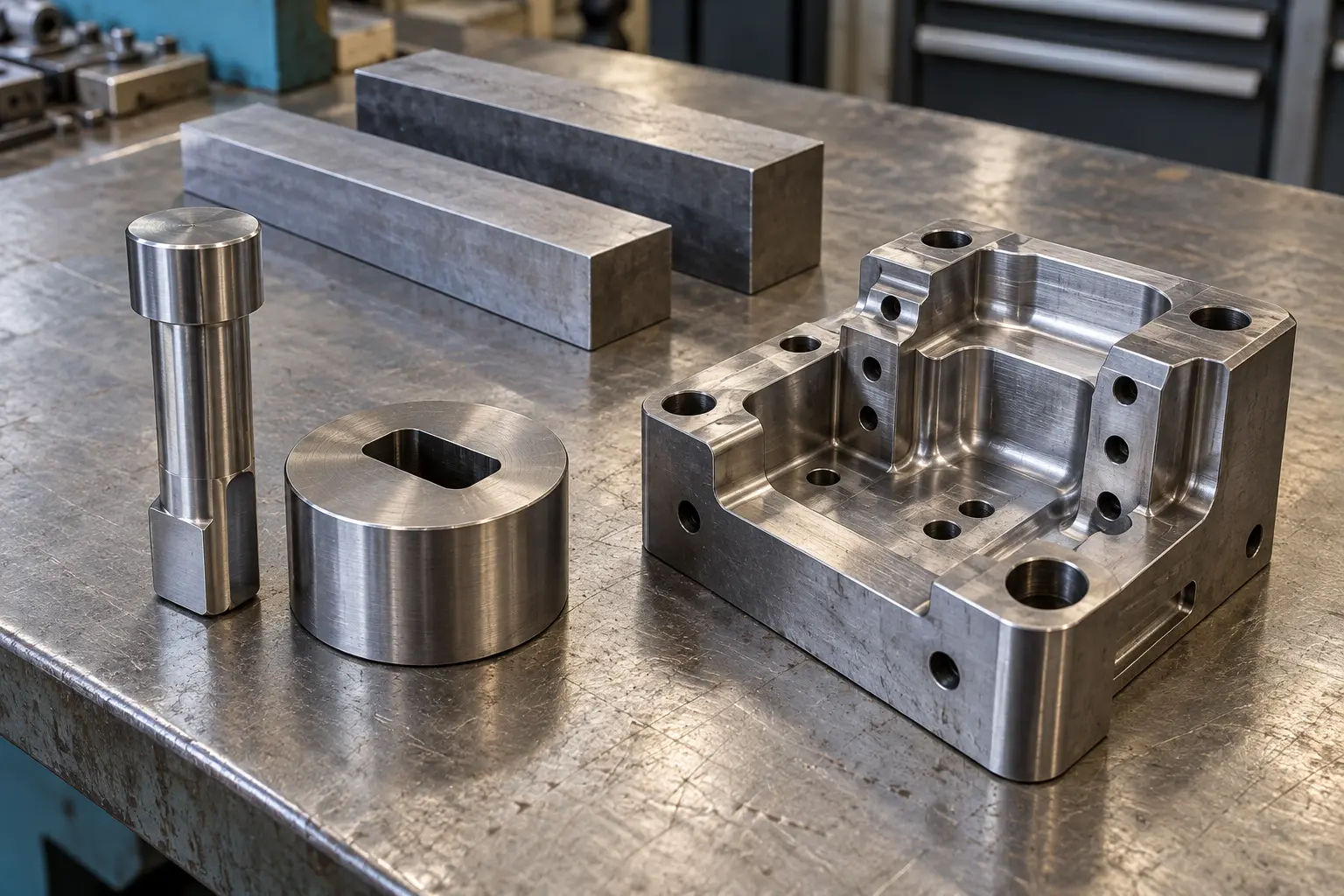
Realistic technical concept image for SKD11 vs. SKD61: Which Tool Steel Should You Select for a Precision-Machined Part?
Conceptual image created to illustrate the article's technical setup; not an actual VietTech production photograph. Specifications and acceptance follow the drawing/RFQ.
Selection factorSKD11SKD61
Material familyCold-work tool steelHot-work tool steel
Typical serviceLow-to-moderate temperature with severe friction or wearThermal cycling, elevated temperature, and impact
Primary strengthsHardness, wear resistance, dimensional stabilityToughness, hot strength, thermal-fatigue resistance
Reference hardened conditionOften specified at approximately 58 HRC or higher, depending on the processOften specified at approximately 50 HRC or higher, depending on the process
Typical applicationsCold-work punches and dies, shear blades, gauges, wear componentsDie-casting dies, hot-forging dies, extrusion tooling, heat-loaded components
Key risks to controlEdge chipping, sharp-corner cracking, difficult machining after hardeningHeat checking, softening in service, thermal-cycle distortion
03

When is SKD11 the more suitable option?

SKD11 is generally appropriate when a working surface is exposed to sliding, cutting, or compressive wear without sustained high-temperature service. Its high-carbon and high-chromium composition supports high hardness and wear resistance after heat treatment. Common applications include blanking punches and dies, shear blades, forming rolls, gauges, and wear-guiding components.

Prioritizing wear resistance

If the primary failure mode is progressive wear that increases clearance or changes the working profile, SKD11 may offer the better starting point. High hardness, however, does not guarantee impact resistance. Abrupt section changes, small internal radii, and holes close to an edge can create stress concentrations and require careful design review.

Machining considerations

Most stock removal should be completed in the annealed or specified supplied condition. Features that will be difficult to access after hardening should be planned before heat treatment, while controlled machining allowance should remain on surfaces that require grinding or wire EDM afterward. Tight-tolerance parts also require a defined datum strategy; dimensions measured before hardening do not by themselves ensure final geometric accuracy.

04

When is SKD61 the more suitable option?

SKD61 is intended for components exposed to elevated temperatures or repeated heating and cooling. It is widely associated with die-casting, hot-forging, and extrusion tooling, as well as inserts and components subjected to thermal loads. Compared with SKD11, it favors toughness and thermal-fatigue resistance over maximum achievable hardness.

Prioritizing toughness and hot strength

When a part is exposed to impact or large temperature gradients, a material selected mainly for hardness can become vulnerable to cracking. SKD61 provides a more appropriate balance of hardness, toughness, and retained mechanical performance at elevated temperature.

Service-condition information matters

The service life of an SKD61 component depends on more than hardness. Corner radii, surface finish, cooling method, working temperature, and heat-treatment quality all influence thermal cracking. An RFQ should identify the heat-contact area, expected cycle conditions, and any surface-treatment requirements.

05

How should machining and heat treatment be sequenced?

Rough machining before heat treatment

CNC milling, CNC turning, and drilling establish the basic geometry. Datum surfaces should be planned so they can be recovered or reused during finish machining. Components with uneven stock removal or strongly asymmetric geometry may require a stress-relief step when specified by the material supplier or heat-treatment specialist.

Allowance for post-heat-treatment finishing

Machining allowance should not be assigned as one fixed value for every part. It depends on size, geometry, target hardness, heat-treatment method, and final tolerance. Thin sections, deep slots, and asymmetric parts are generally more sensitive to distortion. The drawing should identify surfaces that will be ground, surfaces that remain as heat treated, and areas where decarburization is not acceptable.

Finish machining after heat treatment

Critical surfaces may be completed by precision grinding or wire EDM. Grinding is suitable for planar, cylindrical, and low-roughness functional surfaces. Wire EDM is suitable for through-profiles, narrow slots, and geometry that is difficult to produce with conventional cutting tools. For tight geometric tolerances, inspection must verify relationships to the specified datums rather than checking isolated dimensions only. VietTech plans the machining route according to the drawing and material condition. Heat treatment is coordinated with qualified external specialists. VietTech then performs the required finishing and inspection, including coordinate measuring machine (CMM) verification when appropriate for the specified characteristics.

06

What information should an RFQ include?

  • Material grade and governing standard: SKD11 or SKD61, JIS, or another specified standard.
  • Supplied condition and material-certificate requirements.
  • Target hardness, measurement location, and acceptance range.
  • Hardening, tempering, surface-treatment, and masking requirements.
  • Dimensional tolerances, GD&T, surface finish, and datum system.
  • Prototype and production quantities and required inspection documents.
  • 2D drawing, 3D model, and clearly identified critical characteristics.

RELATED PAGES

Steel Hardening and Tempering: Why Hardness Is Not the Only Requirement ↗Wire EDM Explained: When Should It Be Used for Precision Parts? ↗

FAQ

Frequently asked questions

Is SKD11 always better because it can be harder than SKD61?

No. SKD11 is generally selected for cold-work wear resistance. SKD61 is selected for heat exposure, thermal cycling, and toughness. The correct grade is the one matched to the actual failure mechanism.

Can all machining be completed before heat treatment?

That should not be assumed. Heat treatment can change size and geometry. Tight-tolerance surfaces commonly require controlled allowance for grinding or other finishing after hardening.

Can hardened SKD11 be wire-cut?

Yes, when the process route is properly planned. Residual stress, the EDM-affected surface layer, and cracking risk at weak sections or corners must be considered.

Is hardness alone sufficient for SKD61 acceptance?

No. Acceptance should also include dimensions, geometric tolerances, surface condition, and all heat-treatment requirements stated on the drawing.

Does VietTech perform heat treatment in-house?

VietTech machines and inspects the components. Heat treatment is coordinated with specialized partners against the confirmed requirements, followed by post-treatment finishing and inspection as required.

TECHNICAL GUIDE

Request a VietTech review

If you are evaluating SKD11, SKD61, or another tool-steel grade, send VietTech your 2D drawing, 3D model, hardness requirement, quantity, and inspection requirements. We will review the full route—from rough machining and coordinated heat treatment to grinding, wire EDM, and final inspection—before preparing a manufacturing quotation. ---REQUEST A QUOTE ↗