
ENGINEERING MATERIALS

Unfilled PEEK, GF30 or CF30: Which grade should you specify?

Choose a PEEK grade by stiffness, mating surfaces, electrical function and stock orientation, rather than assuming reinforcement improves every property.

01

Choosing PEEK is only the first decision

PEEK identifies the polymer family, not a complete machining-stock specification. Unfilled, glass-fibre-reinforced and carbon-fibre-reinforced grades can behave differently in stiffness, deformation under load, electrical properties and contact surfaces. This guide starts after the PEEK family has been selected; it does not repeat the broader POM-versus-PEEK comparison. In purchasing language, “virgin” may describe non-recycled resin rather than the absence of fillers. Specify unfilled explicitly when that is the design requirement.
02

What do GF30 and CF30 mean?

GF denotes glass fibre and CF denotes carbon fibre. The number 30 commonly denotes 30% reinforcement by mass for the published grade. Confirm the designation in the manufacturer’s datasheet for the actual stock form. Similar shorthand does not make products interchangeable: resin, additives and manufacturing routes may differ. Injection-moulded test data is not automatically a guaranteed property of a component machined from extruded rod. Link the order to the approved grade, supplier documentation and substitution rules.

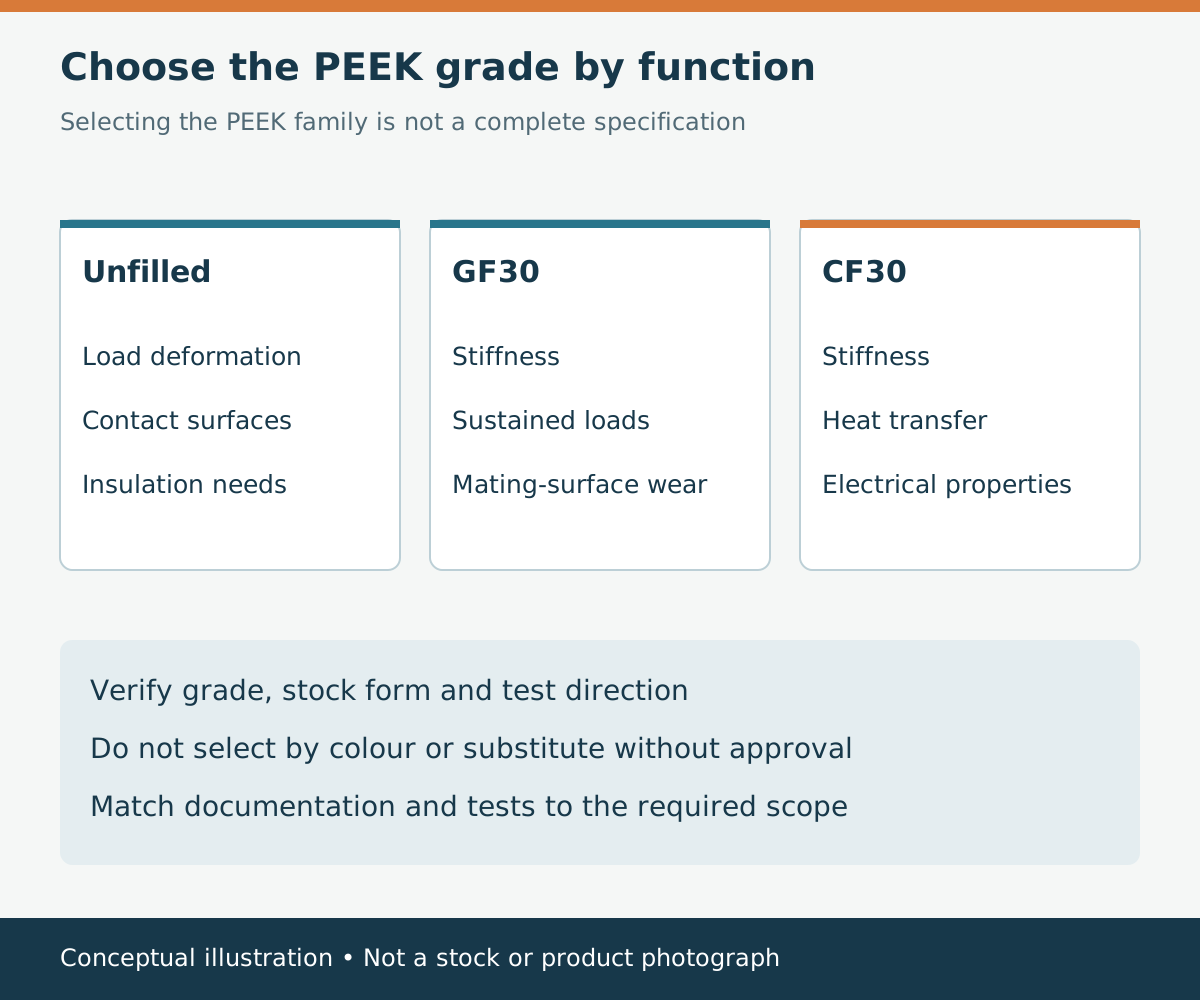
Three PEEK grade-selection branches for unfilled, GF30 and CF30 with checks for the intended function
Conceptual illustration of grade selection, not stock colour, a micrograph or an actual VietTech product.
03

Compare functions, not a single “best” ranking

Reinforcement can improve stiffness and sustained-load performance, but it does not improve every requirement simultaneously. Use this table to ask design questions, not as guaranteed material data. Compare test method, temperature, direction and duration of loading. A room-temperature tensile value alone can miss the condition that governs the component.

PEEK gradeEvaluateDo not assume
UnfilledLoad deformation, contact surface, insulationEvery grade is food-contact or medical compliant
GF30Stiffness and mating-surface interactionSuitability for every sliding bearing
CF30Stiffness, heat transfer and electrical propertiesAutomatic ESD compliance or insulation
04

Sliding contact and electrical function need separate checks

A static support and a sliding bush may need different grades despite identical dimensions. Fibres exposed by machining can affect the mating part. Consider its material and finish together with load, sliding speed and lubrication. Ensinger warns that GF30 may abrade mating surfaces, while its CF30 grade has different friction and heat-transfer advantages. Such guidance does not replace evaluation of the actual contact pair.

Black colour is not an ESD specification

Colour does not establish electrical resistance or static-dissipative behaviour. Specify the required property, conditions and test method for ESD or insulation. CF30 is not automatically equivalent to a purpose-designed ESD PEEK grade.

Compliance belongs to the exact product

Food-contact, medical and other special requirements must be checked against documentation for the actual grade and scope. Do not transfer one product’s compliance claim to every PEEK material.

05

Stock direction and measurement conditions matter

Fibres and manufacturing history can make properties direction-dependent. If a critical fit lies in a different direction from the datasheet test specimen, consult the stock supplier instead of applying one expansion coefficient to every axis. Define stock orientation, datums and measurement condition before machining. For close fits, distinguish dimensions during inspection from dimensions under operating temperature and load. Typical properties support initial assessment; they do not guarantee a tolerance for every shape or stock lot.

06

Do not copy machining settings between grades

Reinforcement changes the interaction with the cutting edge and tool wear. Assess tooling, chip evacuation, clamping and edge condition for the actual grade rather than reusing an unfilled-PEEK program unchanged. Look for protruding fibres, chipped edges and rubbing, and inspect dimensions after unclamping and stabilization. If particle shedding or cleanliness matters, define acceptance criteria in advance. A glossy surface alone does not prove functional suitability.

07

Stock selection and RFQ checklist

Provide the approved manufacturer and grade, datasheet, stock form, colour requirements if applicable, substitution permissions and lot-traceability documents. State important tolerances, finish, sliding or insulating zones and inspection conditions. Describe temperature, media, load and intended life for design review. VietTech uses this information to assess CNC machining and inspection within its confirmed scope. Availability, special tests and suitability of each grade must be established before order acceptance; no universal stock availability is implied.

08

References and use of this guidance

Reviewed on 18 October 2026 against Victrex PEEK documentation and Ensinger’s GF30, CF30 and machining guidance. Published material benefits are not performance guarantees for a VietTech component. A grade or stock-source change needs approval from the design authority and a decision on revalidation. Start from function, review the correct product documentation, then confirm the part: colour, price and fibre percentage alone are insufficient selection criteria.

RELATED PAGES

POM vs PEEK for CNC Machining: Which Plastic Fits Your Part? ↗Material Certificates in a CNC RFQ: MTC, CoC and Lot Traceability ↗Temperature Effects in Dimensional Inspection: When Should Parts Stabilize? ↗How to Request a Quote ↗Ensinger — TECAPEEK GF30 ↗Ensinger — TECAPEEK CF30 ↗Victrex — PEEK technical datasheets ↗Ensinger — PEEK machining ↗

FAQ

Frequently asked questions

Does virgin PEEK always mean unfilled PEEK?

Not necessarily. State unfilled and the exact grade; virgin can refer only to non-recycled resin.

Are GF30 and CF30 direct substitutes?

No. Design approval must consider mechanical, electrical, thermal, contact and machining requirements.

Does black CF30 necessarily meet ESD requirements?

No. Verify the electrical properties and test conditions for the specific grade and application.

Can moulded-specimen properties guarantee rod-stock performance?

Do not assume equivalence. Use relevant stock-form and direction data or an additional assessment.

ENGINEERING MATERIALS

Send an engineering-plastic RFQ

Provide the proposed PEEK grade, controlled design data, quantities and functional requirements so VietTech can assess stock, machining and inspection scope.REQUEST A QUOTE ↗