
ENGINEERING MATERIALS

POM vs PEEK for CNC Machining: Which Plastic Fits Your Part?

Compare POM and PEEK for machined components by operating temperature, dimensional stability, process considerations and material cost.

ENGINEERING MATERIALSTECHNICAL CONCEPT IMAGE
01

Why compare POM and PEEK?

Both polymers can be machined from rod or plate, but they answer different design needs. POM is often considered for guides, sliding components, bushings and machine parts operating in relatively ordinary conditions. PEEK deserves evaluation when a component faces more demanding temperature or chemical exposure. A white or beige stock color does not establish material identity: pigment, filler, stock process and grade vary. Start a material decision with the actual operating temperature, load, mating surface, fluid exposure and intended service life. The cheapest blank is not automatically the lowest-cost functional part, and a premium polymer does not automatically improve an application that does not need its properties.

02

A practical comparison before requesting a quote

Use this table as a screening guide, then check the datasheet and certificate for the exact grade and stock form. POM copolymer and homopolymer differ; unfilled, fiber-filled and bearing-grade PEEK also differ. Values from one supplier cannot simply be transferred to every lot.

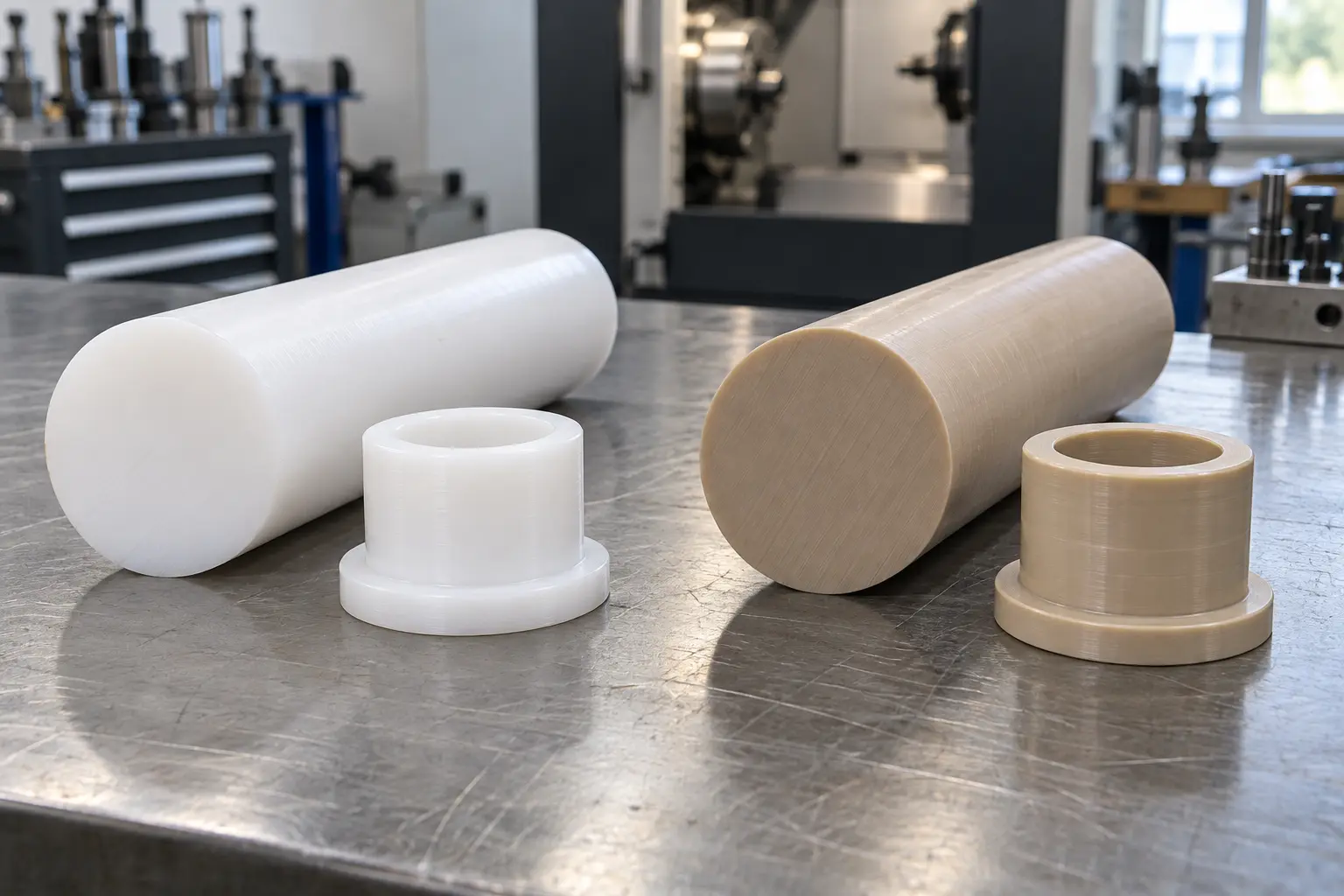
White POM and natural-tan PEEK stock and machined parts on an engineering workbench
Conceptual image created to compare POM and PEEK; not an actual VietTech production photograph. Select the material by grade, service conditions and documentation, not by color alone.
Decision factorPOMPEEKConfirm in the RFQ
Typical fitSliding and structural parts under ordinary conditionsParts exposed to higher heat or demanding mediaLoad, temperature and fluid
CNC machiningGenerally cuts well; control clamping and heatMachinable, but blank value and scrap matter moreStock form, batch size and allowance
Dimensional behaviorGood when temperature and stock stress are controlledGood across a broader thermal range, depending on gradeTolerance and inspection condition
Material costUsually lowerUsually substantially higherCurrent price for the exact stock
TraceabilitySpecify POM-C or POM-H and gradeSpecify unfilled or filled gradeCertificate and lot datasheet
03

Temperature and chemical exposure

PEEK's major advantage is retention of useful properties at temperatures beyond those of many common engineering plastics. Ensinger describes long-term service temperatures of roughly 250–260 °C for certain PEEK grades, but this is not a blanket guarantee for every loaded component. A POM-C datasheet from the same supplier lists around 100 °C for long-term service. Read any number together with time under load, stress, stock form, environment and the design safety margin. Chemical compatibility also needs a defined fluid, concentration, temperature and exposure time. Neither 'chemical resistant' nor 'heat resistant' is a complete specification.

Describe the real medium

State whether the part contacts oil, grease, solvent, hot water, steam or cleaning chemicals. Ask the designer or stock supplier to confirm the exact grade against that exposure.

Substitution needs approval

A suggestion to replace specified PEEK with POM is a design change for the customer to evaluate. Replacing every POM part with PEEK may increase cost without improving the intended function.

04

Milling and turning considerations

A sharp tool and dependable chip evacuation help limit local heat, burrs and surface damage. Plastic can deflect under a fixture: after unclamping, a thin wall may recover and read differently from its clamped condition. Thin sections or large pockets may benefit from staged roughing, a planned finishing allowance and time to stabilize before final inspection. For expensive PEEK stock, nesting, blank selection and risk of scrap deserve attention during quotation rather than after programming. Feed and speed are selected for the actual grade, geometry, cutter, machine and stock condition; there is no universal recipe that fits both materials.

05

Tolerances and inspection

Temperature and residual stress affect plastic dimensions, so agree on inspection conditions before debating a few hundredths of a millimeter. Inspect critical features after the part has stabilized under the agreed procedure. Support the part and choose measurement force so a probe does not indent a surface or bend a wall. For pin holes, plastic threads, sliding faces and flatness, specify datum features and the inspection method. A CMM result or a gauge result depends on how the part is supported. Requiring a very tight tolerance everywhere, including non-functional surfaces, may raise machining and inspection cost without improving assembly performance.

06

Choose by function, then verify the grade

For an ordinary guide bushing, begin with load, sliding speed, lubrication and fit requirements before evaluating POM. For a component near heat or exposed repeatedly to demanding chemicals, evaluate PEEK with the precise grade datasheet and, where justified, testing. A filled POM or PEEK can behave differently from its unfilled base polymer. The polymer family name alone is insufficient when wear behavior, electrical properties or traceability are critical. The designer approves a material change; the machinist can identify process and dimensional risks.

07

What to send VietTech for an accurate RFQ

Provide a revision-controlled 2D drawing, a matching 3D model when available, and a full material designation. State whether you need POM-C, POM-H, unfilled PEEK or a filled grade. If the grade is open, describe temperature, fluid and load so the engineering discussion starts with the application. Add prototype and production quantities, who supplies the blank, critical fits, burr requirements, required material documents, target delivery and inspection scope. VietTech reviews CNC milling or turning and suitable inspection against each drawing; any unusual requirement must be confirmed in the quotation rather than assumed to apply to all parts.

  • Exact grade and stock form
  • Drawing revision and functional tolerances
  • Service condition and documents
  • Quantity, timing and inspection scope

RELATED PAGES

POM vs. Cast Nylon: Which Engineering Plastic for CNC-Machined Parts? ↗How to Specify Materials and Surface Finishes in an RFQ ↗

FAQ

Frequently asked questions

Is PEEK always better than POM?

No. PEEK may suit more demanding heat or chemical conditions, while POM may satisfy the function at a lower cost. Select against the drawing and actual service.

Can color identify the polymer?

No. Color and fillers vary. Verify the grade from stock identification, documents and the supplier datasheet.

Can POM replace specified PEEK?

Only with approval from the customer or authorized designer. Similar machinability does not make the materials interchangeable.

Do PEEK and POM need the same tools?

Tooling, fixturing and chip control depend on the grade and part geometry. Validate the process on the real stock.

Is 'white plastic' enough for a quote?

Not for a firm material quotation. Specify the grade, drawing, quantity, tolerances and document requirements, or describe the service conditions if the grade is still open.

ENGINEERING MATERIALS

Need a POM or PEEK part reviewed?

Send the 2D/3D files, material grade, quantity, functional tolerances and operating conditions. VietTech will review the machining approach and clarify open requirements before quoting.REQUEST A QUOTE ↗