
TECHNICAL GUIDE

QPQ Treatment for Steel Parts: Benefits, Tolerance Effects, and RFQ Requirements

Learn how QPQ treatment works, its compound and diffusion layers, wear and corrosion performance, dimensional effects, inspection, and RFQ requirements.

TECHNICAL GUIDETECHNICAL CONCEPT IMAGE
01

Overview

QPQ is often described simply as a black finish for steel components, but that description is incomplete. It is a surface-engineering sequence based on ferritic nitrocarburizing, followed by polishing and post-oxidation. The objective is to create a functional surface with improved wear, scuffing, and seizure resistance, together with corrosion performance suitable for the specified environment. QPQ is not black paint, black oxide, conventional plating, or through hardening. Diffusion and chemical reactions modify the near-surface region. The substrate, prior heat treatment, pre-process roughness, dimensional requirements, and inspection method must therefore be defined before an order is placed.

02

What is QPQ?

QPQ refers to a “quench–polish–quench” sequence. In industrial practice, a ferrous component undergoes ferritic nitrocarburizing, an intermediate cooling or oxidation stage, polishing, and final post-oxidation. Trade names and detailed cycles vary among suppliers, so a drawing should identify the accepted specification or required performance instead of stating only “black QPQ.” The treated surface normally includes: The outer oxide produces the characteristic dark appearance and can support corrosion resistance. Color alone, however, does not confirm compound-layer thickness, diffusion depth, or surface hardness.

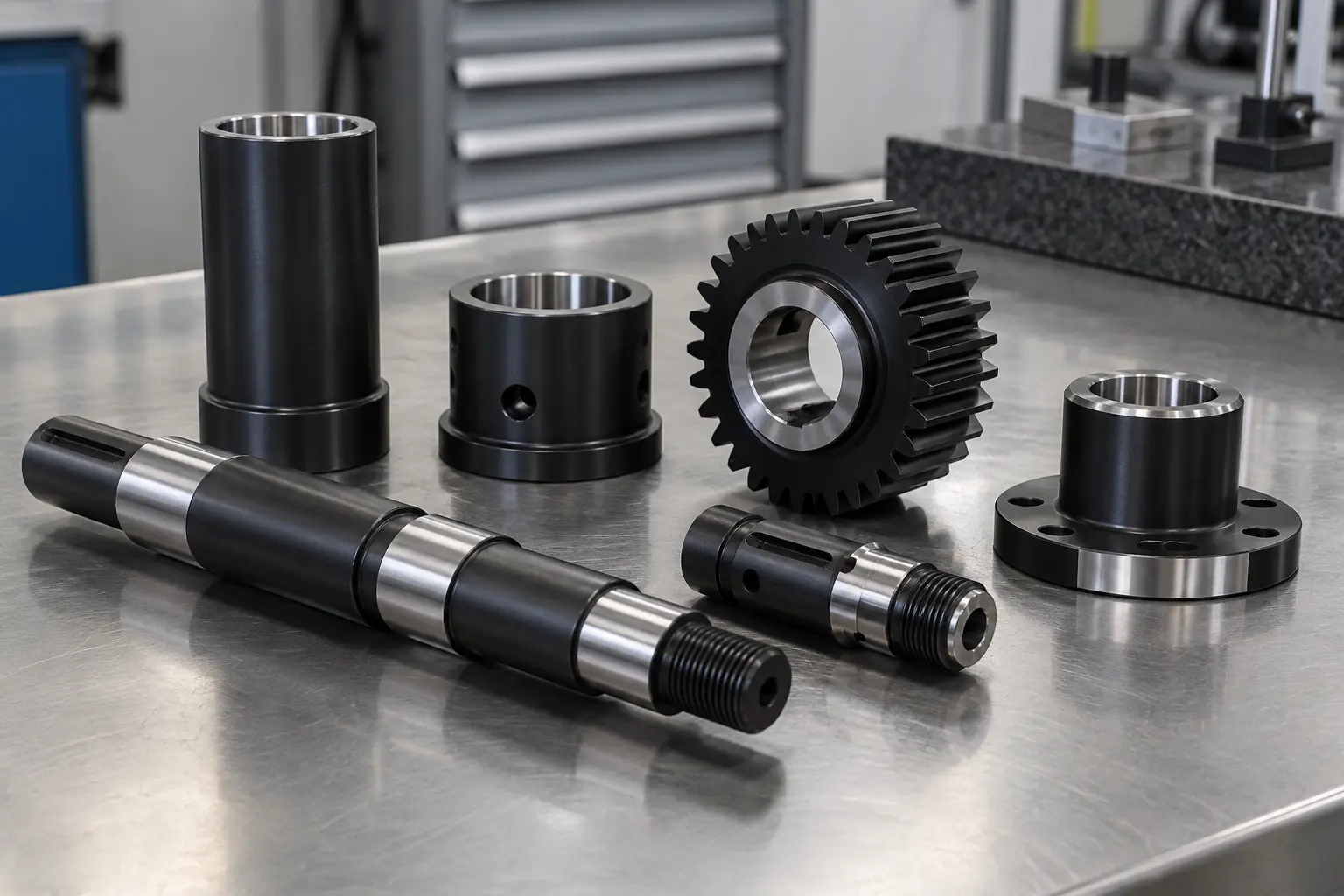
Realistic technical concept image for QPQ Treatment for Steel Parts: Benefits, Tolerance Effects, and RFQ Requirements
Conceptual image created to illustrate the article's technical setup; not an actual VietTech production photograph. Specifications and acceptance follow the drawing/RFQ.
  • A compound layer at the surface, which contributes to wear and friction behavior.
  • A diffusion zone beneath it, where nitrogen diffuses into the substrate and may support load capacity and fatigue performance, depending on the steel and process.
03

What benefits can QPQ provide?

Wear and seizure resistance

The nitrocarburized surface is harder than the base material and can improve resistance to wear and adhesive damage. QPQ is therefore considered for shafts, pins, bushings, sliding components, cams, and repeatedly contacting mechanisms. Actual performance still depends on the material pair, load, lubrication, temperature, and roughness. QPQ should not be treated as a universal answer to every wear mechanism.

Corrosion performance

Post-oxidation and the resulting surface condition can improve corrosion behavior compared with unprotected steel. A salt-spray result must not be assumed to predict every service environment. Sharp edges, deep holes, mating areas, scratches, and any final polishing operation can change performance.

Relatively low distortion

Ferritic nitrocarburizing operates below the temperatures used for many martensitic hardening routes. Because the complete section is not quenched through a conventional phase transformation, distortion risk is often lower. It is not zero: residual stress, thin or long geometry, asymmetric sections, and prior heat treatment can still cause movement.

04

How does QPQ affect dimensions and roughness?

QPQ is a diffusion process rather than a thick build-up coating. Nevertheless, the compound layer, oxide, intermediate polish, and original surface condition may change the measured size. Bores, shaft diameters, threads, and narrow fits should therefore have tolerances defined after treatment. Intermediate polishing reduces roughness peaks and prepares the surface for final oxidation. The polishing method, removal amount, and accessibility differ between external surfaces, deep bores, and narrow grooves. One Ra value should not be imposed on every surface without reviewing process and measurement feasibility.

FeaturePotential effectDrawing/RFQ instruction
Fits and diametersSize may change during treatment and polishingState post-QPQ tolerance and functional surfaces
ThreadsSurface condition or residue may affect assemblyDefine treatment, masking, and post-process gauge check
Deep bores/groovesCleaning and polishing access may be limitedIdentify critical areas and cleanliness requirement
RoughnessDepends on pre-QPQ machining and polishingState whether Ra applies before or after QPQ
Sharp edgesMay affect surface continuity and appearanceIdentify functional edges and edge-break requirement
05

Material and prior condition

QPQ can be applied to many carbon steels, alloy steels, and cast irons, but they do not produce identical results. Alloy content affects surface hardness, diffusion depth, and compound-layer response. Stainless steels or substrates with a passive film require specialized processing and should not automatically use the same cycle as carbon steel. If the component needs core strength, that property must come from material selection and prior heat treatment. QPQ primarily modifies the surface and does not replace through-section mechanical requirements. The process temperature must also be compatible with the previous tempering condition to avoid unintended changes in base-material properties.

06

How should QPQ quality be inspected?

Checking only the black appearance is insufficient. Depending on service requirements, an inspection plan may include: Destructive examinations normally require a witness coupon or sample component. The RFQ should define frequency, section location, and acceptance criteria before production.

  • Visual condition, color consistency, and scratches.
  • Dimensions, GD&T, and functional gauge checks after treatment.
  • Roughness on functional surfaces.
  • Surface hardness or microhardness using an agreed method.
  • Compound-layer thickness and diffusion depth on a representative specimen.
  • Corrosion or wear testing when required by the specification.
07

Suggested manufacturing sequence

A typical route may include rough machining, stress relief when justified, near-final machining, cleaning and QPQ, followed by dimensional and visual inspection. If grinding or polishing is required after QPQ, the permitted removal must be defined because excessive stock removal can reduce or remove the functional surface zone. VietTech provides CNC turning, CNC milling, precision grinding, wire EDM, and dimensional inspection. QPQ is coordinated with a suitable surface-treatment partner to the agreed order requirements. VietTech does not apply one default QPQ condition to every material or component.

08

QPQ RFQ checklist

  • Material grade, standard, and incoming heat-treatment condition.
  • 2D drawing, 3D model, quantity, and service environment.
  • Mandatory process/specification or target performance.
  • Surface hardness, case depth, and test method when required.
  • Treatment and masking areas, including threads and precision bores.
  • Post-treatment dimensions, GD&T, and roughness.
  • Appearance, color, and approved sample requirements.
  • Process certificate, inspection report, and lot traceability.

RELATED PAGES

Nitriding vs Carburizing: Which Process Fits Your Machined Part? ↗How to Specify Materials and Surface Finishes in an RFQ ↗

FAQ

Frequently asked questions

Is QPQ the same as black oxide?

No. Black oxide is primarily a very thin conversion finish. QPQ combines nitrocarburizing, polishing, and oxidation to modify functional surface properties.

Can QPQ distort a component?

Yes, although distortion is often lower than with many high-temperature hardening routes. The result depends on material, residual stress, geometry, and process control.

Can a QPQ surface be ground afterward?

Sometimes, but removal must be limited. Deep grinding can remove the compound layer or reduce the useful diffusion zone.

Does uniform black color prove that QPQ meets the requirement?

No. Color represents only part of the surface condition. Hardness, layer depth, dimensions, and corrosion performance require separate acceptance criteria.

Does VietTech perform QPQ in-house?

VietTech coordinates QPQ through a specialized partner and manages machining and inspection requirements within the agreed order scope.

TECHNICAL GUIDE

Request a VietTech review

Send the drawing, 3D model, steel grade, QPQ areas, required hardness or case depth, and post-treatment tolerances. VietTech will review the machining sequence, masking, inspection feasibility, and documentation before coordinating a quotation. ---REQUEST A QUOTE ↗