
ENGINEERING MATERIALS

SCM415 vs SCM420: Selecting Carburizing Steel for CNC Parts

A practical comparison of SCM415 and SCM420 covering carbon range, core response, carburizing, distortion, grinding allowance and RFQ requirements.

01

What are SCM415 and SCM420?

SCM415 and SCM420 are chromium–molybdenum low-alloy steels for machine structural use under JIS G 4053. They are commonly considered for gears, shafts, pins, cams, bushings and other components that need a wear-resistant case with a load-bearing core. Parts may be machined in a suitable supplied condition and then carburized, quenched and tempered to an approved route. Daido Steel's published product data lists 0.13–0.18% carbon for SCM415 and 0.18–0.23% for SCM420. That difference can influence the heat-treated core response, but it is not a complete selection rule. Section size, hardenability, stock condition, required case depth, service load and distortion allowance must be reviewed together.
02

The grade number is not a guaranteed property

SCM420 has a higher published carbon range and may trend toward a higher core hardness and strength response than SCM415 under comparable conditions. The trade-off can include different sensitivity to cracking, distortion and finishing. SCM415 may suit a design that prioritizes a more ductile core, but this is not automatic. Chromium, molybdenum, section size and actual quenching conditions also matter. Brochure data do not guarantee the final part. Acceptance must follow the contract standard, material certificate, heat-treatment record and required tests. Never substitute SCM415 and SCM420 solely because one stock size is easier to buy.

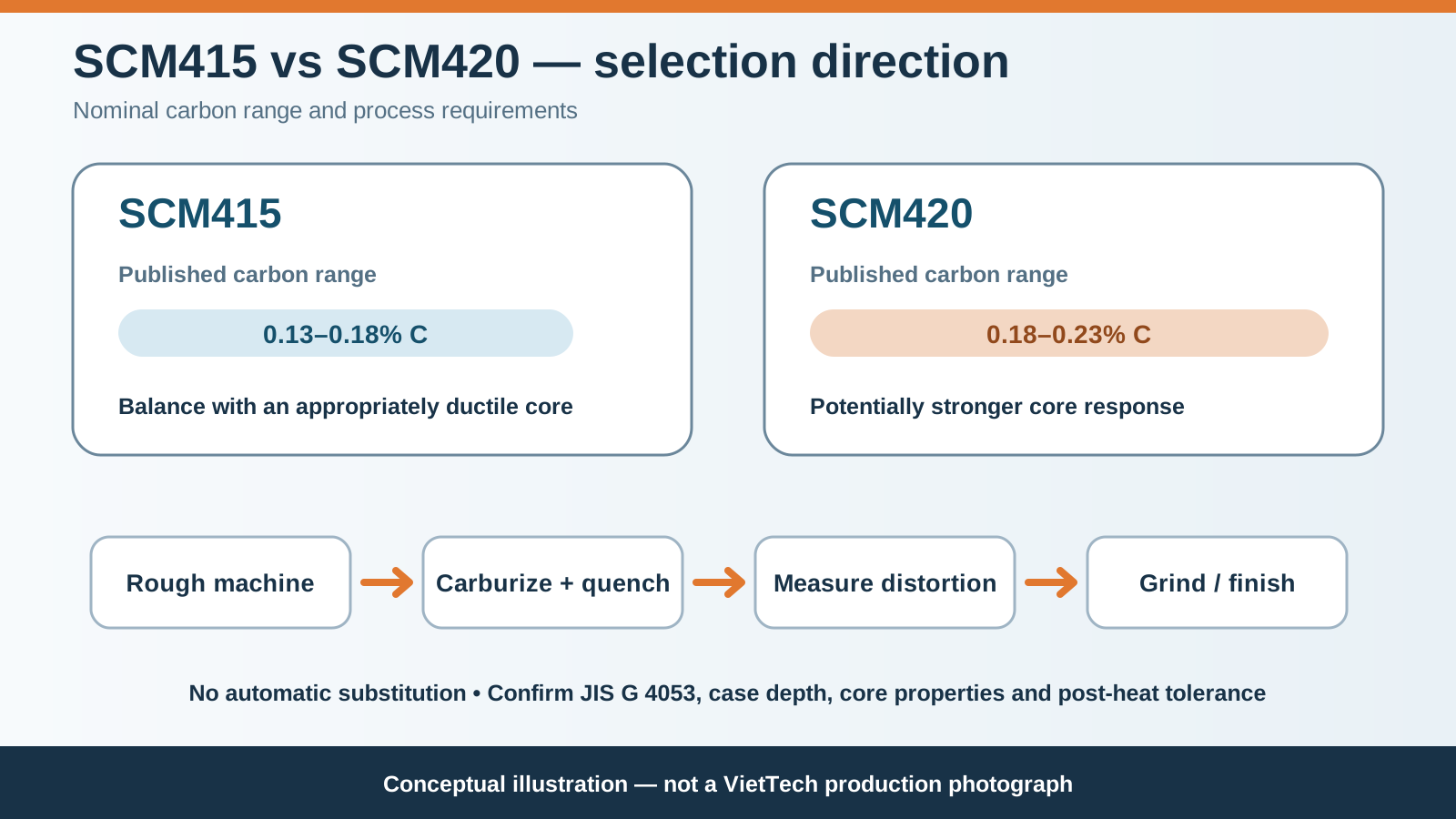
English technical diagram comparing SCM415 and SCM420 carburizing steels
Conceptual illustration: SCM415 and SCM420 mainly differ in nominal carbon range and resulting core response. Final selection follows the drawing, standard and approved heat-treatment route.
CriterionSCM415SCM420RFQ implication
Carbon in Daido data0.13–0.18%0.18–0.23%Do not infer final properties from carbon alone
Steel familyCr–Mo machine structural steelCr–Mo machine structural steelState JIS G 4053 and edition
Typical design directionHard case with an appropriate ductile coreHard case with potentially stronger core responseDefine load, case depth and core requirement
After carburizing and quenchingDistortion risk remainsDistortion risk remainsPlan allowance and final acceptance state
InterchangeabilityNot automaticNot automaticDesign-owner approval required
03

Design the case and core as one system

Carburizing enriches the surface with carbon before quenching, enabling a harder wear-resistant case than the core. A drawing should therefore define more than surface hardness. State the treatment, effective or total case-depth definition, test location, surface-hardness range, core requirement and areas to be protected from carburizing. An excessively shallow case may be lost during grinding; an unnecessarily deep case adds time and can increase distortion risk. Threads, narrow grooves, sharp corners and thin sections may respond differently from heavy sections. If a sectioned coupon is required, define its quantity, representative location and evaluation method. A surface HRC reading alone does not demonstrate case depth or core condition.

04

Machining sequence controls final tolerance

A possible route is stock preparation, rough machining, stress relief where needed, semi-finishing, carburizing–quenching–tempering, cleaning, controlled straightening and grinding or final machining of functional surfaces. This is only a framework. Before heat treatment, distribute allowance and avoid abrupt section changes where design permits. Post-heat-treatment datums need enough stock to restore geometry without removing the required effective case. Threads, keyways and no-case surfaces may require protection or later machining under the heat treater's qualified procedure. VietTech reviews datums, allowance and inspection from the drawing; specialist carburizing is coordinated with a suitable partner.

Before treatment

Confirm datums, stock allowance, protected areas, sharp edges and features that cannot be corrected later.

After treatment

Measure distortion, re-establish datums and remove only the material necessary while retaining the specified case.

05

There is no universal grinding allowance

Bending, ovality, flatness and runout change depend on geometry, mass distribution, residual stress, furnace loading and quench conditions. A long shaft behaves differently from a thin gear or uneven bushing. Grinding stock must be sufficient to restore size and geometry while preserving case depth. For new or tight-tolerance parts, a pilot lot measured before and after treatment is the most defensible way to establish distortion and allowance. Drawings should identify post-treatment runout, cylindricity or flatness, the measurement datum, support condition and final surface state.

06

Machining and inspection considerations

Before treatment, machinability depends on supplied hardness, microstructure, product form and surface condition. Cutting data must follow the actual tool, machine, material and setup rather than copied SCM440 values. After treatment, cylindrical, surface or internal grinding is selected by geometry and retained case requirements. Dimensional inspection should follow cleaning and thermal stabilization. Surface hardness, core hardness and case depth are different evaluations and may require separate equipment and specimens. A CMM supports positional and geometric checks but does not automatically replace roundness equipment, indicators, gauges or hardness testing.

07

RFQ checklist

Identify SCM415 or SCM420, JIS G 4053 edition, stock form, supply condition and certificate. Submit the controlled 2D PDF and 3D model, mark carburized and protected areas, define hardness, case depth and evaluation method, and state all final dimensions and GD&T after treatment. Identify grinding surfaces, restricted removal and no-indent zones. If an equivalent is allowed, define the comparison and approval route. Include pilot quantity, repeat volume, inspection report, heat-treatment certificate, lot traceability and rust-protection packaging.

  • Exact grade, JIS G 4053 edition and supply condition
  • Certificate and substitution policy
  • Carburized/protected areas, hardness and case depth
  • Post-treatment dimensions and GD&T
  • Grinding surfaces, allowance and roughness
  • Quantity, coupons, reports and lot traceability
08

Sources and limits

This article was checked against JIS G 4053:2026 in the Japanese Standards Association catalogue, Aichi Steel's alloy-steel product range and Daido Steel's published SCM415/SCM420 composition data. The carbon ranges are manufacturer data, not a guarantee for every source or certificate. No universal carburizing cycle, hardness, temperature, time or case depth is prescribed here. VietTech performs CNC machining, grinding and inspection within confirmed capability; specialist heat treatment is coordinated with qualified partners. Grade or heat-treatment changes require design-owner approval.

RELATED PAGES

Nitriding vs Carburizing: Which Process Fits Your Machined Part? ↗Stress Relieving After Rough Machining: When Is It Needed for Precision Parts? ↗When Is Precision Grinding Required After Heat Treatment? ↗How to Request a Quote ↗

FAQ

Frequently asked questions

Is SCM420 always better than SCM415?

No. The higher carbon range is only one factor; load, core toughness, section, case depth and distortion govern selection.

Can SCM420 replace SCM415 when stock is unavailable?

Not automatically. Functional review and design-owner approval are required.

Is surface hardness enough on the drawing?

No. Define case depth, core requirement, test method, treated areas and final dimensional state.

Must a carburized part be ground?

It depends on tolerance, distortion and functional surfaces. Precision areas are often reviewed for post-treatment grinding allowance.

Does VietTech carburize in-house?

VietTech handles machining and inspection within confirmed capability; carburizing is coordinated with a specialist heat-treatment partner.

ENGINEERING MATERIALS

Need a quote for an SCM415 or SCM420 part?

Send the controlled drawing and model, material standard, stock condition, carburizing requirements, post-treatment tolerances, quantity and documentation needs for a machining, grinding and inspection review.REQUEST A QUOTE ↗