
HEAT TREATMENT

Stress Relieving After Rough Machining: When Is It Needed for Precision Parts?

Learn when to stress relieve a part after rough machining, how to plan the process sequence, retain machining allowance, and control distortion before finishing.

HEAT TREATMENTTECHNICAL CONCEPT IMAGE
01

Overview

A part may meet dimensional targets after rough machining and still bow, twist, or lose parallelism as additional material is removed. The cause is not always the machine tool, cutting tool, or fixture. Residual stresses already present in the stock—or introduced during machining—can redistribute as the section changes and shift the part geometry. For thin-walled steel components, long parts, asymmetric sections, and features with demanding flatness, parallelism, or relational tolerances, stress relieving after rough machining and before finish machining deserves consideration. It is not mandatory for every part, however, and it cannot compensate for an unstable process, improper fixturing, or an inadequate inspection plan.

02

What is stress relieving?

Stress relieving is a controlled thermal process in which a component is heated according to its material and initial condition, held as specified, and then cooled at a controlled rate. Its purpose is to reduce and redistribute residual stress, thereby lowering the risk of dimensional change during subsequent manufacturing or service. For steel, the cycle is generally kept below the critical transformation range to avoid unintended changes in microstructure and mechanical properties. Temperature, soak time, and cooling rate should not be selected from a universal rule. They depend on the alloy, section thickness, supplied condition, previous heat treatment, and required hardness. For quenched-and-tempered parts, the stress-relieving temperature must be controlled relative to the previous tempering temperature to avoid reducing hardness. Stress relieving can reduce distortion risk, but it does not guarantee complete removal of residual stress. It will not straighten an already distorted component, correct a misplaced feature, or replace finish machining or grinding.

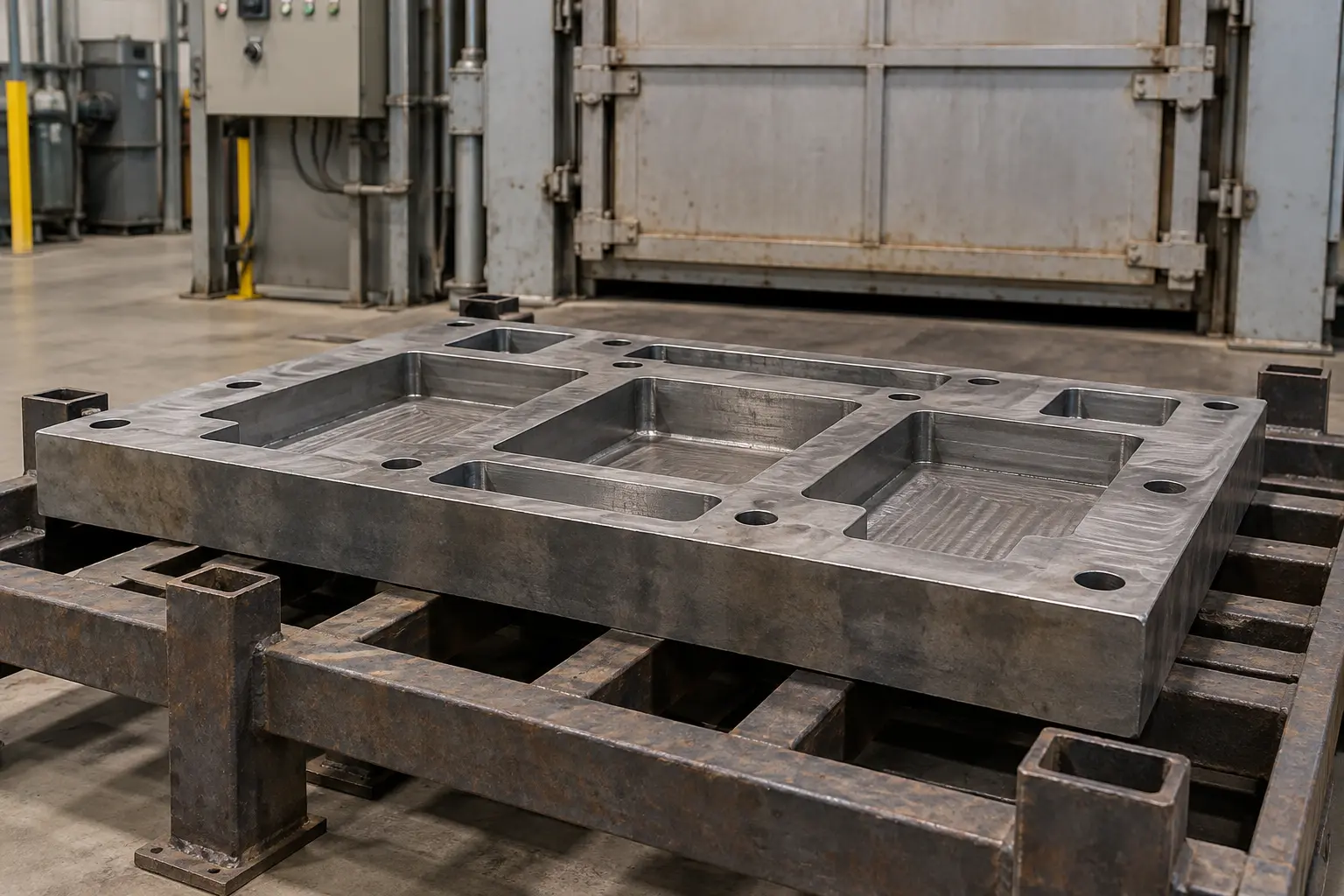
Realistic technical concept image for Stress Relieving After Rough Machining: When Is It Needed for Precision Parts?
Conceptual image created to illustrate the article's technical setup; not an actual VietTech production photograph. Specifications and acceptance follow the drawing/RFQ.
03

Where does residual stress come from?

Primary material processing

Rolling, forging, casting, cold drawing, and welding can produce nonuniform residual-stress fields. When an outer layer is removed, the original equilibrium changes and the stock may move toward the remaining material. Plate, cold-drawn bar, and welded fabrications warrant additional review when tight geometry is required.

Machining

Cutting heat, cutting force, worn tooling, aggressive engagement, and one-sided stock removal can introduce or reveal stress. The thinner and less balanced the final geometry becomes, the more sensitive it is to movement. Excessive clamping may also hold a flexible part within size during machining only for it to spring out of tolerance after release.

Previous thermal operations

Hardening, tempering, weld repair, and localized heating can leave thermal gradients or nonuniform transformations across the section. Material documentation and process history are therefore important inputs to process planning; the grade designation alone is insufficient.

04

When should stress relieving be considered?

The decision should combine material condition, geometry, stock removal, and drawing requirements. Common candidates include: For a small, rigid component with limited stock removal and general tolerances, an additional thermal cycle may not deliver proportional value. Engineering review or a controlled first-article trial should determine the need.

  • Thin plates, housings, or frames with tight flatness and parallelism.
  • Long shafts, guide members, or parts with a high length-to-section ratio.
  • Deep pockets, thin ribs, or asymmetric material removal.
  • Welded blanks or stock with forming, straightening, or localized heating history.
  • Parts that require precision grinding after rough machining.
  • Parts that will undergo another thermal or surface-treatment step capable of releasing stress.
  • Trial lots that remain stable in the fixture but move after unclamping, storage, or the next operation.
05

Recommended manufacturing sequence

A reference sequence for a distortion-sensitive component is:

  • Verify material and supplied condition: Confirm the grade, certificate, annealed or quenched-and-tempered condition, and hardness requirements.
  • Establish preliminary datums: Prepare stable reference surfaces for rough machining.
  • Rough machine in a balanced manner: Alternate or symmetrically remove stock where geometry permits. Avoid finishing one side while substantial stock remains on the opposite side.
  • Retain machining allowance: Preserve sufficient material on critical surfaces to recover geometry after heat treatment.
  • Stress relieve: Use a material-specific process from a qualified heat-treatment source, with controlled loading, heating, soaking, and cooling.
  • Clean and inspect: Remove scale when applicable, measure free-state distortion, and confirm the remaining allowance.
  • Re-establish datums: Do not assume that rough-machined datums remain valid after the thermal cycle. Recut or requalify them as required.
  • Semi-finish, finish machine, or grind: Distribute stock removal, and control clamping force and heat input.
  • Perform final inspection: Verify size, flatness, parallelism, location, and applicable GD&T requirements.
06

How much machining allowance should remain?

No single allowance fits every component. The remaining stock must be sufficient to remove post-treatment geometric deviation, but it should not be so large that finishing creates another major stress-release cycle. Overall size, wall thickness, hardness, finishing method, expected distortion, and the ability to re-establish datums all influence the plan. For critical features, validate allowance with a trial lot or data from geometrically and metallurgically comparable components. If the drawing constrains intermediate stock conditions, the manufacturer and customer should align on the approach before production.

Part characteristicPrimary riskAllowance and process direction
Thick, relatively symmetric sectionGenerally lower distortion sensitivityRetain uniform allowance on functional surfaces; requalify datums after treatment
Thin plate or housingBowing and flatness lossBalance allowance on opposing surfaces; rough machine symmetrically and avoid forced clamping
Long shaft or asymmetric stepsShaft bow and concentricity shiftRetain stock on journals and center references; verify straightness before grinding
Deep pocket, frame, or thin ribsLocal movement as material is releasedOpen pockets in stages; retain temporary support features when the process design permits
Precision-ground componentInsufficient cleanup or excessive grinding heatReserve grinding stock while limiting removal per pass and controlling thermal input
07

What must be controlled during stress relieving?

Thermal cycle and material condition

The heat-treatment provider needs the exact material grade, current condition, hardness requirement, and known prior cycles. Applying one schedule to every steel can alter hardness, mechanical properties, or suitability for subsequent processing.

Loading and support

Long or thin parts may sag under their own weight at elevated temperature. Support points, orientation, and spacing must be planned to avoid introducing new distortion. A bowed part should not be forcibly constrained throughout the cycle unless that method has been qualified.

Oxidation, decarburization, and cleaning

An air furnace may create oxide scale or affect the surface depending on the alloy and cycle. Protective atmosphere or vacuum processing may be considered when surface condition and cleanup allowance are restrictive. Post-treatment cleaning must be included in the routing.

Measurement before and after treatment

Record flatness, straightness, or runout before stress relief, after stress relief, and after finishing. These measurements help distinguish movement caused by the stock, heat treatment, clamping, or final cutting operation and improve allowance planning for repeat lots.

08

Common misconceptions

  • Stress relieving is not hardening. Its primary purpose is residual-stress reduction, not surface-hardness improvement.
  • Not every part needs it. Rigid geometry and broad tolerances may not justify an added operation.
  • It will not correct machining errors. Hole location, size, and perpendicularity do not automatically return to nominal.
  • Do not fully finish before stress relief. If the part moves and no allowance remains, recovery options are limited.
  • Do not use one temperature for every material. An unsuitable cycle can change the properties of quenched-and-tempered steel, stainless steel, or aluminum alloys.
  • PWHT is not always equivalent to interstage machining stress relief. Welded fabrications may be governed by separate codes, thickness rules, and mandatory procedures.
09

Information to include in an RFQ

For a sound machining and heat-treatment plan, include: VietTech provides CNC milling, CNC turning, precision grinding, wire EDM, and drawing-based inspection. When stress relieving is required, VietTech coordinates the operation with a specialized heat-treatment partner and incorporates it into the dimensional-control plan. The final route is confirmed only after reviewing the material, geometry, tolerances, and quantity.

  • Revision-controlled 2D drawings and 3D models.
  • Material grade, governing material specification, and supplied condition.
  • Required hardness and known prior heat-treatment history.
  • Raw-stock dimensions or intermediate allowance constraints.
  • Critical dimensional tolerances and GD&T after finishing.
  • Oxidation, decarburization, cleaning, or surface-protection requirements.
  • Quantity, first-article plan, and required inspection documentation.

RELATED PAGES

Steel hardening and tempering ↗CNC machining thin-wall parts ↗Precision grinding after heat treatment ↗

FAQ

Frequently asked questions

Should stress relieving be performed before or after rough machining?

For many distortion-sensitive parts, it is scheduled after rough machining and before finish machining or grinding. Roughing releases some stock stress and may add machining stress; the subsequent thermal cycle reduces the risk of movement during finishing.

Does stress relieving reduce hardness?

The effect depends on the material and its previous heat-treatment condition. For quenched-and-tempered parts, the cycle must remain within an approved range relative to the prior tempering temperature. The grade designation alone is not enough to select the cycle.

Can finish machining begin immediately after furnace unloading?

The component should cool and thermally stabilize, be cleaned, and be remeasured before finish datums are established. Machining or inspection before the part reaches thermal equilibrium can create dimensional error.

Does stress relieving eliminate all distortion?

No. It reduces risk, but final movement still depends on material, geometry, furnace loading, cooling rate, stock removal, fixturing, and heat generated during finishing.

How is the correct allowance determined?

Combine geometry, tolerance, hardness, finishing method, and measured distortion history. For a new or high-risk part, a controlled trial lot with measurements before and after each stage is the most reliable basis for refinement.

HEAT TREATMENT

Have a distortion-sensitive part to review?

Send the drawing, material, stock condition, removal pattern, tolerances, and heat-treatment requirements for a roughing, stabilization, finishing, and inspection review.REQUEST A QUOTE ↗