
SURFACE TREATMENT

Stainless Steel Passivation vs. Electropolishing: What Is the Difference?

Compare passivation and electropolishing for stainless steel, including material removal, roughness, appearance, corrosion performance, and tolerances.

SURFACE TREATMENTVIETTECH · TECHNICAL RESOURCES
01

What is passivation?

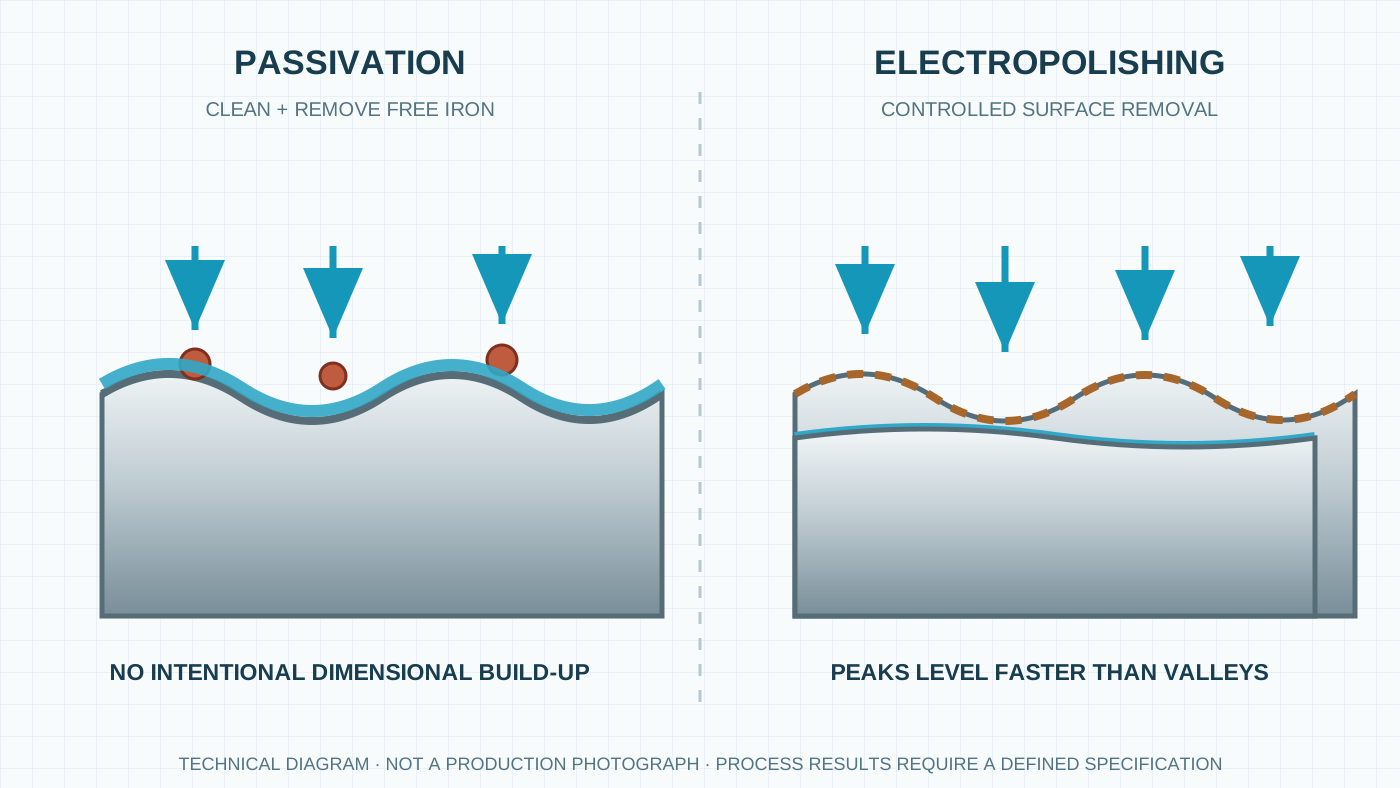
Stainless steel forms a very thin chromium-rich oxide film that supports corrosion resistance. Cutting, grinding, or contact with carbon-steel tooling may deposit free iron on the surface. These particles can rust if not removed and may create the appearance that the stainless substrate itself is corroding. A passivation process generally includes cleaning, chemical treatment in a suitable solution, rinsing, and drying. Its primary purpose is not polishing or tool-mark removal. It removes contamination and creates favorable conditions for a stable passive surface. ASTM A967/A967M is commonly specified for chemical passivation of stainless-steel parts. The process option and required verification tests should be identified in the drawing or purchase requirement.

02

What is electropolishing?

Electropolishing makes the part an electrode in an electrolyte and applies current to dissolve a controlled, very thin surface layer. Microscopic peaks generally dissolve faster than lower regions, allowing the surface to become smoother and often brighter. The process may reduce very small burrs, lower contaminant-retention sites, and improve cleanability. It is not a primary geometry-correction process. Deep tool marks, major burrs, pits, scratches, or flatness error require machining or mechanical finishing before electropolishing. ASTM B912 is commonly referenced for passivation of stainless steel using electropolishing. Material, cycle, removal, verification, and appearance must be agreed.

  • Primary purpose — Remove free iron and support the passive film — Microsmooth, clean, and improve appearance
  • Material removal — Minimal; not intended for sizing — Controlled material removal occurs
  • Tool-mark removal — No — Only minor reduction; deep marks remain
  • Brightness — Not a primary objective — Typically increases
  • Burr removal — Not a deburring method — May reduce microburrs
  • Edge effect — Normally minimal — May lightly round sharp edges
03

Dimensional and tolerance effects

Proper passivation is generally not used to change nominal dimensions. Surfaces still require cleaning, and masking or excluded areas must be identified when applicable. Electropolishing removes material. Removal depends on current density, time, electrolyte, geometry, electric-field distribution, and racking. Edges, peaks, and well-exposed areas may respond differently than recessed features. Tight-tolerance components, small threads, sharp edges, and precision bores require review before processing. Do not assume a universal removal value. Drawings should state whether dimensions apply before or after treatment and identify edges that must remain sharp.

04

Surface roughness and appearance

Passivation does not replace the operation that creates surface roughness. High Ra, tool marks, or scratches present before treatment may remain afterward. Appearance can change slightly through cleaning, but passivation should not be treated as a decorative finish. Electropolishing can reduce microscopic roughness, but the result depends strongly on the incoming surface. A uniformly machined and mechanically prepared surface responds differently from one containing deep cutter marks or untreated weld areas. If an Ra value is required after electropolishing, the drawing should define the measurement zone and evaluation method.

05

Corrosion performance

Both processes can support corrosion resistance by removing contamination and creating a more favorable surface state. Performance still depends on stainless grade, chloride exposure, temperature, crevices, cleanliness, and actual service conditions. Surface processing does not make SUS303 equivalent to SUS304, nor does it make SUS304 suitable for every chemical. Base-alloy selection remains fundamental. Food, medical, semiconductor, and chemical applications may also require industry-specific validation.

06

Which process should be selected?

Select passivation when the objective is to remove free iron and machining contamination, preserve geometry with minimal material change, and meet a specified cleaning or verification requirement. Select electropolishing when a smoother, brighter, more cleanable surface or reduction of microscopic peaks and microburrs is required. If both surface morphology and passive condition are critical, the complete cycle should be established by the specialized processor.

07

Part preparation

VietTech performs machining and inspection and coordinates passivation, electropolishing, and specialized surface treatment through suitable external partners.

  • Remove major burrs and clean inaccessible corners.
  • Identify cosmetic and functional surfaces.
  • Mark threads, fits, sharp edges, and no-removal areas.
  • Agree on racking and permitted electrical-contact locations.
  • Segregate carbon-steel operations to reduce free-iron transfer.
  • Define post-treatment packaging to prevent recontamination.
08

RFQ information

  • Stainless-steel grade and material standard.
  • Treatment standard, method, and required tests.
  • Dimensions applying before or after treatment.
  • Target roughness and appearance.
  • Masked areas, no-removal zones, and sharp-edge requirements.
  • Cleanliness, packaging, and certification requirements.
  • Quantity and critical service conditions.

RELATED PAGES

Electroless nickel vs. hard chrome ↗Surface roughness Ra ↗Materials and treatments ↗

FAQ

Frequently asked questions

Does passivation make stainless steel shiny?

Not necessarily. Its main purpose is cleaning and passive-surface support, not decoration.

Does electropolishing remove every scratch?

No. Deep scratches and geometry errors require appropriate mechanical finishing or machining first.

Can electropolishing change dimensions?

Yes. It removes material, so tolerances, threads, bores, and edges must be reviewed.

Is passivated stainless completely rust-proof?

No. Corrosion performance still depends on grade, environment, design, and handling.

Does VietTech perform these processes in-house?

VietTech coordinates them through specialized surface-treatment partners and manages the agreed order requirements.

SURFACE TREATMENT

Need a stainless-finish review?

Send the drawing, stainless grade, quantity, processing standard, surface-roughness target, and functional zones. VietTech will review machining sequence, allowance, masking, and pre- and post-treatment inspection before coordinating a quotation. ---REQUEST A QUOTE ↗