
TECHNICAL GUIDE

SUS304 vs SUS316: Which Stainless Steel Should You Choose for CNC Machined Parts?

Compare SUS304 and SUS316 for corrosion resistance, CNC machining, welding, surface finish and RFQ requirements for precision components.

TECHNICAL GUIDETECHNICAL CONCEPT IMAGE
01

Overview

SUS304 and SUS316 are widely used austenitic stainless steels. Both offer useful corrosion resistance, formability and weldability, but they should not be treated as automatic substitutes. SUS316 normally contains molybdenum, which improves resistance to localized corrosion in many chloride-bearing environments. SUS304 is generally more economical and widely available for general service where chloride exposure is limited. The correct choice depends on more than the grade name. Exposure chemistry, chloride level, temperature, crevices, cleaning cycles, welding, surface finish, tolerances and the governing specification all matter. This guide focuses on the information that designers and buyers should review before requesting CNC machining.

02

What is the practical difference between SUS304 and SUS316?

Alloy composition and molybdenum

SUS304 is a general-purpose chromium-nickel austenitic stainless steel. SUS316 is also austenitic but typically includes about 2–3% molybdenum within the limits of the applicable standard and product specification. Molybdenum improves resistance to pitting and crevice corrosion, particularly in chloride-containing service. This does not make SUS316 immune to seawater or chemicals. Higher temperature, stagnant deposits, tight crevices, extended exposure, stress and poor surface condition can still cause corrosion. Severe service may require a higher-alloy grade, duplex stainless steel or another corrosion-resistant alloy. Chemical and mechanical properties must be confirmed against the selected standard, product form and material certificate. Typical values from a generic table should not be used as acceptance limits.

03

When is SUS304 a sensible choice?

SUS304 is often suitable for indoor service, normal atmospheric exposure and applications without meaningful contact with salt or chloride solutions. Typical examples may include brackets, covers, machine components, food-processing hardware and general equipment parts requiring a clean surface and good corrosion resistance. Its practical advantages include broad availability in bar, plate, sheet and tube, generally lower cost than SUS316 and easier sourcing for prototypes or repeat production. However, SUS304 can still pit in chloride service, especially at joints, wet pockets and iron-contaminated surfaces.

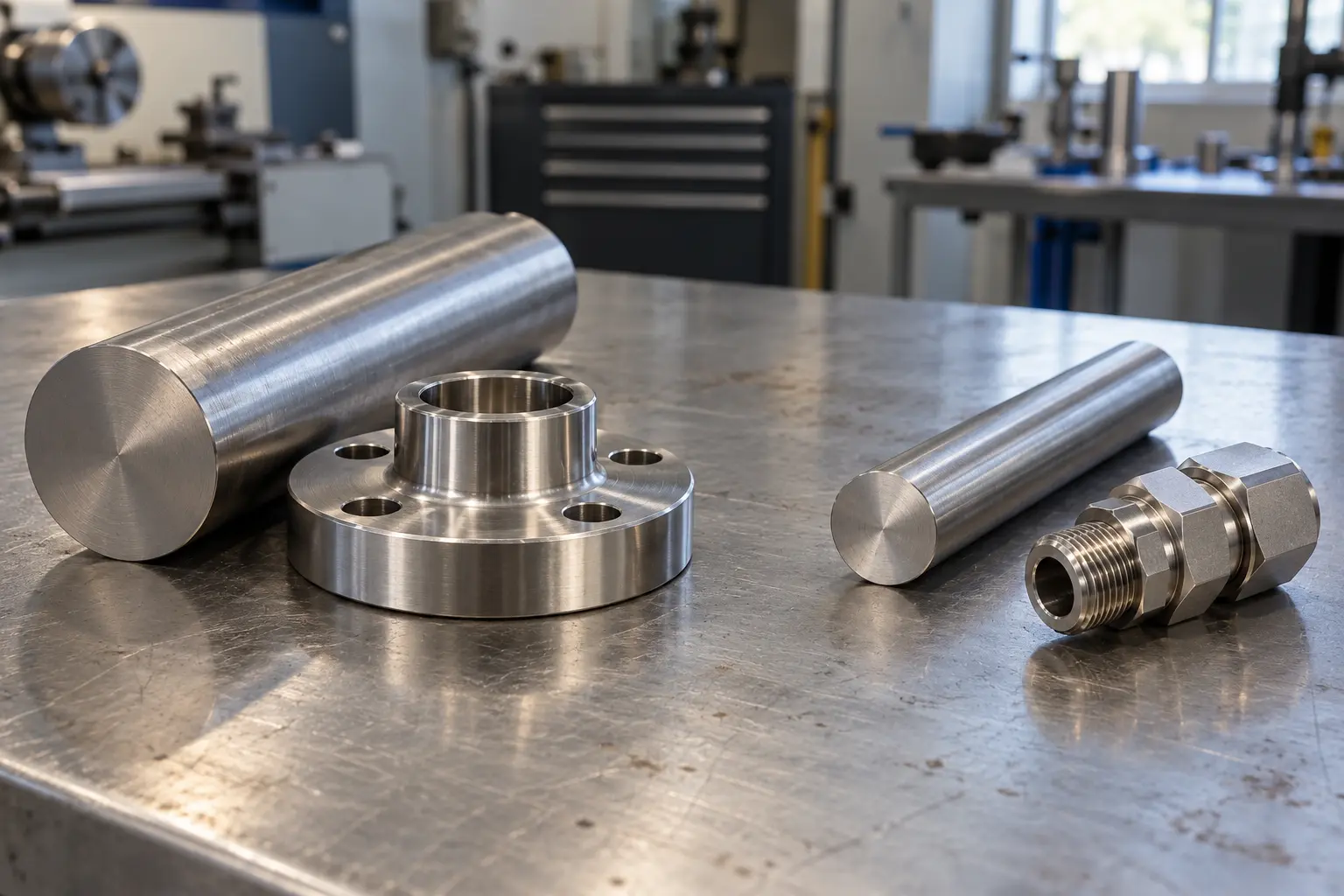
Realistic technical concept image for SUS304 vs SUS316: Which Stainless Steel Should You Choose for CNC Machined Parts?
Conceptual image created to illustrate the article's technical setup; not an actual VietTech production photograph. Specifications and acceptance follow the drawing/RFQ.

When should SUS304L be considered?

The “L” designates lower carbon. SUS304L is commonly considered for welded assemblies when resistance to sensitization in the heat-affected zone is important. Selection must still follow the drawing and specification because minimum mechanical properties and certification requirements may differ.

04

When is SUS316 appropriate?

SUS316 is commonly considered for components exposed to chlorides, stronger cleaning chemicals, coastal atmospheres, industrial water or more demanding hygienic conditions. Threads, covered areas, joints and alternating wet-dry zones deserve special attention because solution can concentrate locally. SUS316 is not a universal guarantee against corrosion. Warm seawater, high chloride concentration, acids or elevated temperatures may require a detailed materials review. Descriptions such as “outdoor use” or “water contact” are not sufficient inputs for material selection.

Is SUS316L always better than SUS316?

SUS316L has lower carbon and is often selected for welded parts or when sensitization control is specified. That does not mean every property is superior. For non-welded parts, the applicable standard, stock form, minimum strength, availability and certificate requirements remain relevant.

05

CNC machining considerations for SUS304 and SUS316

Both grades work-harden rapidly and conduct heat less effectively than common carbon steels. If the tool rubs rather than cuts, the surface hardens, cutting temperature rises and tool life falls. Long, tough chips can also wrap around the tool, scratch the part or block coolant.

Tooling, feed and coolant

A stable process uses rigid workholding, sharp cutting edges, suitable positive geometry and enough feed to cut beneath the work-hardened layer. Dwelling and repeated light rubbing passes should be minimized. Consistent coolant flow helps remove heat and chips. Actual parameters must be developed for the stock condition, machine, tool, overhang and feature geometry; a single cutting-data table cannot cover every job. SUS316 is often experienced as slightly more demanding to machine, but material condition may be equally important. Cold-drawn bar, rolled plate, work-hardened stock and enhanced-machinability variants can behave differently even when the base grade designation looks similar.

Burrs, threads and distortion

Ductile stainless steel readily forms burrs at edges, intersecting holes and threads. The drawing should identify functional edges, allowable edge break and burr-free zones. Thin walls and parts requiring heavy material removal need a suitable machining sequence and stock allowance to control distortion. Internal threads should define the standard, tolerance class, effective depth and inspection method.

Cleaning after machining

Tools, brushes or abrasive media previously used on carbon steel can transfer free iron to stainless surfaces. The resulting contamination may produce surface rust even when the base alloy is correct. Cleaning, pickling and passivation should be specified when required. Passivation helps remove free iron and supports the natural passive surface; it does not convert SUS304 into SUS316 or compensate for poor crevice design.

06

Why surface finish matters

Rough surfaces can retain deposits, moisture and cleaning chemicals. Deep scratches, dead zones, tight gaps and heat tint can reduce cleanability and corrosion performance. A requirement that states only “316 stainless steel” may therefore be incomplete. The RFQ should identify machined, ground, polished, passivated or electropolished surfaces; required Ra on functional areas; grain direction for cosmetic surfaces; and allowable clamping marks. When specialist passivation or electropolishing is required, VietTech can coordinate with qualified partners and inspect dimensions within the agreed scope.

07

Do not identify the grade with a magnet

Annealed SUS304 and SUS316 are generally nonmagnetic or only weakly magnetic, but cold work can create measurable magnetic response. A magnet is therefore not a reliable method for distinguishing these grades. Material traceability, certificates and agreed composition testing are more appropriate.

08

RFQ checklist for SUS304 or SUS316 parts

Include the following information so VietTech can review manufacturability and quote accurately: VietTech provides CNC milling, CNC turning, precision grinding, wire EDM and dimensional inspection within the agreed project scope. Specialist surface treatments are coordinated with suitable partners when required. Any material selection or substitution remains subject to the customer's design approval.

  • Matching 2D drawing and 3D model with revision and data-authority rules.
  • Full grade: SUS304, SUS304L, SUS316 or SUS316L; material standard and stock form.
  • Material certificate, heat traceability or composition-verification requirements.
  • Service environment: chemicals, chloride, temperature, cleaning cycle, crevices and liquid traps.
  • Dimensional tolerances, GD&T, surface roughness and critical features.
  • Welding, passivation, electropolishing, polishing and masking requirements.
  • Prototype and production quantities, inspection reports and packaging needs.

RELATED PAGES

SUS303 vs SUS304: Which Stainless Steel for Precision-Machined Parts? ↗Stainless Steel Passivation vs. Electropolishing: What Is the Difference? ↗

FAQ

Frequently asked questions

Is SUS316 completely corrosion-proof in seawater?

No. It often performs better than SUS304 in chloride environments, but pitting and crevice corrosion can still occur depending on concentration, temperature, time and design.

Can SUS316 replace SUS304 without changing the drawing?

It should not be substituted automatically. Cost, availability, certification and design requirements may change. Formal approval is recommended.

Are SUS304L and SUS316L easier to machine?

Not necessarily. “L” primarily indicates low carbon. Machinability also depends on detailed composition, stock condition, hardness, tooling and cutting strategy.

Does passivation add significant thickness?

Passivation is a chemical cleaning treatment rather than a thick coating. Nevertheless, the required process and post-treatment inspection should be defined in the RFQ.

Can VietTech recommend SUS304 or SUS316?

VietTech can provide manufacturability input related to machining, stock form, tolerances and inspection. Final material compatibility and grade approval remain the customer's design responsibility.

TECHNICAL GUIDE

Request a VietTech review

Need precision parts in SUS304 or SUS316, or need help clarifying manufacturability? Send your 2D drawing, 3D model, quantity, service environment, surface requirements and inspection criteria. VietTech will review the machining scope, identify points requiring clarification and propose an inspection approach before quotation. ---REQUEST A QUOTE ↗