
TECHNICAL GUIDE

Glass Bead vs. Aluminum Oxide Blasting: Which Process Fits a Machined Part?

Compare glass bead and aluminum oxide blasting for cleaning, satin finishing, surface profiling, dimensional control, masking, and RFQ specifications.

TECHNICAL GUIDEVIETTECH · TECHNICAL RESOURCES
01

Overview

“Sandblasting” is often used as a broad term, but precision manufacturing requires a more specific definition. Blast media directly affects cleaning action, surface topography, appearance, and the risk of altering a component. Glass beads and aluminum oxide differ in particle shape, hardness, and cutting behavior, so they should not be treated as interchangeable finishes. Glass beads are commonly selected for gentle cleaning and a uniform satin appearance. Angular aluminum oxide cuts more aggressively and is better suited to oxide removal, coating stripping, or creating a profile for a subsequent coating. Precision bores, threads, sealing faces, and thin sections require explicit masking and post-process inspection requirements.
02

How does abrasive blasting work?

Abrasive blasting accelerates media with compressed air or a wet-blast system and directs it against the part. Each impact removes contamination, changes microgeometry, or produces a small indentation. The result depends on more than the media name: A note that says only “bead blast” may therefore produce different results between suppliers or production lots if the approved appearance, treatment zones, and acceptance criteria are not defined.

Glass Bead vs. Aluminum Oxide Blasting: Which Process Fits a Machined Part?
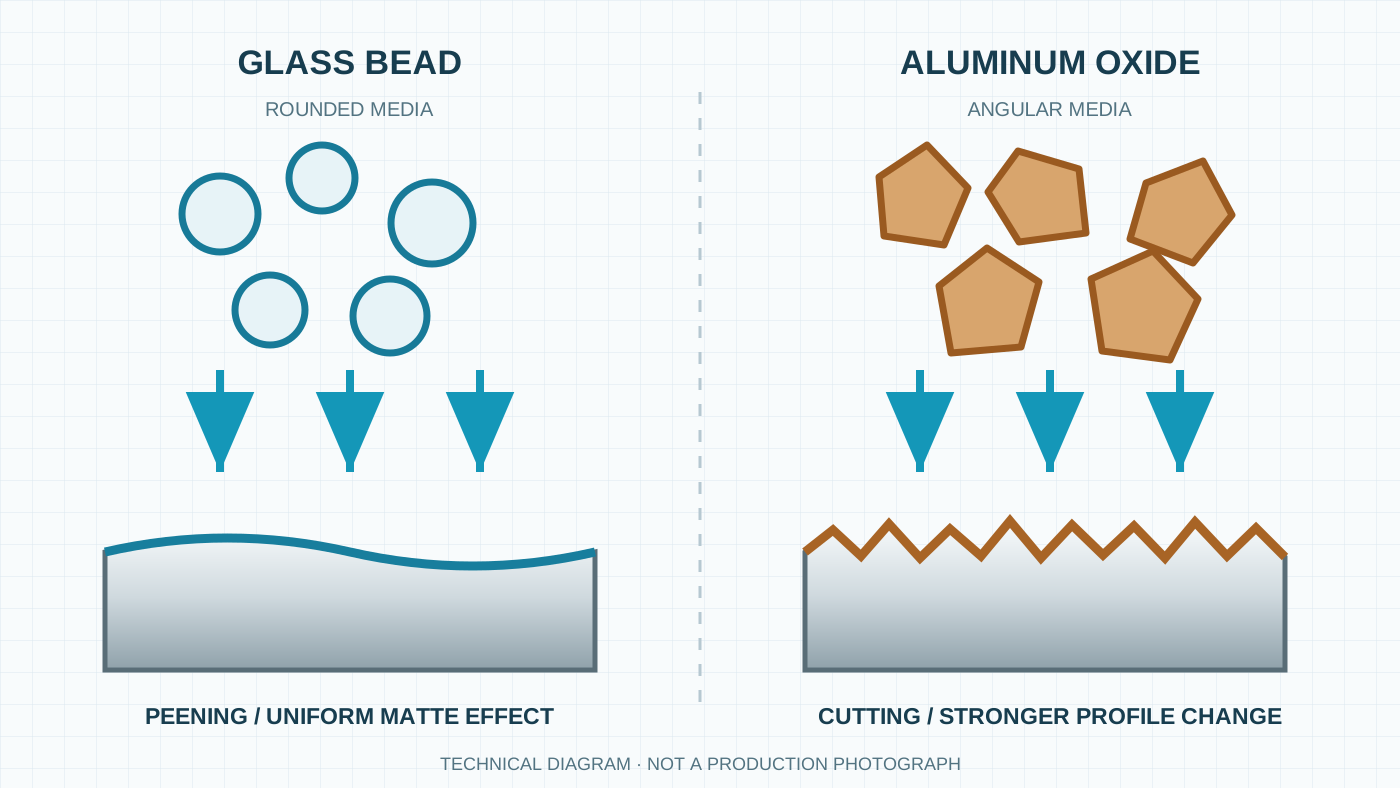
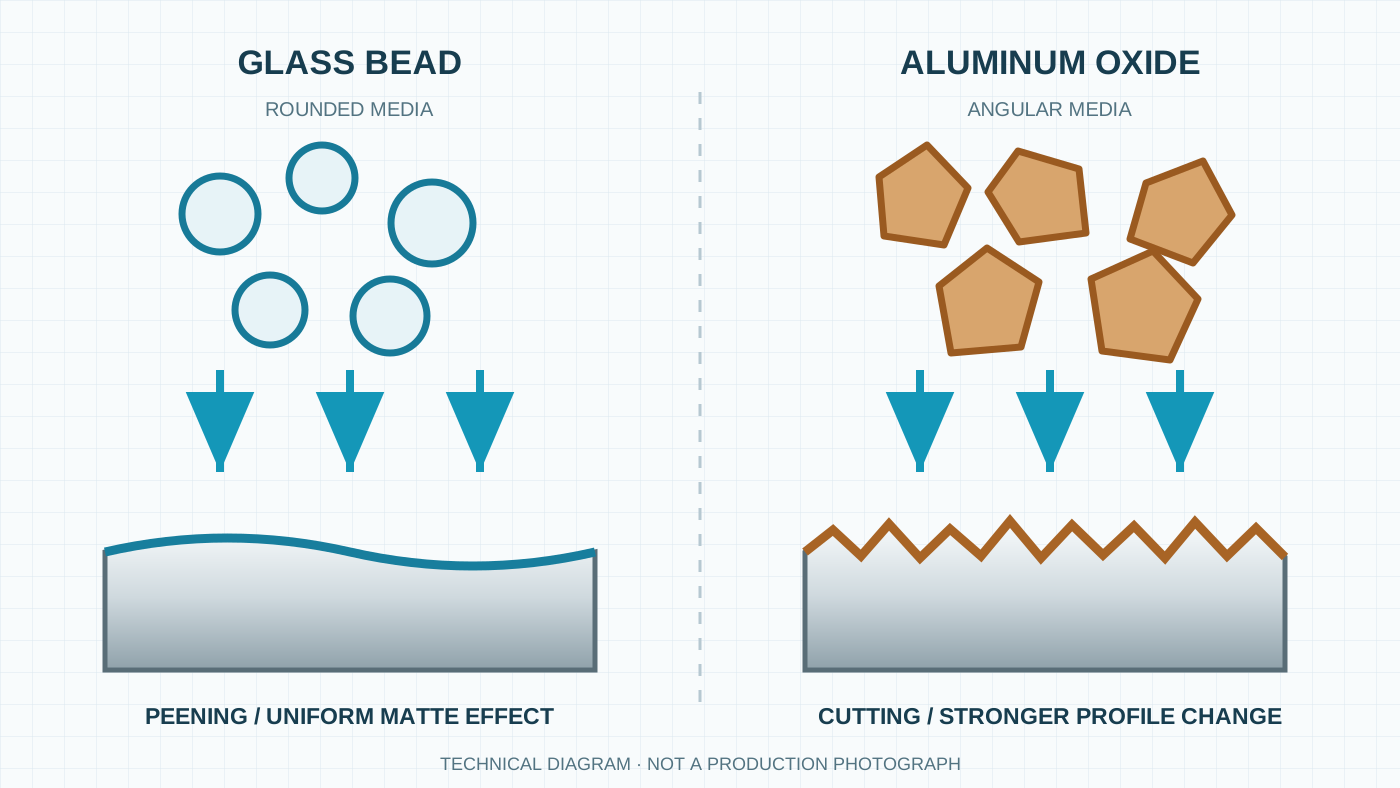
Rounded glass beads and angular alumina affect the substrate differently; mask fit surfaces before blasting.
  • Particle size and size distribution.
  • Blast pressure and media flow.
  • Nozzle distance, angle, and traverse speed.
  • Exposure time in each area.
  • Substrate hardness, thickness, and incoming surface condition.
  • Dry versus wet blasting, media reuse condition, and equipment cleanliness.
03

What is glass bead blasting?

Glass beads are approximately spherical. Their impact creates overlapping micro-indentations and diffuses reflected light without the aggressive cutting action of angular media. The typical visual result is a relatively uniform matte or satin surface that reduces glare and blends minor tool marks. Glass bead blasting is often considered for: Glass beads will not erase deep machining marks, scratches, porosity, or other manufacturing defects. Increasing pressure and exposure to hide such defects can create uneven appearance, round edges, distort thin parts, or allow fractured media to produce a more angular action than intended.

  • Aluminum housings requiring a matte appearance before anodizing.
  • Stainless steel parts requiring reduced reflectivity and consistent appearance.
  • Light surface cleaning where a deep anchor profile is not required.
  • Cosmetic parts whose edges and critical dimensions still require control.
04

What is aluminum oxide blasting?

Aluminum oxide, or alumina, is a hard, angular abrasive. Its mechanism is more strongly associated with cutting and etching, so it generally cleans and profiles faster than glass bead media. Typical uses include: Because the process is more aggressive, aluminum oxide can affect sharp edges, shallow markings, sealing surfaces, and small dimensions if the parameters are not appropriate. Residual abrasive and dust require thorough removal, especially from blind holes, threads, and internal passages. Stainless steel and cleanliness-critical applications also require controlled media and dedicated or suitably cleaned equipment to reduce cross-contamination risk.

  • Removing oxides, corrosion, or old coatings.
  • Preparing a surface for paint, coating, or bonding that needs mechanical adhesion.
  • Creating a more pronounced matte texture.
  • Cleaning tooling, fixtures, or parts with tenacious deposits when the substrate allows it.
05

Quick comparison

This table is directional only. A surface roughness value should not be guaranteed from the media name alone. Roughness and appearance require a qualified process, representative sample, or specification that defines media grade and controlled parameters.

CriterionGlass beadAluminum oxide
Particle geometryApproximately sphericalAngular and sharper
Primary actionImpact and micro-indentationCutting, etching, and surface removal
Relative aggressivenessLow to moderateModerate to high
Typical appearanceMatte or satin with diffuse reflectionDuller, more visibly profiled texture
Deposit removalBest for lighter cleaningBetter for oxide and hard-coating removal
Coating preparationSuitable where a light profile is specifiedOften preferred where a stronger anchor profile is needed
Edge-rounding riskPresent with excessive exposure or pressureHigher because of stronger cutting action
Primary controlsBroken media and cosmetic uniformityProfile, stock removal, residue, and contamination
06

Effects on dimensions and tolerances

Abrasive blasting is a surface process, but it is not necessarily dimension-neutral. Impact can change microgeometry, soften edges, or remove a small amount of material. The effect becomes important on tightly toleranced or small features and with extended exposure. Areas commonly considered for masking include: Masking involves more than placing tape on a surface. The masking material, edge location, and fixture must resist the blast stream without lifting or leaving an unacceptable boundary. After treatment, the part should be checked for trapped media in threads, bores, and enclosed cavities.

  • H7 bores and other close-tolerance diameters.
  • Internal and external threads and threaded inserts.
  • Sealing faces, datum surfaces, bearing seats, and sliding surfaces.
  • Laser marks, mechanical engraving, and shallow traceability codes.
  • Precision-ground or polished surfaces.
  • Blind holes and passages from which residual media is difficult to remove.
07

Selecting the process by functional objective

When a satin appearance is the priority

Glass bead media is often a practical starting point for aluminum and stainless steel when the goal is reduced gloss and consistent appearance. An approved sample, media grade, and lighting condition should be agreed upon to reduce subjective disputes between lots.

When coating removal or adhesion is required

Aluminum oxide is generally more effective when removing oxide or coating, or when producing texture for a subsequent paint or coating. In this case, Ra alone may not fully define the requirement; some applications require a surface-profile parameter or a dedicated surface-preparation standard.

When the part is thin or geometrically delicate

Lower energy, finer media, shorter exposure, or a trial coupon may be required. Thin blades, small ribs, datum edges, and parts with tight flatness should be evaluated for distortion and edge rounding before the process is approved.

Before anodizing, plating, or passivation

Blasting is one operation within a larger finishing route. The downstream finisher should confirm the acceptable media, texture, cleaning method, and any effect on color or adhesion. Blasting does not replace degreasing, chemical preparation, or passivation when those steps are required by the applicable specification.

08

How to specify blasting on a drawing or RFQ

A robust requirement identifies the media, treatment area, intended function, and acceptance method. Include: For cosmetic requirements, a phone photograph is not a definitive standard because lighting and white balance vary. A physical limit sample or approved first article is normally more reliable.

  • Material grade and incoming surface condition.
  • Media type—glass bead or aluminum oxide—and media grade when established.
  • Dry or wet blasting when one process is specifically required.
  • Surfaces to blast and surfaces to mask, clearly identified on the drawing.
  • Objective: cleaning, satin appearance, coating removal, or coating preparation.
  • Approved appearance sample, color limits, roughness, or surface-profile criteria.
  • Residual-media cleaning, preservation, and packaging requirements.
  • Dimensions to re-inspect and the required sampling level.
09

VietTech’s coordination scope

VietTech provides CNC milling, CNC turning, precision grinding, wire EDM, and drawing-based inspection. Bead blasting, abrasive blasting, and related surface-treatment operations are coordinated through specialized partners. Critical features are reviewed before treatment to establish masking requirements, and parts are cleaned and inspected after processing as specified. Final appearance, roughness, and dimensional capability must be evaluated against the material, geometry, media, downstream treatment, and production quantity. For new cosmetic requirements, an approved sample is recommended before the complete lot is processed.

RELATED PAGES

Type II vs. Type III Anodizing: Which Finish for a Machined Aluminum Part? ↗How to Specify Materials and Surface Finishes in an RFQ ↗

FAQ

Frequently asked questions

Does glass bead blasting change part dimensions?

It can cause small changes through impact, edge rounding, or altered microgeometry. Close-tolerance bores, threads, and mating surfaces should be masked and re-inspected when function requires it.

Is aluminum oxide blasting the same as sandblasting?

“Sandblasting” is a general term used for several media-blasting methods. Aluminum oxide is a specific hard, angular abrasive and should not be treated as equivalent to silica sand.

Which process gives a better-looking finish?

That depends on the approved visual target. Glass beads commonly produce a softer, more uniform satin appearance, while aluminum oxide creates a duller and more strongly textured surface. A sample is more objective than the word “better.”

Can one fixed Ra value be assumed for bead blasting?

No. Ra may be specified when the process and measurement method are controlled, but the process name alone does not guarantee it. Media size, pressure, stand-off distance, angle, exposure, and substrate all affect the result.

Should threads and precision bores be masked?

They generally should be masked when blasting is not allowed to alter those surfaces. The final decision depends on tolerance, mating function, and residual-media cleaning requirements.

TECHNICAL GUIDE

Request a VietTech review

Send VietTech your 2D drawing, 3D model, material, quantity, blast areas, masking zones, and approved appearance sample. Our engineering team will review dimensional risk, cleaning requirements, and the full finishing route before proposing a process and quotation. ---REQUEST A QUOTE ↗