
SURFACE TREATMENT

Hydrogen Embrittlement After Electroplating: Managing Risk in High-Strength Steel Parts

Understand hydrogen entry during cleaning and plating, the difference between stress relief and post-coating baking, and what a CNC RFQ should specify.

01

Why a dimensionally acceptable part can crack later

Hydrogen embrittlement occurs when absorbed hydrogen reduces the load capacity or ductility of susceptible steel under particular stress conditions. A part may look sound after machining and coating but fail under sustained or cyclic load after a delay. Risk is especially important for high-strength or high-hardness steel, tensile residual stress, notches, threads, springs, fasteners and ground surfaces. Coating colour and thickness cannot demonstrate freedom from embrittlement. Prevention must begin with material condition, heat-treatment history, machining and the complete cleaning–plating–post-treatment route.
02

Hydrogen can enter before and during coating

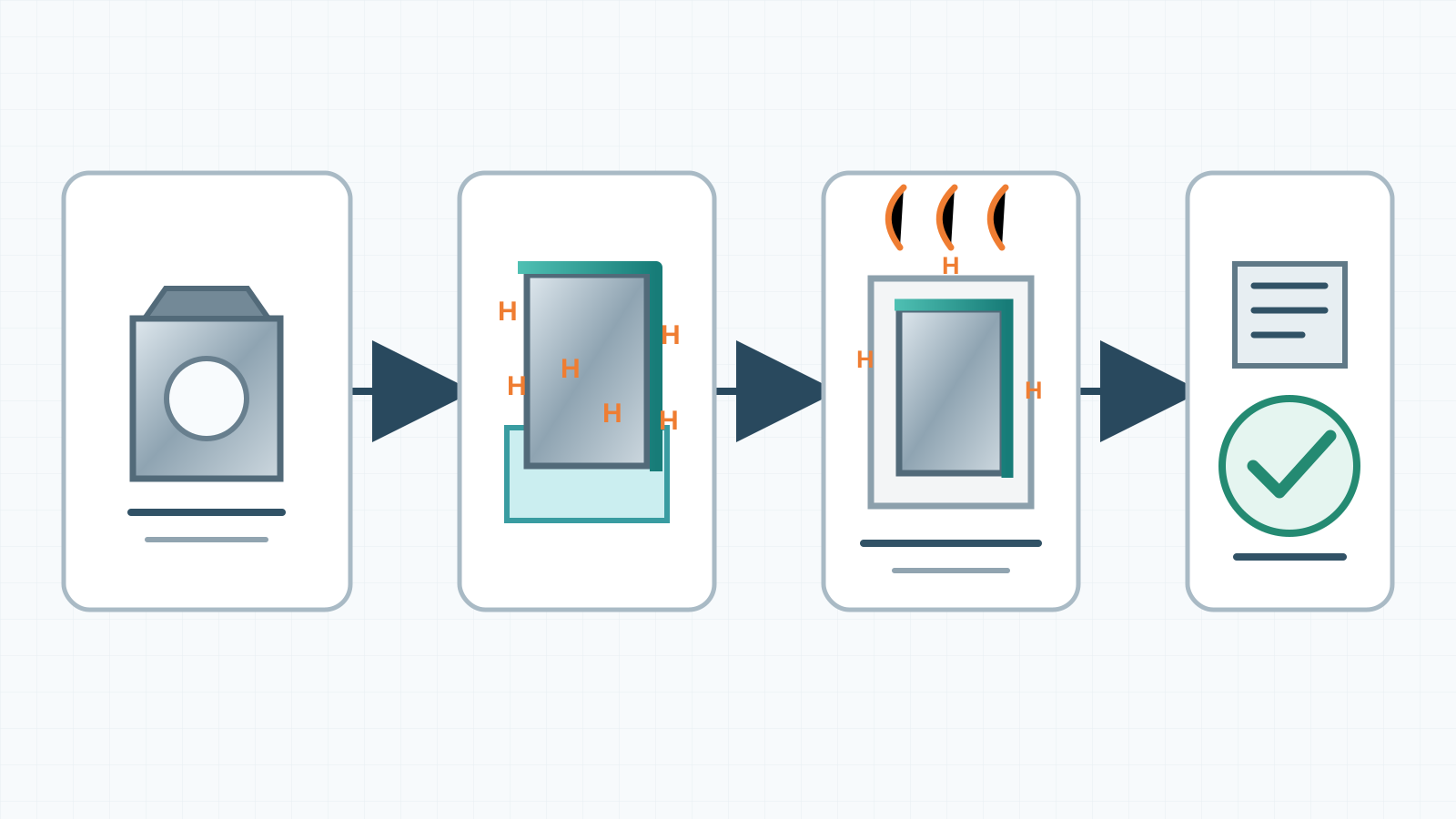
Acid pickling, activation, electrolytic cleaning, electrodeposition and some conversion processes can charge a steel surface with hydrogen. Corrosion in service can also generate hydrogen. A coating name alone is therefore insufficient. The approved route should identify preparation, surface condition, exposure, current conditions, underlayers, thickness, post-treatment and validation. Autocatalytic deposition should not be assumed risk-free because its pretreatment and surface reactions also require evaluation.

Technical process diagram showing hydrogen entry during cleaning and plating followed by embrittlement-relief treatment
Conceptual illustration: hydrogen can enter during pretreatment and plating; post-coating heat treatment is one risk-reduction measure under the governing specification. This is not an actual VietTech process photograph.
03

Actual strength, hardness and stress matter more than the grade name

Parts made from the same grade can have different susceptibility when heat treatment, hardness, residual stress and geometry differ. Grinding, cold straightening, thread forming and severe section changes may increase tensile stress. State the actual strength class or final hardness, not only SCM440, S45C or tool-steel grade. Do not invent one threshold for every part; the product specification, drawing and customer requirement control. Safety-critical parts need design approval of material, coating route and verification.

04

Pre-coating stress relief and post-coating baking are different

Pre-coating stress relief addresses residual stress from machining, grinding, cold work or previous heat treatment before the part enters a hydrogen-charging operation. Post-coating heat treatment promotes hydrogen diffusion out of the steel after coating. One does not automatically replace the other. Temperature, duration, delay from coating and the position of any conversion coating must follow the approved specification. A generic bake cycle can alter hardness, coating performance or part function.

StageRiskConfirmRetain
Material and heat treatmentHigh strength or susceptible structureGrade, standard and actual hardness/strengthMTC and heat-treatment records
Machining and grindingResidual stress, grinding damage and notchesFinal pre-coating operation and required stress reliefOperation history and surface checks
PretreatmentHydrogen entry during cleaning and activationApproved cleaning routeProcessor batch parameters
Plating/coatingHydrogen entry and trappingSpecification, coating system, thickness and areaCertificate and lot traceability
Post-treatmentDelayed crackingBake cycle, delay and validation testFurnace chart, timing and results
05

Baking reduces risk; it is not an absolute guarantee

Effectiveness depends on absorbed hydrogen, material susceptibility, part thickness, coating, start delay and the actual cycle. Baking cannot repair an existing crack and may not remove hydrogen from strong traps. Pretreatment control and transfer time are therefore as important as the word 'bake'. A furnace record proves that a thermal cycle ran; a sensitive specimen, sustained-load test or product-specific method may still be required. Hardness and visual inspection do not replace an embrittlement test when the contract requires one.

06

Select the finish together with hydrogen controls

Zinc, nickel, chromium and other deposited systems serve different corrosion, wear and dimensional purposes. Good corrosion performance does not make a process suitable for a high-strength part if embrittlement controls are missing. A mechanical coating, non-electrolytic system or another protection route may avoid one charging source in some applications, but changes to friction, thickness, temperature capability and qualification require design approval.

07

Threads, fits and masking must be defined before machining

Coating changes functional dimensions and can build differently on edges, threads and deep holes. State the thread standard, class, acceptance before or after coating and gauge requirement. For fits, define thickness per surface, masking and whether controlled post-coating finishing is permitted. Removing coating can destroy protection or create new stress, so any rework belongs in the approved route.

08

Testing and records follow the product specification

ASTM F519 provides mechanical evaluation methods for plating/coating processes and service environments that may cause hydrogen embrittlement; fasteners also have process-control standards. Prior qualification does not replace lot control when the contract requires it. State the standard and revision, specimen, frequency, load or hold period, acceptance criterion and party providing specimens. If a drawing says only 'hydrogen embrittlement relief', raise an RFI before quotation or production.

09

RFQ checklist

VietTech performs machining and inspection within confirmed scope; specialist plating and heat treatment are coordinated with suitable partners. Provide material, strength and coating information before process planning. Adding baking or testing after machining can change processor selection, lead time, documentation, pre-plate dimensions and cost.

  • Steel grade, standard, heat-treated condition and hardness/strength
  • Last pre-coating operation such as grinding, straightening or thread forming
  • Coating specification, thickness and masked areas
  • Pre-coating stress relief and post-coating bake specification
  • Maximum plating-to-bake delay when specified
  • Test coupons, furnace records, certificates and lot traceability
  • Final acceptance state for dimensions, threads and surfaces
010

Technical sources and limits

This article references ASTM B1031-26, ASTM B849-02(2023), ASTM B850-98(2022) and ASTM F519-23. ASTM B1031 directs mandatory baking, stress-relief, mitigation and testing requirements to the relevant product or process specification. Standards change and may be sector-limited; the drawing/contract revision and design approval remain controlling.

RELATED PAGES

Black Oxide vs Zinc Plating: Choosing a Finish for Machined Steel Parts ↗Electroless Nickel vs Hard Chrome: Which Coating Fits a Machined Part? ↗Material Certificates in a CNC RFQ: MTC, CoC and Lot Traceability ↗How to Request a Quote ↗

FAQ

Frequently asked questions

Must every electroplated steel part be baked?

No universal rule applies. Strength, hardness, stress, process and the product specification determine the requirement; high-strength parts deserve specific review.

Does baking remove all hydrogen?

No. A correct cycle can reduce risk, but effectiveness depends on the material, absorbed hydrogen, coating, delay and cycle.

Does a hardness check prove the part is safe from hydrogen embrittlement?

No. Hardness is not an embrittlement test. Use the specified mechanical method when required.

Is electroless plating automatically free of hydrogen risk?

No. Pretreatment and surface reactions must still be evaluated for the actual material and approved process.

Does VietTech perform plating and embrittlement-relief baking in-house?

VietTech performs CNC machining and inspection within confirmed scope; specialist plating and heat treatment are coordinated with qualified partners for each RFQ.

SURFACE TREATMENT

Have a high-strength steel part that requires coating?

Send the drawing, material, strength or hardness, coating specification, masking, quantity and embrittlement requirements. VietTech will review machining, partner processing and inspection before quotation.REQUEST A QUOTE ↗