
RFQ GUIDE

ISO 2768 General Tolerances in a CNC RFQ: When and How to Specify Them

How to use ISO 2768 without obscuring functional dimensions, datums, GD&T or the October 2026 standards transition.

01

What problem do general tolerances solve?

A mechanical drawing can contain many dimensions that do not need a separate ± value. General tolerances provide a default for dimensions without an individual indication and keep the drawing readable. ISO 2768-1:1989 covers untoleranced linear and angular dimensions in four classes: f, m, c and v. It is intended for parts made by material removal or formed sheet metal and uses nominal-size ranges. A note such as ISO 2768-m does not control every drawing requirement. Position, profile, runout, datum structure, threads, fits, theoretically exact dimensions and features governed by other standards still need the appropriate specification. The RFQ should state the edition and scope.
02

Read specific requirements before the general note

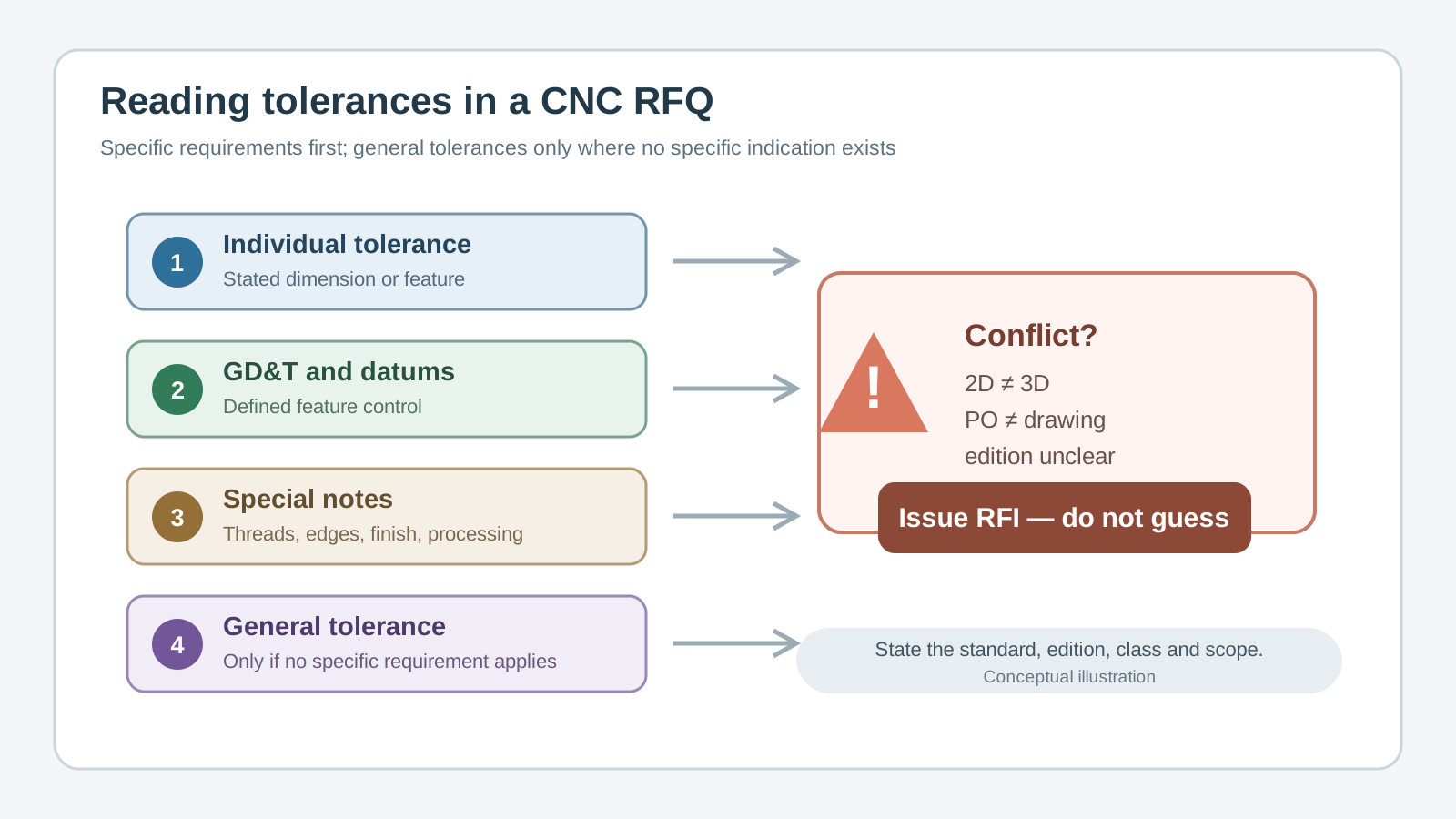
A safe practical hierarchy starts with the most specific requirement. A tolerance next to a dimension controls that dimension. A geometric tolerance frame controls its stated feature and datum references. Special notes for threads, edges, finishes or processing apply to their defined scope. Only then should the general-tolerance note be considered. If the PDF, 3D model, internal standard and purchase order conflict, the supplier should not select the easiest condition; an RFI and approved revision are safer. The RFQ should also say whether model dimensions are authoritative.

Technical hierarchy diagram for individual tolerances, GD&T, special notes and ISO 2768 general tolerances
Conceptual illustration: specific requirements are read before the general-tolerance note, and conflicts require clarification. This graphic does not replace the governing standard or contract drawing.
Drawing informationTreatmentExample
Individual toleranceApplies to the stated dimension25.00 ±0.02
GD&T frameApplies to the feature and datum systemHole position to A|B|C
Special noteApplies to its defined scopeThread, edge, finish, treatment
General toleranceOnly where no specific indication existsISO 2768-1 and stated class
ConflictStop assumptions and issue an RFI2D differs from 3D or PO
03

Select f, m, c or v by function and process

The class names fine, medium, coarse and very coarse should not be selected simply because one sounds more precise. The class must fit function, process capability, nominal size, stock-making method and control cost. Applying a fine class to the complete drawing may turn non-functional surfaces into costly machining and inspection characteristics. A class that is too broad may fail to protect an assembly. Put individual tolerances on locating faces, fits, hole patterns, seals and safety-related features; reserve the general note for suitable secondary dimensions.

04

ISO 2768-1 does not replace GD&T

ISO 2768-1 addresses untoleranced linear and angular sizes. It does not establish datums, create a position zone for a hole pattern or replace profile control for a functional 3D surface. Older drawings often show ISO 2768-mK, combining dimensional and general geometrical rules. ISO 2768-2:1989 has been withdrawn, while ISO 22081:2021 provides the current framework for general geometrical and general size specifications. Do not copy an mK note into a new design without reviewing the governing GPS rules and customer contract.

05

The October 2026 transition

As checked on 14 October 2026, ISO lists ISO 2768-1:1989 as the published and current edition confirmed in 2022, while ISO 2768 Edition 2 dated 2026-10 remains at stage 60.00, under publication. During this transition, writing ISO 2768 without an edition can lead the buyer and supplier to different documents. New drawings should identify the contract edition; old drawings should not be silently upgraded. VietTech will request clarification when the note does not establish the version or scope.

06

Features that need specific control

Functional items should not be left to a general note: dowel or bearing bores, locating surfaces, hole patterns, seal thickness, motion clearances, threads, optical faces, post-plating sizes and post-heat-treatment geometry. Basic dimensions, reference dimensions and features governed by a specialist standard also require correct interpretation. For model-based definition, confirm which semantic PMI or document controls. Clear specific requirements allow the process and measurement method to be chosen before quotation.

07

Write an RFQ that suppliers can compare

State the full standard reference, part or edition, class, unit and scope. Attach the 2D PDF and STEP model with the same revision, list functional features with individual tolerances, and define inspection records. If a legacy drawing uses ISO 2768-mK, state whether it remains contractual, is being converted or requires an RFI. Do not ask each supplier to choose the class. When the general note changes, release a new revision and describe the impact. VietTech reviews machining and inspection against the controlled package, and quotation assumptions must be confirmed before order.

  • 2D PDF and STEP at the same revision
  • Standard, part/edition and tolerance class
  • Functional tolerances and GD&T
  • Priority rule for 2D, 3D and PO
  • Condition after heat treatment or coating
  • Reports, quantity and delivery
08

Sources and limits

This article uses the official ISO pages for ISO 2768-1:1989, the ISO 2768 Edition 2 project under publication in October 2026, and ISO 22081:2021. It does not reproduce copyrighted tolerance tables; designers and buyers should use their organization's licensed standards. Status may change after the publication date and should be rechecked before drawing release. The article is RFQ guidance, not a substitute for design authority, contract interpretation or metrology advice.

RELATED PAGES

2D Drawing and 3D Model in a CNC RFQ: Which File Governs When They Differ? ↗CMM Datum Setup from a Drawing: Understanding the 3-2-1 Principle ↗How to Request a Quote ↗

FAQ

Frequently asked questions

Is ISO 2768-m alone enough in a title block?

Not always. State the part or edition, scope and individual controls for functional or geometrical characteristics.

Does ISO 2768 apply to every dimension?

No. It does not replace individual tolerances, basic or reference dimensions, threads, GD&T or specialist standards.

Should a new drawing use ISO 2768-mK?

Do not copy it automatically. ISO 2768-2 was withdrawn; review ISO 22081 and the contract's GPS rules.

Is the 2026 edition already published?

On 14 October 2026, ISO showed Edition 2 at the under-publication stage, while ISO 2768-1:1989 remained the published edition. Recheck before release.

What if 2D and 3D disagree?

Use the released priority rule or issue an RFI for an approved revision; do not guess.

RFQ GUIDE

Need a general-tolerance note reviewed before RFQ?

Send the 2D PDF, STEP model, revision, standard/edition, class and functional-characteristic list. VietTech will review the machining and inspection basis before quotation.REQUEST A QUOTE ↗