
SURFACE TREATMENT

Shot peening: Almen intensity, coverage and the difference from cleaning

Separate controlled shot peening from cleaning blasts, distinguish intensity from coverage and specify treatment zones and evidence correctly in an RFQ.

01

Similar media impact, different objectives

Controlled shot peening is a mechanical process intended to introduce beneficial compressive residual stress near a surface. It is considered for cyclically loaded components where surface crack initiation or growth matters. Cleaning or cosmetic blasting primarily targets scale, contamination or texture. The operations can look similar while their controls and acceptance evidence differ. This guide addresses requirements for a peening specification, rather than choosing glass beads or alumina for a decorative finish.
02

A matte surface does not prove the intended effect

Media impacts create local plastic deformation. Restraint from underlying material contributes to compressive residual stress near the surface. The result depends on material, heat-treatment condition, geometry and process. No universal fatigue-life improvement applies to every part, and peening cannot repair a poor design or every pre-existing defect. Uniform appearance alone is insufficient evidence. If fatigue performance is the purpose, define process controls and suitable evidence instead of relying only on a photograph.

03

What does Almen intensity control?

The Almen system uses a standard strip peened on one side. Arc height is measured under a specified procedure to determine and verify intensity. Specify strip type, units and intensity range, together with the applicable saturation or verification procedure. An arbitrary arc-height reading at an arbitrary exposure time is not automatically valid intensity. Almen is a process-control indicator, not a direct residual-stress measurement on the component; it cannot be converted indiscriminately into MPa or surface roughness Ra.

Air pressure is not intensity

The same supply pressure can produce a different media stream after changes to nozzle, flow, size, distance or angle. Maintain and verify the process parameters; pressure-gauge readings alone are not acceptance evidence.

Verification positions must be representative

Strip positioning and verification locations must represent the treatment zones under the procedure. A conveniently placed strip does not establish conditions in every recess or hidden corner.

04

Coverage answers a different question

Coverage describes the extent of surface area covered by impact impressions, assessed by the specified method. Passing intensity does not prove that every required area received sufficient treatment; many impressions do not prove correct intensity either. Requirements above 100% coverage commonly refer to multiples of the exposure time needed for full coverage under the process, not a physical area exceeding 100%. Follow the contractual definition. More exposure is not automatically better.

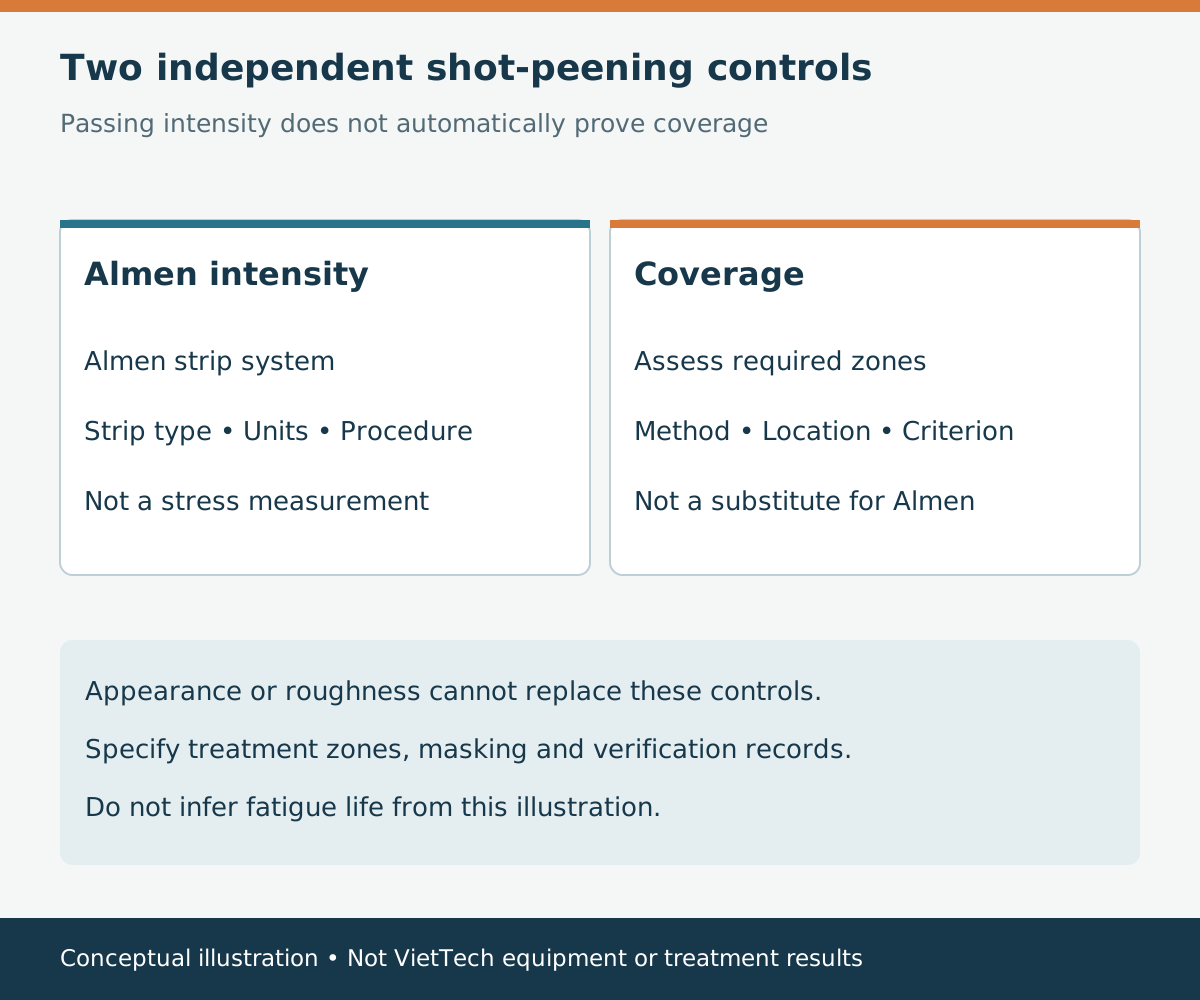
Two separate shot-peening controls: intensity using the Almen system and coverage of the specified component zones
Conceptual illustration of process controls, not equipment or treatment results at VietTech.
InformationQuestion addressedDoes not replace
Almen intensityIs the process at the specified intensity?Direct residual-stress measurement
CoverageAre required areas covered to the criterion?Almen intensity
Appearance / roughnessIs the finish requirement satisfied?Both intensity and coverage
05

Mark treatment and protected zones on the drawing

Identify mandatory peening zones, prohibited zones and permitted transitions. Evaluate precision bores, threads, thin edges, sealing faces and fits separately. Masking must protect the intended area without accidentally shielding a required treatment zone. For difficult geometry, establish media access and the method for verifying results. A changed external appearance or a nozzle passing near a feature is not a coverage guarantee.

06

Preserve the effect through the process sequence

Peening is often placed after major shaping operations, but the actual sequence must follow design requirements and the approved process. Subsequent grinding, polishing or cutting may remove treated surface material. Later heating can also alter residual stress. If finishing remains, specify permissible removal and how its influence will be assessed. Check dimensions, distortion, roughness and cleanliness as appropriate, especially on thin parts. Do not change the sequence merely to simplify packing or improve appearance.

07

RFQ checklist and supply scope

Provide material, heat-treatment condition, standard and revision, treatment zones, media specification, intensity range with Almen strip type and units, coverage, masking, final condition and required records. Specify residual-stress measurement or fatigue testing separately if the design requires them; a peening certificate does not automatically include those tests. VietTech performs CNC machining and inspection within confirmed capability and coordinates specialist surface treatments with partners. For shot peening, partner availability, process and scope must be confirmed before commitment. This article does not imply an in-house peening line.

08

Technical references and limitations

Reviewed on 19 October 2026 against the SAE listings for J443_202512 on intensity, J2277_202301 on coverage and Curtiss-Wright’s process-control guidance. These documents serve different purposes; the order must identify the applicable editions. This guide supports specification review and RFQ preparation, not replacement of a complete standard or qualified procedure. Do not select intensity, coverage or expected life from an illustration or from an unrelated part merely because the material is the same.

RELATED PAGES

Glass Bead vs. Aluminum Oxide Blasting: Which Process Fits a Machined Part? ↗Ra 3.2, Ra 1.6 and Ra 0.8: Choosing Surface Roughness for CNC Parts ↗How to Specify Materials and Surface Finishes in an RFQ ↗How to Request a Quote ↗SAE J443_202512 — Peening intensity ↗SAE J2277_202301 — Peening coverage ↗Curtiss-Wright — Controlled shot peening ↗Sinto — National Peening ↗

FAQ

Frequently asked questions

Does cleaning with shot automatically qualify as shot peening?

No. The objective, controlled parameters and verification must meet the peening requirement; similar appearance is insufficient.

Does passing Almen intensity prove coverage?

No. They are separate controls and must be verified under the procedure.

Does 200% coverage mean twice the surface area?

No. It commonly expresses additional exposure relative to full-coverage time. Use the governing definition.

Can a part be freely reground after peening?

No. Removing surface material may affect the treatment. Appropriate limits and engineering approval are needed.

SURFACE TREATMENT

Include surface-treatment requirements in your RFQ

Send the treatment zones, governing standard, Almen requirement and coverage so VietTech can assess machining, inspection and specialist-partner coordination.REQUEST A QUOTE ↗