
ENGINEERING MATERIALS

SUS630 (17-4PH): Choosing H900, H1025 or H1150 for CNC Parts

Compare H900, H1025 and H1150 conditions for SUS630 precipitation-hardening stainless steel, including properties, machining sequence, heat treatment and inspection.

01

SUS630 is not a single material condition

SUS630, also known as 17-4PH or Type 630, is a martensitic precipitation-hardening stainless steel. A part's performance depends not only on the alloy name but also on its final heat-treatment condition. Stock is commonly supplied solution treated as Condition A and then aged to an H condition. H900, H1025 and H1150 identify nominal aging temperatures in degrees Fahrenheit and produce different combinations of strength, hardness, ductility and toughness. A drawing that says only “SUS630” may therefore be incomplete for a load-bearing part. State the governing material specification, product form, incoming condition and final acceptance condition.
02

How H900, H1025 and H1150 differ

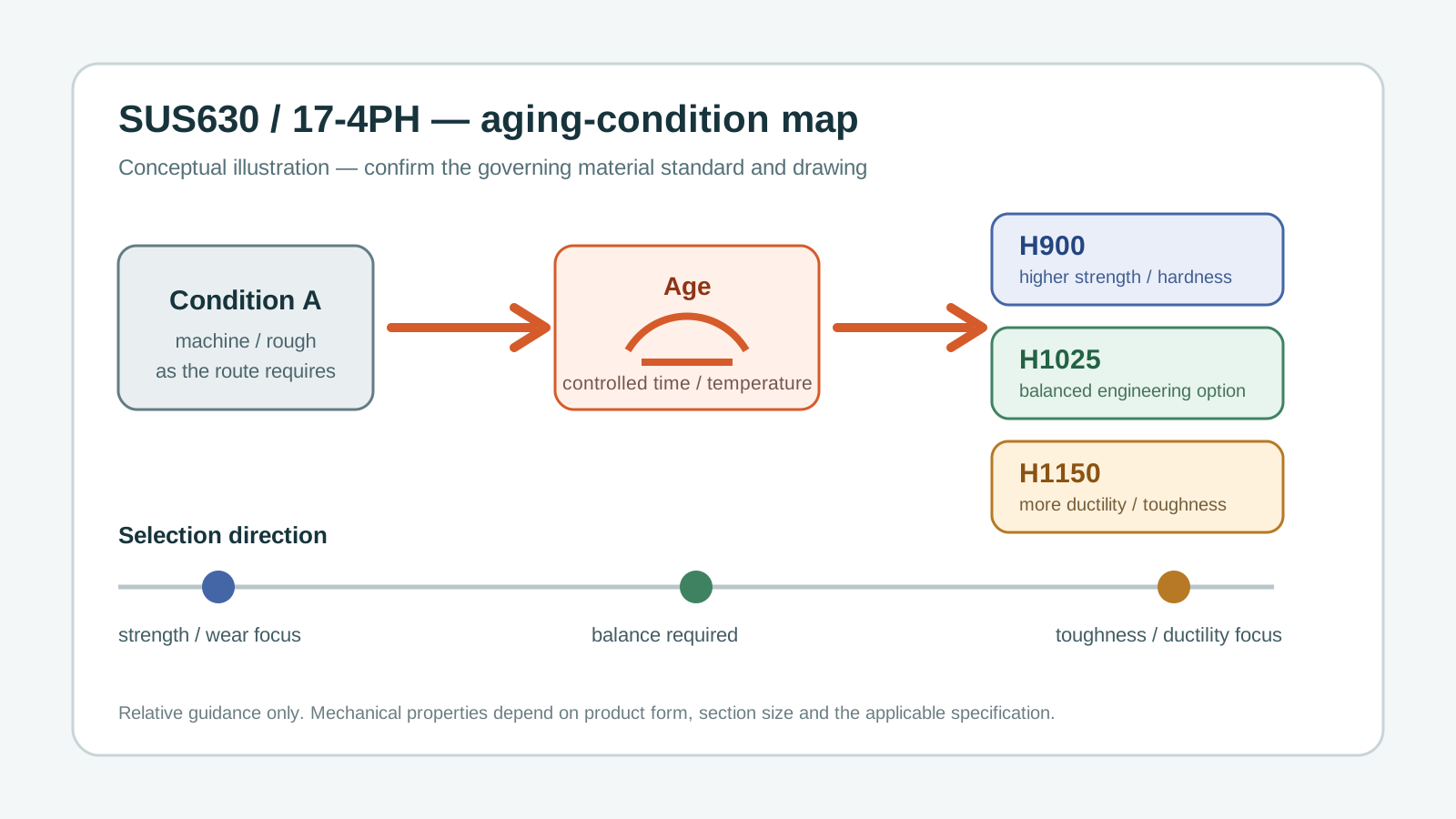
Carpenter Technology's Custom 630 data show the general selection trend: lower-temperature aging such as H900 produces higher strength and hardness, while higher aging temperatures progressively trade some strength for ductility and toughness. H900 may suit strength-led designs, H1025 is often considered as a balanced engineering option, and H1150 may suit parts where toughness or resistance to stress-related cracking matters more than maximum strength. This is a decision framework, not a universal ranking. Acceptance values must come from the correct specification, product form and section size rather than a generic online table.

Technical diagram comparing selection trends for SUS630 H900, H1025 and H1150
Conceptual illustration: relative selection trends for H900, H1025 and H1150. This is not a photograph of VietTech production and does not replace the applicable material specification.
ConditionGeneral trendTypical design focusConfirm before release
H900Higher strength and hardnessLoad capacity or resistance to local deformationToughness, section size, environment and finishing route
H1025More balanced strength, ductility and toughnessLoaded shafts, pins, valve bodies and similar partsMinimum properties for the exact specification and form
H1150Lower strength, generally higher ductility and toughnessToughness, stability or crack resistanceDesign approval and whether H1150M/H1150D is required
03

Select from service loads and environment

Start with tension, bending, torsion, impact, cyclic loading and service temperature. A steady-torque shaft does not present the same design problem as an impact-loaded pin or a valve body in a corrosive medium. Corrosion behaviour also depends on condition, surface, stress and environment; the stainless designation does not guarantee immunity from pitting, crevice attack or stress-corrosion cracking. Industry requirements such as NACE, aerospace or medical specifications may impose additional restrictions. VietTech does not substitute one H condition for another without written design approval.

04

Plan machining and aging as one route

A common route is rough machining in Condition A, leaving controlled stock, aging through a qualified specialist partner, then finish machining or grinding critical surfaces. It is not the only valid route. Completing more machining before aging may reduce later work but requires an allowance for dimensional change and residual stress. Finishing after aging allows correction of functional dimensions but changes cutting conditions, tool life and burr risk. Threads, precision bores, seals and long datum chains need a clear pre- and post-treatment acceptance plan. VietTech performs CNC machining and inspection within the confirmed scope and coordinates specialist heat treatment with an appropriate partner.

05

Tolerance and inspection after aging

Dimensional change during aging may be modest compared with quenching many tool steels, but it is not zero. Slender geometry, uneven sections, deep pockets, machining stress and furnace loading can still influence the result. Define datums, critical dimensions, measurement state, measurement temperature and inspection timing. A heat-treatment certificate or hardness result does not replace dimensional inspection, while a CMM report does not prove the H condition without material and treatment records.

06

RFQ information that prevents rework

Do not stop at the alloy name. Provide the material standard and form, incoming and final condition, required mechanical property or hardness, surfaces finished before and after aging, GD&T and datums, and required records. Terms such as SUS630, 17-4PH, UNS S17400 and 1.4542 appear in different supply chains, but their specifications and product requirements should not be treated as automatically interchangeable.

07

Sources and limits

This guide was checked against Carpenter Technology's Custom 630 datasheet and Nippon Yakin Kogyo's NAS630 technical information. ASTM A564/A564M is a commonly referenced specification for heat-treated precipitation-hardening stainless bars and shapes, but the contractual drawing, cited edition and product form govern. The table is for screening choices only; the responsible design authority must approve the final condition for the actual load and environment.

RELATED PAGES

SUS304 vs SUS316: Which Stainless Steel Should You Choose for CNC Machined Parts? ↗When Is Precision Grinding Required After Heat Treatment? ↗Material Certificates in a CNC RFQ: MTC, CoC and Lot Traceability ↗How to Request a Quote ↗

FAQ

Frequently asked questions

Is H900 always better than H1025 or H1150?

No. H900 generally prioritizes strength and hardness; H1025 or H1150 may be better when toughness, ductility or crack resistance is more important.

Can SUS630 be machined in Condition A and aged afterward?

Often yes, but the route must allow for dimensional change and identify surfaces that require post-aging finishing.

Is 'SUS630' enough on a drawing?

Usually not for a structural part. Add the specification, product form, incoming condition, final H condition and acceptance properties.

Does VietTech heat treat SUS630 in-house?

VietTech performs confirmed CNC machining and inspection; specialist heat treatment is coordinated with qualified partners for each RFQ.

What records may be required?

Depending on the contract: material certificate, heat-treatment certificate or chart, hardness/mechanical results and final inspection report.

ENGINEERING MATERIALS

Need a SUS630 part in a defined H condition?

Send the 2D/3D data, material specification, H condition, quantity, tolerances and record requirements. VietTech will review machining, partner heat treatment and inspection before quotation.REQUEST A QUOTE ↗