
TECHNICAL GUIDE

Tempering After Hardening: Why It Matters and How to Control Final Hardness

Learn why steel is tempered after hardening, how grade-specific tempering conditions are selected, when to measure hardness, and how to plan grinding allowance.

TECHNICAL GUIDETECHNICAL CONCEPT IMAGE
01

Overview

Hardening can form martensite and significantly increase the hardness and wear resistance of steel. A freshly quenched component, however, may also contain high residual stress, limited toughness, retained austenite, and an increased risk of cracking or distortion. For most hardened steel components, tempering is not an optional correction. It is an integral part of the heat-treatment route used to achieve the specified final properties. Tempering reheats hardened steel below the critical transformation range, holds it for a defined period, and cools it under controlled conditions. A suitable cycle relieves stress, adjusts toughness, stabilizes the microstructure, and delivers the properties required by the drawing or material specification. There is no universal tempering temperature. SKD11, SKD61, S45C, and SCM440 respond differently even when processed at the same nominal temperature. Steel grade, starting condition, austenitizing temperature, quench method, section size, number of tempering cycles, and service requirements must be considered together.

02

Why is tempering required after hardening?

Residual-stress and crack-risk reduction

During quenching, the surface and core cool at different rates while phase transformation changes material volume. These effects generate residual stress. Proceeding directly to grinding, EDM, or assembly without the specified temper increases the risk of cracking, warpage, or dimensional movement. The permitted delay between quenching and tempering should be part of the approved heat-treatment procedure.

Hardness–toughness balance

Maximum hardness is not ideal for every application. Tools, dies, wear pins, shafts, and impact-loaded components require different combinations of hardness, toughness, wear resistance, and dimensional stability. For many steels, increasing tempering temperature or time tends to reduce hardness and improve toughness. This is a general trend, not a universal rule. Certain alloy tool steels exhibit secondary hardening, so their tempering curves do not decrease monotonically. Selection must be based on the curve for the exact steel grade and the intended heat-treatment route.

Microstructural and dimensional stability

Retained austenite may transform during service, subsequent machining, or temperature changes and cause dimensional movement. Some grades therefore require multiple tempering cycles or an approved sub-zero treatment.

03

How does tempering temperature affect properties?

A generic online temperature table should not be used as a production specification. The correct approach is to identify the steel grade and standard, then consult the material producer's datasheet or a validated heat-treatment specification. A tempering curve normally relates achieved hardness to tempering temperature under stated test conditions; actual results also depend on section size and the preceding thermal history. This table explains direction only; it does not provide process parameters. A production instruction must also define soaking time, the number of tempers, cooling method, and the acceptable final-hardness range.

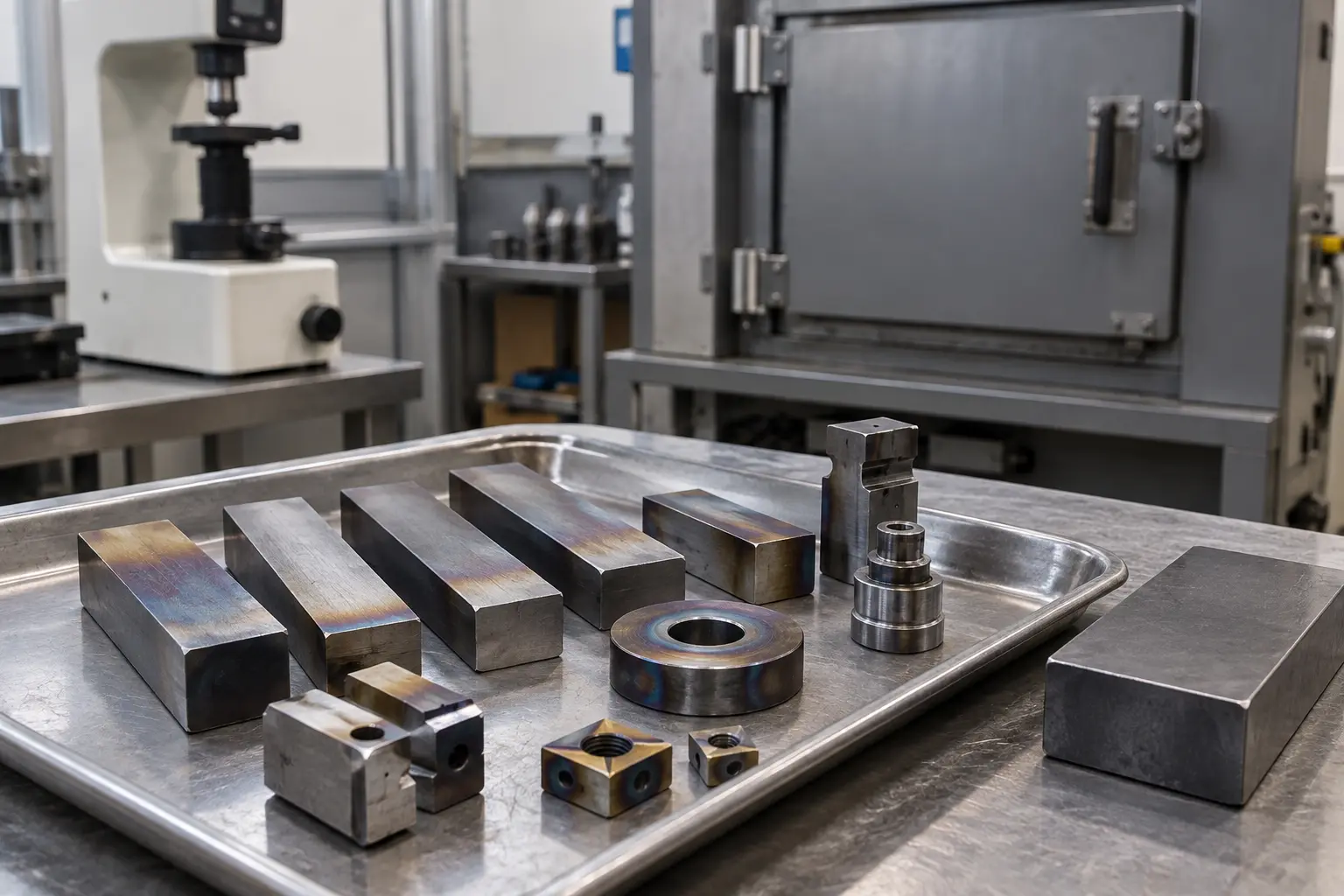
Realistic technical concept image for Tempering After Hardening: Why It Matters and How to Control Final Hardness
Conceptual image created to illustrate the article's technical setup; not an actual VietTech production photograph. Specifications and acceptance follow the drawing/RFQ.
Engineering objectiveRelative tempering levelCommon trendMain control point
Prioritize hardness and wear resistanceRelatively lowHigher retained hardness, potentially lower toughnessChipping or cracking risk under impact loading
Balance hardness and toughnessIntermediateBalanced properties for many machine componentsUse the exact grade-specific tempering curve
Prioritize toughness and stabilityRelatively highHardness often decreases while toughness improvesSecondary hardening or embrittlement may occur in some steels
04

When are two or more tempers needed?

Multiple tempering is commonly considered for tool steels and certain high-alloy steels. After the first temper, some retained austenite may transform into fresh martensite during cooling. A subsequent temper can temper this newly formed martensite and improve microstructural stability. “Double temper” is not a universal rule. The number of cycles, temperature of each cycle, and cooling conditions must follow the steel producer's recommendation or the customer's specification. If sub-zero treatment is required, its sequence relative to tempering must also be defined before production.

05

What is temper embrittlement?

Temper embrittlement is a loss of toughness that can occur under particular combinations of steel chemistry, tempering range, holding time, and cooling rate. It is inaccurate to apply one prohibited temperature range to every steel. For impact-loaded components, large sections, or alloy grades known to be sensitive, the heat-treatment provider should assess the risk using grade-specific technical data. The RFQ should describe the critical service condition and mechanical-property requirement rather than specify only one HRC value.

06

When and where should hardness be measured?

Acceptance hardness should normally be measured after the final temper and after the component has cooled and stabilized according to the procedure. A reading taken immediately after hardening is useful for process monitoring, but it does not represent the final delivered condition. The result also depends on method, scale, material thickness, surface curvature, surface finish, and test location. Oxide, decarburization, or a rough surface can bias the reading. If surface and core hardness must be distinguished, the drawing or inspection requirement should identify the location, depth, and test method. A practical inspection plan normally includes:

  • Verification of steel grade and incoming condition.
  • Hardness testing after the final heat-treatment operation.
  • Defined scale, test locations, and number of readings.
  • Distortion or dimensional inspection before finish grinding.
  • Heat-treatment certification and test results when contractually required.
07

Can tempering change dimensions?

Most heat-treatment distortion develops during heating and quenching, but tempering continues to relieve stress and may cause further dimensional change. The magnitude depends on material, geometry, section uniformity, support method, furnace loading, and machining history. Tight-tolerance components should retain a planned allowance for grinding or finish machining after heat treatment. One allowance must not be applied to every part. Thin, long, deeply slotted, or asymmetric components require individual assessment because their distortion risk is higher.

Suggested manufacturing sequence

1. Rough-machine the component and establish suitable process datums. 2. Apply intermediate stress relief when material, geometry, or stock removal warrants it. 3. Semi-finish and leave a justified allowance for heat-treatment movement and grinding. 4. Harden and temper to the agreed grade-specific specification and target hardness. 5. Inspect hardness, distortion, and critical dimensions. 6. Precision-grind, wire-EDM, or finish-machine to the approved route. 7. Perform final inspection and prepare the required report. VietTech provides CNC machining, precision grinding, wire EDM, and dimensional inspection. Heat treatment is coordinated with specialized partners against agreed technical requirements, and the final component is checked within the inspection scope defined for the order.

08

What should an RFQ specify for hardened and tempered parts?

For accurate process selection and quotation, please provide:

  • Material grade, governing standard, and supply condition.
  • Required hardness range, scale, and test location.
  • Mandatory heat-treatment procedure or specification, if applicable.
  • Requirements for mechanical properties, microstructure, surface hardness, or core hardness.
  • Dimensional tolerances and GD&T applicable after heat treatment.
  • Surfaces to be ground, designed allowance, and required roughness.
  • Requirements for heat-treatment certificates, hardness reports, and lot traceability.
  • Prototype quantity, batch quantity, and critical service conditions.

RELATED PAGES

Steel Hardening and Tempering: Why Hardness Is Not the Only Requirement ↗When Is Precision Grinding Required After Heat Treatment? ↗

FAQ

Frequently asked questions

Can tempering be omitted if as-quenched hardness already meets the target?

Normally, no. Meeting a hardness target does not confirm acceptable residual stress, toughness, or dimensional stability. Tempering should only be omitted when a specific approved process allows it.

Does higher tempering temperature always mean lower hardness?

Not in every case. It is a common trend for many steels, but alloy tool steels may show secondary hardening. Use the curve for the exact grade and hardening condition.

Why are some tool steels tempered more than once?

Additional cycles can temper fresh martensite formed from retained austenite and improve structural stability. The number of cycles must follow the material datasheet or approved specification.

Should hardness be checked before or after grinding?

Final-condition hardness must be confirmed after the last temper. Whether the test is made before or after grinding depends on the test location, surface layer, and inspection requirement. The test surface must suit the method and avoid damage to a functional area.

How much grinding allowance is required after hardening and tempering?

There is no universal value. It depends on component size and shape, steel grade, heat-treatment method, expected distortion, hardness, and final tolerance.

TECHNICAL GUIDE

Request a VietTech review

For parts requiring hardening and tempering, send the drawing, 3D model, material grade, target hardness, post-treatment tolerances, and certification requirements. VietTech will review the machining sequence, stock allowance, grinding or EDM route, and inspection plan before quotation. ---REQUEST A QUOTE ↗